Showing posts with label Archaea. Show all posts

Thursday, January 23, 2014

Microbiology Daily Newsletter: January 22, 2014 - Bacterial Cell Membranes

Site LogoMicrobiology Daily Newsletter

January 22, 2014 - Archaeal Cell Membranes


Bacteria and Eukarya have a membrane composed of a phospholipid bilayer.  The phospholipid is a common lipid, and naturally gathers so that the hydrophobic tails interact with each other and the polar heads face water.  The lipid bilayer, seen below, creates a perfect semi-permeable structure by having a hydrophobic layer sandwiched between two hydrophilic layers.  NOTE:  The lipid bilayer by its self is semi-permeable; once we add proteins, we describe the membrane as selectively permeable (why?).
Phospholipid Bilyaer: http://en.wikipedia.org/wiki/Image:Lipid_bilayer_section.gif
Like the Bacteria and Eukarya, the Arachaea have a lipid bilayer, but the composition of the lipids is radically different.  What's different?  The phospholipids.

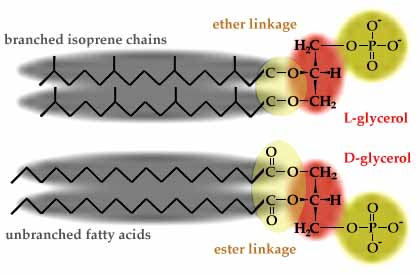
  • Bacteria and Eukarya use an ester linkage between glycerol and fatty acids, while archaea use an ether linkage.
Ester Linked Fatty Acids: http://www.uic.edu/classes/bios/bios100/lecturesf04am/phospholipid.jpg
Differences between Archaeal Phospholipids (Top) and Bacteria/Eukarya Phospholipids (bottom). http://www.ucmp.berkeley.edu/archaea/esterether.jpg
  • Instead of fatty acids, Archaea utilize isoprenoids as the hydrophobic tails.  Unlike straight chain fatty acids, isoprenoid chains have branches, and can include ring structures (cyclopropane and cyclohexane rings are the two most commonly found).  You can see an example of a branched isoprenoid chain in the above diagram.
  • As can be seen above, the glycerol used by Archaea is an enantiomer of the glycerol used by Bacteria and Eukarya.  Archaea utilize L-Glycerol while Bacteria and Eukarya utilize D-Glycerol.  Question: can an enzyme that uses D-glycerol use L-glycerol?
  • In some Archaea, the membrane is composed of a monolayer instead of a bilayer.  In this type of membrane, a long isoprenoid has connects two separate glycerols, each with polar heads.  This type of amphipathic molecule is referred to as a bolaamphiphile.
Archaeal bolaamphiphiles from Ferroplasma acidiphilum.  Pivovarova, T. A.; Kondrat'eva, T. F.; Batrakov, S. G.; Esipov, S. E.; Sheichenko, V. I.; Bykova, S. A.; Lysenko, A. M.; Karavaiko, G. I. (2002). Microbiology 71 (6): 698–706. doi:10.1023/A:1021436107979. ISSN 0026-2617.


Daily Challenge

How would the metabolism of archaeal phospholipids differ from the production of phospholipids in bacteria and eukarya?  What would it take to change from the production of archaeal phospholipids to the production of bacterial/eukarya phospholipids?  How does this change your understanding of the domains of life and the tree of life?

Friday, September 14, 2012

Daily Newsletter: September 14, 2012 - Evolution Friday

Site logoDaily Newsletter

September 14, 2012 Evolution Friday


The evolution of the cell, especially the development from prokaryote to eukaryote, is an important topic as it demonstrates core differences between living organisms. Archaea, Bacteria, and Eukarya are dramatically different from each other, but even within these domains, there are vast differences in cell types. When studying the development of cellular differences and structures, and thus studying the evolution of cells, biologists often look toward existent organisms that do not fit the typical cellular model. Anomalous structures give us insight into possible evolutionary steps.Symbiodium symbiosis with Jellyfish
For example, the genus Symbiodinium is an algae of the phyllum Dinoflagellata. These algae are known to live inside the cells of cnidarians (corals and jellyfish). Within the cell, they algae will deliver photosynthetic products to the cnidarians. Sound familar? How does this cell "know" to become symbiotic? Are there signals between the two cells? Does this mimic the entry of a Cyanobacteria into a cell where it became the chloroplast?
Then there is the bacterial phyllum Planctomycetes which researchers suspect is the "missing-link" between prokaryotic and eukaryotic cells, i.e., the development of a nucleus. Beyond membrane alterations, this is a bacteria that reproduces by budding (the daughter cell has a reduced cytoplasm). Other bacteria reproduce by binary fission, which results in two daughter cells with equal cytoplasm.Bdellovibrio Life Cycle
The bacterium Bdellovibrio is of interest in that it is a predator of other bacteria. This organism hunts other bacteria, enters their cell wall, then devours them. This is a very unusual characteristic. Not only in the recognition of prey, but in the entire life cycle. This is a complexity that we do not see in other bacterial groups.


Daily Challenge

Review the following diagram showing proposed steps in the evolution of the eukaryotic cell.
Evolution of Eukaryotic Cell
In your own words, discuss the origin of the eukaryotic cell. Using the examples above, and any others you find, how can we provide evidence of these evolutionary steps or stages. Some claim that the Archaea are the ancestors of the Eukarya, but if so, why are there so many differences, espeically when it comes to phospholipids? How easy would it be to change the phospholipids a cell uses?

Link to Forum

Wednesday, September 12, 2012

Daily Newsletter: September 10, 2012 - Cell Theory and Domains

Site logoDaily Newsletter

September 10, 2012 Cell Theory and Domains


The fundamental unit of life is the cell. This is one of characteristics of life, and is a foundational principle of biology. Based on the discussions from last week, you see that for life to exist, we must first create a barrier that seperates and inside fluid compartment from the outside (external) fluid compartment. This allows us to create electrochemical gradients that will be necessary for life functions. When that membrane seperating inside from outside is disrupted and broken, life functions cease. While the cell membrane may be the defining structure of the cell, the cell is more than just the cell membrane.
This week, we turn our attention to cellular structure, and begin to look at the life functions of a cell. The first step is to recognize that all life is made up of cells, and that all living cells come from pre-existing cells. The following phrase, highlighted in yellow, is the core of the modern cell theory. This theory, which we credit to the work of Matthais Schleiden (1838) and Theodor Schwann (1839), was based upon growing microscopic work in the early 1800's. Work, even into the modern day, has provided robust evidence to support this theory, and has helped in some refinements.
What is interesting about the cell theory are the implications, e.g., a complex organism, such as man, is made up of millions of individual, and seemingly independent, cells. The overall organism, is an expression of the total activity of each of these cells. This has led to people studying communication between cells, for how do you coordinate the action of millions of individual cells? Another study is how the individual metabolic operations of cells can sum to the overall metabolic operation of an organism. As you can see, the idea of the cell being the fundamental unit of life has rather important implications for biology.
When we look at life, we begin to notice that there are different types of cells. The most basic difference between cells is the presence or absence of a nucleus. Prokaryotic cells lack a nucleus, while eukaryotic cells contain a nucleus. The nucleus, which will will cover in more depth later this week, is an internal comparment that contains the cells DNA. An internal compartment means that there is a membrane barrier that seperates the contents of the compartment from the rest of the cell. Like the cell membrane, these internal compartments are surrounded by protein containing phospholipid bilayers (fluid mosaics). As the cell membrane seperates the extracellular fluid from the intracellular, so to do these internal membranes create new fluid compartments. Just like the cell membrane, these internal membranes are selectively permeable, and allow for internal spaces with different chemical concentrations.
The presence or absence of a nucleus is a major taxonomic feature for organisms, and the ability to form and maintain internal compartments has many implications for the organism (some of which we will discuss this week). One of the major differences is in size. Remember all the proteins found on the cell membrane? An important thing to remember is that there are a termendous number of metabolic reactions that occur at the membrane, as well as the import and export of ions. We have to have enough membrane to satisfy our metabolic needs. The larger the volume of the cell, the smaller the surface area, so cells have to remain small. That is, unless you have the ability to make internal membranes. Internal membranes increase the available surface area...so eukaryotic cells, which are able to make internal membranes, can be larger than prokaryotic cells.
Living organisms are divided into three domains: Eukarya, Archaea and Bacteria. Eukarya contains all cells that are eukaryotic (nucleus containing). The Archaea and Bacteria are prokaryotic. The division of organisms into three domains was based on genetic and biochemical analysis conducted over the previous 30 years. Each domain represents a unique cellular structure.

Daily Challenge

Members of all three domains are based on the fundamental unit of the cell. For today's challenge, you are to discuss the differences that led to the three domains being declared unique from one another.
Link to Forum

Reflection

Cells are the fundamental unit of life, but over the past four years, virologists have been saying that the definition of life should be expanded to include acellular structures such as viruses. Currently, viruses and other acellular structures are considered to be biological agents; i.e., structures that can affect the genetics and metabolism of a cell, but are not technically living. What would be the logic behind expanding the definition of life to include viruses? What problems would it create?