Showing posts with label DNA. Show all posts

Friday, September 5, 2014

Daily Newsletter: September 5, 2014 - DNA Replication

Site LogoDaily Newsletter

September 5, 2014 - DNA Replication


Textbooks have a tendency to make replication one of the most complext topics covered. With a tendency to throw all the current research and understanding at students, they rarely take a step back and try to explain it. This newsletters has two goals: 1) to help biology students understand DNA replication, and 2) to show you want is expected from a Biology Freshman/Sophmore.


Central Dogma of Biology
Before we get into replication, let's take a step back and look at the three core genetic processes, a.k.a., the Central Dogma. The central dogma describes the flow of genetic information in a cell. The core idea is INFORMATION. You may recall some of our early discussion on DNA, and about base complimentarity and the directionality of the molecule. This will become important rather quickly, but for just this moment, I want you to concentrate on the fact that DNA carries information. Information on how to build RNA and Proteins, both of which will produce the phenotype (expression) of the cell. For this reason, DNA, RNA and Proteins are considered Informational Macromolecules. This means that the sequence of monomers contains infomation, e.g., instructions on how to build RNA and Proteins. Since it is critical, the sequence of nucleotides carries information.
As you can see from the diagram of central metabolism shown above, there are three processes: Replication, Transcription and Translation. Think about those words. They are words used in reference to languages and documents. When you replicate a docuement, you want to ensure that you are getting a faithful (or even exact) copy of the original.

When you transcribe, you are moving from one medium, e.g., spoken word, to another medium, e.g., text. If you watch news shows, they will tell you that transcripts of the show are available. Court reports make transcripts of the trial. You are taking the language from one medium (in our case DNA) to another medium (RNA). The language is still the same (i.e., nucleic acid lanugae), just in a different form. Does the transcript have to be 100% correct? You want it to be, but it is not as exacting as a replication.
Translation is where you change languages. Unless you're fluent in another language, you will need somoene to help translate, or at least a good translation dictionary. Now you are moving the context from one language (nucleic acid) to another language (amino acids).

All of these processes rely on one key feature of nucleic acids: BASE COMPLIMENTARITY. In DNA: A complements T, and G complements C. In RNA: U complements A, and G still complements C.

Replication

In replication our goal is to take one molecule of DNA and make two daughter molecules of DNA that are identical to the first. Even the best replication processes can produce errors, but our goal is to be error free. This takes precision! As DNA is long, we also need this to be a fast process.

The enzyme that is ultimately responsible for replication is DNA Polymerase. [NOTE: there are multiple types of DNA Polymerase, but for now you just need to understand the core concept common to the DNA Polymerase family.] DNA polymerase is only one component of the Replication Complex, which is a complex association of proteins needed to successfully complete the replication event. Your goal at this time is to concentrate on DNA polymerase; we will talk about some of the other components later.
DNADNA is a double stranded molecule, in which the strands are anti-parallel. This means that one strand starts at the 5' end 3' end, while the the other strand is revered. This can be seen in the image to the right. A common way of saying this is that we read DNA in the 3' 5' direction. Why is this important? DNA Polymerase can only read DNA in the 3' 5' direction, and can only build a new strand in the 5' 3' direction. Before we go on, let's look another time at how deoxyribonucleotides are polymerized.

DNA Polymerization
To the left you will see a generic image showing DNA Polymerase adding nucleotides to a growing DNA strand. Look carefully: A deoxyribonucleotide triphosphate (dTTP) is being added. The 5' phosphate of the new nucleotide is what will be used to form the phosphodiester bond. DNA Polymerase requires a free 3' end on which to grow the new DNA strand. To the right is another image that will help you with this concept.Phosphodiester Bond Formation At this point, the critical thing to remember is that DNA Polymerase will need a free 3' end on which to add a new nucleotide.
This requirement to build in only one direction (5' 3') creates a problem for the DNA process: the two strands read in opposite directions, and each must be replicated. It was noticed that one strand appears to replicate continuously, while the opposite strand appears to replicate discontinuously.

The original strand that reads 5' 3' can be used by DNA polymerase to continuously produce the new 5' 3' strand (the antiparallel complement to the original strand). We refer to the continuous synthesis strand as the Leading Strand. The other original strand, which read 3' 5' cannot be copied continuously. A section will have to be exposed, replicated, and then another section exposed. This strand is constructed discontinuously, and is reffered to as the Lagging Strand.DNA ReplicationThe image above shows the leading and lagging strand. Notice that the leading strand is replicating toward the Replication Fork(where the original strands seperate). As more DNA unwinds and opens, DNA synthesis continues down the leading strand.
The lagging strand though has to build in a start-stop action, producing Okazaki fragments. These fragments have to be sealed (phosphodiester bonds) together before DNA can rewind into the α-helix.

In the image above, you will notice a number of enzymes on the lagging strand. These enzymes are required for the initiation of DNA polymerazation, and then sealing the fragments. Looking at the image, you will see an enzyme called Primase, and a structure in red known as a Primer. Another restriction on DNA polymerase is that it must have a free 3' end from which to start building. DNA Polymerase is prevented from building a DNA strand from nothing. Something (a primer) must be in place upon which DNA polymerase can build. The Primer is constructed from RNA, and is a temporary scaffold upon which DNA polymerase can start working.

Eventually the primer will need to be moved. This is where you need to learn a little more about DNA polymerase. There are multiple DNA polymerases in eukaryotic systems. The general work horse of replication is DNA Polymerase III (DNA pol III), which is used to make long strands of DNA. DNA Polymerase I (DNA pol I) is used to replace primers (it is also used in repair functions). Even after the RNA primer is replaced with DNA, there is still a gap between fragments. Ligase is the enzyme used to create a phosphodiester bond between fragments, thus sealing the new sugar-phosphate backbone of the synthesized strand.

The result of DNA replication is that one molecule one DNA was used to create two new molecules of DNA. The two strands of the original DNA molecule became the template from which to build new complimentary strands of DNA. This is referred to as semi-conservative replication, as each new molecule has one strand from the original molecule, and one freshly synthesized complimentary strand.

Daily Challenge

In your own words describe the purpose and process of replication.
Link to Forum

Thursday, September 4, 2014

Daily Newsletter: September 4, 2014 - Nucleotides

Daily Newsletter

September 4, 2014   Nucleotides


Nucleic Acids

Nucleotide Structure: The following image from wikipedia's image gallery shows the basic structure of the nucleotide and the five nitrogenous bases.
The central component of all nucleotides will be a pentose sugar (5-carbon sugar). We will either see ribose or 2'deoxyribose as the sugar (the second carbon has one less oxygen than ribose). Off of the 5' carbon of the sugar, you will find a phosphate group attached, while on the 1' carbon, you will find a nitrogenous base. [NOTE: remember the numbering of carbon atoms in carbohydrates from yesterday? Do you see why the numbering is important?]
There are five nitrogenous bases, divided into two categories: Purines and Pyrimidines. Notice that the purines are a composite of two ring structures, while the pyrimidines are a single ring structure. When you take organic chemistry and biochemistry, the importance and complexity of these ring structures will be further discussed. At present, just become aware of their respective shapes and sizes (and inclusion of nitrogen).

As with amino acids, the nucleotide contains a functional group: the nitrogenous base. Just like the side chain in an amino acid, the nitrogenous base will play an important part in the function of this biomolecule. The Sugar-Phosphate then becomes the backbone of the molecule (line the Amino-Chiral Carbon-Carboxyl of an amino acid). We will in later weeks that the sugar-phosphates of nucleotides will create the strands of DNA and RNA. The nitrogenous bases then playing an information role.


Base Complementarity:

The nucleic acids are referred to as informational biomolecules (biopolymers). This is because the sequence of nucleotides carries information on how to build RNA and Proteins. One of the central foundations of genetics (i.e., how it all works), is base complementarity. Here we are looking at the interactions between purines and pyrimidines:

A links with T through 2 hydrogen bonds.

G links with C through 3 hydrogen bonds.

A to T G to C

U has the binding properties of T, but is only found in RNA.
T is never found in RNA, only DNA.
NOTE: base complementarity is a critical concept to remember. All genetic processes rely on base complementarity!

Directionality

When we get to genetics, we will be talking about the directionality of the nucleic acids. For example, we will talk about DNA being built from the 5' to 3'. This is in reference to the carbon atoms in the ribose or deoxyribose. The 5' holds a phosphate, while the 3' holds an open -OH (hydroxyl) group. This concept of directionality is critical, and you are warned to learn how it works, and what the terms represent.
As with all biopolymers, monomers are added together through dehydration synthesis, and separation is through hydrolysis. When synthesis occurs, the 5' phosphate links to the 3' -OH, forming a phosphodiester bond.

Daily Challenge

The challenge today is to understand the history of the discovery of DNA.  Look up the following researchers and read about their discovery, how it was done, and the importance the the discovery.  In addition, watch the TED Talk from James Watson "How we discovered DNA."  Write up a discussion about how these researchers contributed to our understanding of DNA.
Link to Forum


Tuesday, October 29, 2013

Daily Newsletter: October 29, 2013 - Chromosomes

Daily Newsletter

October 29, 2013 Chromosomes


Chromosomes

The word chromosome has a number of common means, but as biologists we need a strong (strict) definition of the word. For a biologist, a chromosome is a single molecule of DNA with associated packaging proteins, and is visible only during Metaphase and Anaphase of nuclear division. This second part is important; the chromosome is visible under light microscopy (the common form of microscopy). The chromosome is visible because it condenses (becomes tightly packed) during nuclear division (thus it is a eukaryotic phenomena).

We use the term chromosome to refer to a single molecule of DNA, but remember, in the strict sense, it only refers to a visible arrangement of DNA and proteins seen during nuclear division.

Another loose use is referring to the single, circular DNA molecule found in bacteria (or other prokaryotic DNA). As bacterial DNA is not held by the same packaging proteins, and has different packaging issues, the use of chromosome in this case is in error. The term genophore is a more appropriate term for prokaryotic DNA.

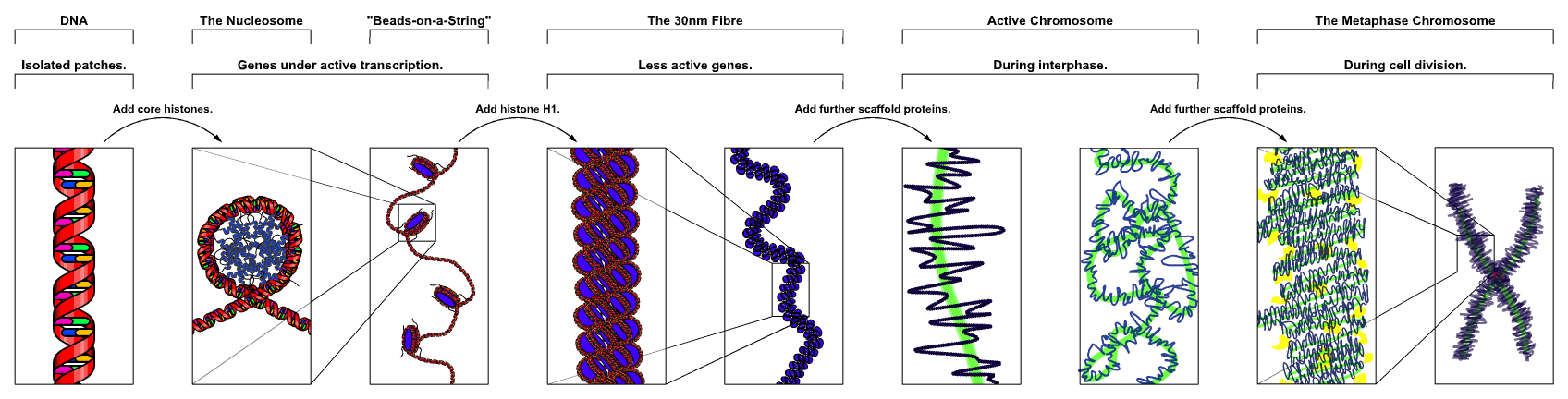
In eukaryotes, DNA must be packaged. One reason for this is to prevent physical strain or damage to the DNA molecule. The second reason is to conserve space. DNA is just too large when it is not packaged. The basic unit of DNA packaging is nucleosome. The nucleosome is a unit of packaged DNA, in which the DNA molecule is wrapped 1.67 times (~147 base pairs) around a core of 8 positively charged histone molecules (positive charge attracts negative phosphates).

These histone cores, when associated with Histone1 can begin to supercoil into a fiber. A cascade of interactions causes more supercoiling which ultimately forms the chromosome.
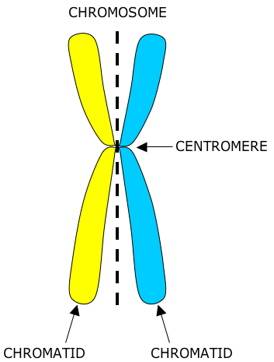
The chromosome when it first forms during prophase of nuclear division is actually two freshly replicated molecules of DNA (we just copied DNA). The image below is a single chromosome composed of two sister chromatids:

Notice that the two sides of the Chromosome are individual DNA molecules that we refer to as Chromatids. Holding the two chromatids together is a protein rich region known as the centromere. At the centromere, we will find a molecular motor known as the kinetochore. We will see the operation of the kinetochore during cell division.

NOTE: You have some words here that sound familiar and often get confused. In your notes, make sure you have definitions of Chromosome and Chromatid. Work on using these terms correctly.

Here is a video to help you visualize the process: How DNA is Packaged


Daily Challenge

In your own words, describe how DNA is packaged into a chromosome. Why is it important that we package DNA at the nucleosome and chromosome level?


Other resources:

Monday, October 21, 2013

Daily Newsletter: October 21, 2013 - DNA Replication

Site LogoDaily Newsletter

October 21, 2013 - DNA Replication


Textbooks have a tendency to make replication one of the most complext topics covered. With a tendency to throw all the current research and understanding at students, they rarely take a step back and try to explain it. This newsletters has two goals: 1) to help biology students understand DNA replication, and 2) to show you want is expected from a Biology Freshman/Sophmore.


Central Dogma of Biology
 Before we get into replication, let's take a step back and look at the three core genetic processes, a.k.a., the Central Dogma. The central dogma describes the flow of genetic information in a cell. The core idea is INFORMATION. You may recall some of our early discussion on DNA, and about base complimentarity and the directionality of the molecule. This will become important rather quickly, but for just this moment, I want you to concentrate on the fact that DNA carries information. Information on how to build RNA and Proteins, both of which will produce the phenotype (expression) of the cell. For this reason, DNA, RNA and Proteins are considered Informational Macromolecules. This means that the sequence of monomers contains infomation, e.g., instructions on how to build RNA and Proteins. Since it is critical, the sequence of nucleotides carries information.
As you can see from the diagram of central metabolism shown above, there are three processes: Replication, Transcription and Translation. Think about those words. They are words used in reference to languages and documents. When you replicate a docuement, you want to ensure that you are getting a faithful (or even exact) copy of the original.

When you transcribe, you are moving from one medium, e.g., spoken word, to another medium, e.g., text. If you watch news shows, they will tell you that transcripts of the show are available. Court reports make transcripts of the trial. You are taking the language from one medium (in our case DNA) to another medium (RNA). The language is still the same (i.e., nucleic acid lanugae), just in a different form. Does the transcript have to be 100% correct? You want it to be, but it is not as exacting as a replication.
Translation is where you change languages. Unless you're fluent in another language, you will need somoene to help translate, or at least a good translation dictionary. Now you are moving the context from one language (nucleic acid) to another language (amino acids).

All of these processes rely on one key feature of nucleic acids: BASE COMPLIMENTARITY. In DNA: A complements T, and G complements C. In RNA: U complements A, and G still complements C.

Replication

In replication our goal is to take one molecule of DNA and make two daughter molecules of DNA that are identical to the first. Even the best replication processes can produce errors, but our goal is to be error free. This takes precision! As DNA is long, we also need this to be a fast process.

The enzyme that is ultimately responsible for replication is DNA Polymerase. [NOTE: there are multiple types of DNA Polymerase, but for now you just need to understand the core concept common to the DNA Polymerase family.] DNA polymerase is only one component of the Replication Complex, which is a complex association of proteins needed to successfully complete the replication event. Your goal at this time is to concentrate on DNA polymerase; we will talk about some of the other components later.
DNADNA is a double stranded molecule, in which the strands are anti-parallel. This means that one strand starts at the 5' end 3' end, while the the other strand is revered. This can be seen in the image to the right. A common way of saying this is that we read DNA in the 3' 5' direction. Why is this important? DNA Polymerase can only read DNA in the 3' 5' direction, and can only build a new strand in the 5' 3' direction. Before we go on, let's look another time at how deoxyribonucleotides are polymerized.

DNA Polymerization
To the left you will see a generic image showing DNA Polymerase adding nucleotides to a growing DNA strand. Look carefully: A deoxyribonucleotide triphosphate (dTTP) is being added. The 5' phosphate of the new nucleotide is what will be used to form the phosphodiester bond. DNA Polymerase requires a free 3' end on which to grow the new DNA strand. To the right is another image that will help you with this concept.Phosphodiester Bond Formation At this point, the critical thing to remember is that DNA Polymerase will need a free 3' end on which to add a new nucleotide.
This requirement to build in only one direction (5' 3') creates a problem for the DNA process: the two strands read in opposite directions, and each must be replicated. It was noticed that one strand appears to replicate continuously, while the opposite strand appears to replicate discontinuously.

The original strand that reads 5' 3' can be used by DNA polymerase to continuously produce the new 5' 3' strand (the antiparallel complement to the original strand). We refer to the continuous synthesis strand as the Leading Strand. The other original strand, which read 3' 5' cannot be copied continuously. A section will have to be exposed, replicated, and then another section exposed. This strand is constructed discontinuously, and is reffered to as the Lagging Strand.DNA ReplicationThe image above shows the leading and lagging strand. Notice that the leading strand is replicating toward the Replication Fork(where the original strands seperate). As more DNA unwinds and opens, DNA synthesis continues down the leading strand.
The lagging strand though has to build in a start-stop action, producing Okazaki fragments. These fragments have to be sealed (phosphodiester bonds) together before DNA can rewind into the α-helix.

In the image above, you will notice a number of enzymes on the lagging strand. These enzymes are required for the initiation of DNA polymerazation, and then sealing the fragments. Looking at the image, you will see an enzyme called Primase, and a structure in red known as a Primer. Another restriction on DNA polymerase is that it must have a free 3' end from which to start building. DNA Polymerase is prevented from building a DNA strand from nothing. Something (a primer) must be in place upon which DNA polymerase can build. The Primer is constructed from RNA, and is a temporary scaffold upon which DNA polymerase can start working.

Eventually the primer will need to be moved. This is where you need to learn a little more about DNA polymerase. There are multiple DNA polymerases in eukaryotic systems. The general work horse of replication is DNA Polymerase III (DNA pol III), which is used to make long strands of DNA. DNA Polymerase I (DNA pol I) is used to replace primers (it is also used in repair functions). Even after the RNA primer is replaced with DNA, there is still a gap between fragments. Ligase is the enzyme used to create a phosphodiester bond between fragments, thus sealing the new sugar-phosphate backbone of the synthesized strand.

The result of DNA replication is that one molecule one DNA was used to create two new molecules of DNA. The two strands of the original DNA molecule became the template from which to build new complimentary strands of DNA. This is referred to as semi-conservative replication, as each new molecule has one strand from the original molecule, and one freshly synthesized complimentary strand.

Daily Challenge

In your own words describe the purpose and process of replication.

Thursday, October 25, 2012

Special Edition: October 25, 2012 - DNA Replication

Site LogoSpecial Edition

October 25, 2012 DNA Replication


Textbooks have a tendency to make replication one of the most complext topics covered. With a tendency to throw all the current research and understanding at students, they rarely take a step back and try to explain it. This newsletters has two goals: 1) to help biology students understand DNA replication, and 2) to show you want is expected from a Biology Freshman/Sophmore.


Central Dogma of Biology
 Before we get into replication, let's take a step back and look at the three core genetic processes, a.k.a., the Central Dogma. The central dogma describes the flow of genetic information in a cell. The core idea is INFORMATION. You may recall some of our early discussion on DNA, and about base complimentarity and the directionality of the molecule. This will become important rather quickly, but for just this moment, I want you to concentrate on the fact that DNA carries information. Information on how to build RNA and Proteins, both of which will produce the phenotype (expression) of the cell. For this reason, DNA, RNA and Proteins are considered Informational Macromolecules. This means that the sequence of monomers contains infomation, e.g., instructions on how to build RNA and Proteins. Since it is critical, the sequence of nucleotides carries information.
As you can see from the diagram of central metabolism shown above, there are three processes: Replication, Transcription and Translation. Think about those words. They are words used in reference to languages and documents. When you replicate a docuement, you want to ensure that you are getting a faithful (or even exact) copy of the original.

When you transcribe, you are moving from one medium, e.g., spoken word, to another medium, e.g., text. If you watch news shows, they will tell you that transcripts of the show are available. Court reports make transcripts of the trial. You are taking the language from one medium (in our case DNA) to another medium (RNA). The language is still the same (i.e., nucleic acid lanugae), just in a different form. Does the transcript have to be 100% correct? You want it to be, but it is not as exacting as a replication.
Translation is where you change languages. Unless you're fluent in another language, you will need somoene to help translate, or at least a good translation dictionary. Now you are moving the context from one language (nucleic acid) to another language (amino acids).

All of these processes rely on one key feature of nucleic acids: BASE COMPLIMENTARITY. In DNA: A complements T, and G complements C. In RNA: U complements A, and G still complements C.

Replication

In replication our goal is to take one molecule of DNA and make two daughter molecules of DNA that are identical to the first. Even the best replication processes can produce errors, but our goal is to be error free. This takes precision! As DNA is long, we also need this to be a fast process.

The enzyme that is ultimately responsible for replication is DNA Polymerase. [NOTE: there are multiple types of DNA Polymerase, but for now you just need to understand the core concept common to the DNA Polymerase family.] DNA polymerase is only one component of the Replication Complex, which is a complex association of proteins needed to successfully complete the replication event. Your goal at this time is to concentrate on DNA polymerase; we will talk about some of the other components later.
DNADNA is a double stranded molecule, in which the strands are anti-parallel. This means that one strand starts at the 5' end 3' end, while the the other strand is revered. This can be seen in the image to the right. A common way of saying this is that we read DNA in the 5' 3' direction. Why is this important? DNA Polymerase can only read DNA in the 5' 3' direction, and can only build a new strand in the 3' 5' direction. Before we go on, let's look another time at how deoxyribonucleotides are polymerized.

DNA Polymerization
To the left you will see a generic image showing DNA Polymerase adding nucleotides to a growing DNA strand. Look carefully: A deoxyribonucleotide triphosphate (dTTP) is being added. The 5' phosphate of the new nucleotide is what will be used to form the phosphodiester bond. DNA Polymerase requires a free 3' end on which to grow the new DNA strand. To the right is another image that will help you with this concept.Phosphodiester Bond Formation At this point, the critical thing to remember is that DNA Polymerase will need a free 3' end on which to add a new nucleotide.
This requirement to build in only one direction (3' 5') creates a problem for the DNA process: the two strands read in opposite directions, and each must be replicated. It was noticed that one strand appears to replicate continuously, while the opposite strand appears to replicate discontinuously.

The original strand that reads 5' 3' can be used by DNA polymerase to continuously produce the new 3' 5' strand (the antiparallel complement to the original strand). We refer to the continuous synthesis strand as the Leading Strand. The other original strand, which read 3' 5' cannot be copied continuously. A section will have to be exposed, replicated, and then another section exposed. This strand is constructed discontinuously, and is reffered to as the Lagging Strand.DNA ReplicationThe image above shows the leading and lagging strand. Notice that the leading strand is replicating toward the Replication Fork(where the original strands seperate). As more DNA unwinds and opens, DNA synthesis continues down the leading strand.
The lagging strand though has to build in a start-stop action, producing Okazaki fragments. These fragments have to be sealed (phosphodiester bonds) together before DNA can rewind into the α-helix.

In the image above, you will notice a number of enzymes on the lagging strand. These enzymes are required for the initiation of DNA polymerazation, and then sealing the fragments. Looking at the image, you will see an enzyme called Primase, and a structure in red known as a Primer. Another restriction on DNA polymerase is that it must have a free 3' end from which to start building. DNA Polymerase is prevented from building a DNA strand from nothing. Something (a primer) must be in place upon which DNA polymerase can build. The Primer is constructed from RNA, and is a temporary scaffold upon which DNA polymerase can start working.

Eventually the primer will need to be moved. This is where you need to learn a little more about DNA polymerase. There are multiple DNA polymerases in eukaryotic systems. The general work horse of replication is DNA Polymerase III (DNA pol III), which is used to make long strands of DNA. DNA Polymerase I (DNA pol I) is used to replace primers (it is also used in repair functions). Even after the RNA primer is replaced with DNA, there is still a gap between fragments. Ligase is the enzyme used to create a phosphodiester bond between fragments, thus sealing the new sugar-phosphate backbone of the synthesized strand.

The result of DNA replication is that one molecule one DNA was used to create two new molecules of DNA. The two strands of the original DNA molecule became the template from which to build new complimentary strands of DNA. This is referred to as semi-conservative replication, as each new molecule has one strand from the original molecule, and one freshly synthesized complimentary strand.

Optional Challenge

In your own words describe the purpose and process of replication. While you are encouraged to deepen your knowledge of replication, you are only required at this time to go into as much detail as was presented in this newsletter.
Link to Forum

Link to Lecture Reflection Forum

Monday, October 22, 2012

Daily Newsletter: October 22, 2012 - Chromosomes

Daily Newsletter

October 22, 2012 Chromosomes


The word chromosome has a number of common means, but as biologists we need a strong (strict) definition of the word. For a biologist, a chromosome is a single molecule of DNA with associated packaging proteins, and is visible only during Metaphase and Anaphase of nuclear division. This second part is important; the chromosome is visible under light microscopy (the common form of microscopy). The chromosome is visible because it condenses (becomes tightly packed) during nuclear division (thus it is a eukaryotic phenomena).

We use the term chromosome to refer to a single molecule of DNA, but remember, in the strict sense, it only refers to a visible arrangement of DNA and proteins seen during nuclear division.

Another loose use is referring to the single, circular DNA molecule found in bacteria (or other prokaryotic DNA). As bacterial DNA is not held by the same packaging proteins, and has different packaging issues, the use of chromosome in this case is in error. The term genophore is a more appropriate term for prokaryotic DNA.

In eukaryotes, DNA must be packaged. One reason for this is to prevent physical strain or damage to the DNA molecule. The second reason is to conserve space. DNA is just too large when it is not packaged. The basic unit of DNA packaging is nucleosome. The nucleosome is a unit of packaged DNA, in which the DNA molecule is wrapped 1.67 times (~147 base pairs) around a core of 8 positively charged histone molecules (positive charge attracts negative phosphates).

These histone cores, when associated with Histone1 can begin to supercoil into a fiber. A cascade of interactions causes more supercoiling which ultimately forms the chromosome.
The chromosome when it first forms during prophase of nuclear division is actually two freshly replicated molecules of DNA (we just copied DNA). Below is a picture of an individual chromosome:
Notice that the two sides of the Chromosome are individual DNA molecules that we refer to as Chromatids. Holding the two chromatids together is a protein rich region known as the centromere. At the centromere, we will find a molecular motor known as the kinetochore. We will see the operation of the kinetochore during cell division.

NOTE: You have some words here that sound familiar and often get confused. In your notes, make sure you have definitions of Chromosome and Chromatid. Work on using these terms correctly.

Here is a video to help you visualize the process: How DNA is Packaged

Daily Challenge

In your own words, describe how DNA is packaged into a chromosome. Why is it important that we package DNA at the nucleosome and chromosome level?
Link to Forum

Other resources: