Showing posts with label Gene Regulation. Show all posts

Wednesday, February 7, 2018

Introduction to Eukaryotic Gene Regulation

The Lac operon, a classic example of bacterial gene regulation, and set the stage for understanding Eukaryotic gene regulation.  While Eukaryotes can possess the equivalent of operators, there are more complex levels of regulation to help determine the differentiation and physiology of cells.  As we move to eukaryotic cells, we find that there are other ways that gene expression can be regulated.  Below are a few examples.  If you want to learn more about Eukaryotic Gene regulation, this page from the NCBI Bookshelf gives a good overview: Regulation of Transcription in Eukaryotes.
  • Transcriptional control:  This is control of the promoter and operator, and is very similar to what was seen with the Lac operon.
  • Enhancers and Activators: Enhancers are sequences on the DNA that are found away from the initiation site (promoter).  Activators are proteins that bind to enhancer sequences and help regulate the RNA Polymerase complex.  This allows for variable expression of the gene.  Eliminating one enhancer does not abolish transcription, but can reduce the efficiency of transcirption.
  • Epigenome:  This occurs in both prokaryotes and eukaryotes.  In eukaryotes, the epigenome is noted by chemical changes to DNA and histone molecules that result in changes to the chromatin strand.  These changes can "lock down" genes, preventing even the recognition of the promoter.
    • IMPORTANT:  the epigenome does not represent mutations.  Instead, it is a reversible chemical alteration to chromatin structure.
    • This chromatin alteration can be passed vertically to offspring.
    • Changes to the epigenome occur due to chemical signals and environmental changes (they change the organisms adaptation range).
  • DNA Methylation (Epigenetic):  Methylation of cytosine (the nitrogenous base of the nucleotide) prior to a promoter reduces transcription rates of the gene, or can inactivate the gene.
  • Post-Transcription regulation:  If you don't add the 5' cap, then RNA can't leave the nucleus.  If you don't add the 3' poly-A tail, RNA is digested.  If you don't splice out the introns, you don't have a code.  Prevention of post-transcriptional modification can play a role in gene expression.
Suggested Reading:
Eukaryotic Gene Regulation
Tissue Specific Gene Regulation
Gene Regulation in Eukaryotes (advanced)
Eukaryotic Gene Expression Problem Set (advanced)


Epigenome Videos

GOAL
At present, I want you to concentrate on gene regulation at the promoter.  This includes the concepts discussed in regards to the Lac and Trp operons, as well as enhancers and activators.  Having an idea of how chromatin remodeling works will also help in regards to eukaryotic gene regulation.  In subsequent semesters, these concepts will be the foundation for further exploration of gene expression.

Tuesday, February 6, 2018

lac operon

One of the most well-studied gene regulation systems is the Lac Operon found in Escherichia coli. To understand this system, it is important to first understand that bacteria do not experience Transcription and Translation in exactly the same way as eukaryotes (the mechanics are very similar, but there are some distinct differences).
The core difference between prokaryotes and eukaryotes is the nucleus. Since bacteria lack a nucleus, transcription takes place in the cytosol. There is no need for a tag to get out of the nucleus, so there is no need for capping. Also, there are no introns, so no need for splicing. Basically, there is no processing of RNA to make mRNA. There is no pre-mRNA. When a gene is transcribed, the transcript is mRNA.
https://cnx.org/resources/0d9811947495ba69dfd93f4c655e0384deb5b73e/Figure_16_01_01.jpg

Since there is no membrane separating transcription from translation, you can couple these to processes. As mRNA is made, it can be translated (polyribosome).

Bacteria have a single circular molecule of DNA (a genophore, not a true chromosome). They have to conserve their genetic space, so bacteria combine genes for a metabolic process in a single mRNA. IMPORTANT: bacteria can combine genes for a metabolic pathway into a sequential sequence with a single promoter. Thus, when you transcribe, you get all the genes for a given metabolic pathway.
The word OPERON describes this unique arrangement of prokaryotic genes: One promoter and one operator for a given series of metabolically linked genes.Lac Operon
The lac Operon holds three genes that give the cell the ability to take in and use the sugar LACTOSE. [Image Note: Bacteria have two promoter regions, -10 & -35, for a given gene or operon]


For E. coli, glucose is the preferred sugar. When glucose is present, there is no need to use lactose: these genes are not transcribed. When there is no glucose, E. coli has to use other sugars. IF lactose is present, the genes for lactose utilization will be made. Conversely, if there is no lactose, they genes remain locked down.
  • Glucose Present: No transcription
  • Glucose Absent: Minimal transcription
  • Glucose Absent, Lactose Present: Transcription of the lac operon.
NOTE: In this example, there are two ways to control the expression of a gene or operon:
  1. You can block the operator of the gene. This prevents RNA polymerase from making RNA.
  2. You can alter the promoter (or the interaction between transcription factors and DNA) to prevent binding of the Transcription Complex (RNA polymerase).
  • Author: Howard A. Shuman,Thomas J. Silhavy
https://www.nature.com/scitable/content/7005/10.1038_nrg1087-f1_full.gif

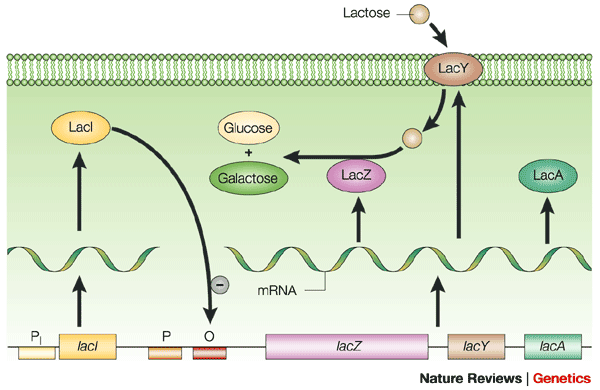
Negative Transcription Regulation (Repression) in the lac operon: There is a repressor for the lac operon. This is a protein that can bind to the operator of the lac operon (that region immediately downstream from the promoter). This creates a physical block that prevents RNA polymerase from transcribing.

The lac operon repressor (LACI) is a protein that is constitutively (always) expressed. This indicates that the lac operon is normally turned OFF. Notice that the gene for the regulatory protein is upstream from the lac operon.  The lac repressor (LacI) binds to the major groove of the DNA at the operator. As you can see in the annotated image of the repressor, you have a DNA-binding region (active site), and a regulatory domain. The regulatory domain has the ability to bind to Lactose (the inducer).
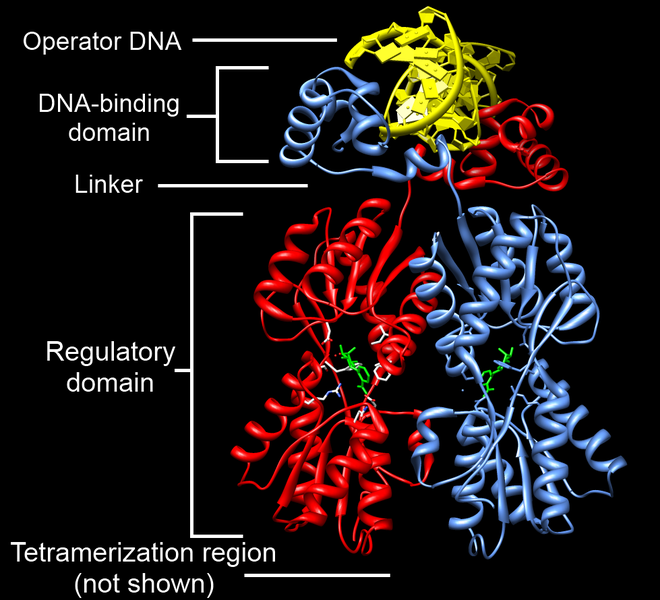
Lac RepressorYou must have a way to unlock the operon, or to put it another way, to inactivate the repressor. An inducer is a ligand that can bind to a regulatory domain, changing the shape of the regulatory domain, and thus inactivating the DNA-binding domain. In the case of the the lac repressor, the ligand is allolactose (a derivative of lactose). When allolactose binds to the lac repressor, the repressor is inactivated, and the operon cleared. This is seen in the image below.

Therefore, the lac operon is partially regulated by the presence of lactose in the environment. If there is no lactose in the environment, then there is no need to transcribe the three genes needed to use lactose.
https://upload.wikimedia.org/wikipedia/commons/0/0c/Lac-operon.jpeg


Remember, we don't want to expend energy for things we don't need. Below is the size of the three gene products:
  • β-Galactosidase 1,024 Amino Acids
  • β-Galactoside Permease 418 Amino Acids
  • β-galactoside transacetylase 203 Amino Acids
Total Amino Acids, 1645. Using the assumption of 4 ATP per amino acid added to a protein, that makes 6580 ATPs needed just for protein synthesis. With this many amino acids, you are also looking at 4935 nucleotides (remember 3 nucleotides = codon = 1 amino acid), plus at least 3 stop codons. Each nucleotide added to a transcript takes the equivalent of 1 ATP, so you are looking at 4944 ATP minimum to make the transcript. Just to make one example of each protein (gene product), you are looking at 11,524 ATP. Do you just make one example of each protein? NO! Do you have the idea that this is energy consumptive? Would you make it if there was no lactose around?

Tomorrow we will look at the positive regulation of the lac operon. Remember, you still will not transcribe this operon if glucose is present. You only transcribe when glucose is absent. So how does the operon know when glucose is absent? That will be our discussion tomorrow.

Challenge

In your own words, describe how lactose (allolactose) is used to regulate the transcription of the lac operon. In your discussion, make sure that you explain the concept of an operon, and discuss the differences between eukaryote and prokaryote gene transcription.


The Lac operon has two levels of regulation.  The first is through a repressor protein that binds to the operator of the operon.  The repressor is constitutively expressed and binds to the Lac Operon operator.  When lactose is present, it binds to the repressor, thus changing the shape of the repressor protein; the repressor detaches from the operator, and transcription can occur.

There is a second regulation system for the Lac Operon, and it has to deal with the promoter and the CRP binding site.  In the case of the Lac operon, the promoter is "weak".  RNA polymerase does not readily bind to the promoter.  To assist in binding RNA polymerase, there is an activator site (CRP binding site) that can be used to "enhance" the promoter (enhance the binding of RNA polymerase to the promoter).

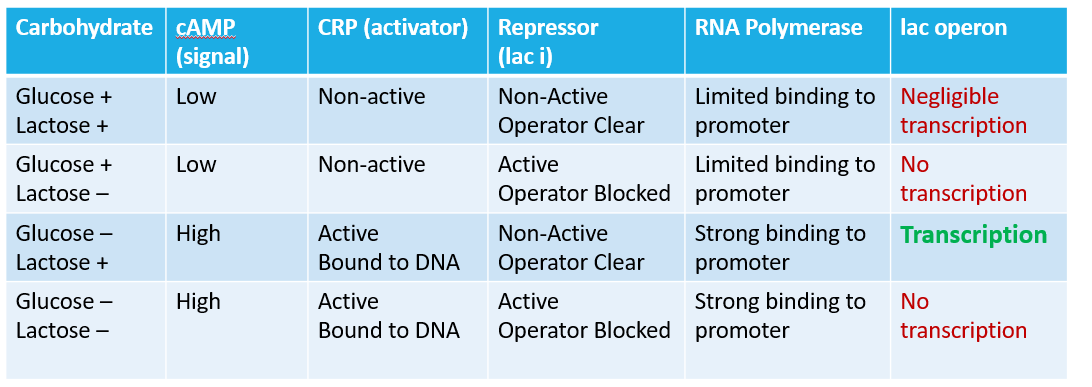
CRP stands for cAMP Regulator Protein (it is also known as the Catabolite Activator Protein).  CRP has a binding site for cAMP, and the protein is activated (turned on) when cAMP binds.  The CRP-cAMP complex can bind to the CRP binding site, and alter the Lac Operon promoter, enhancing the binding of RNA Polymerase to the promoter.  But why this second regulatory system?

Remember that for this cell, glucose is the preferred carbohydrate and energy source (Escherichia coli is a chemoheterotrophic organism).  The first regulatory system for the operon dealt with the presence/absence of Lactose (you only transcribe the operon when lactose is present).  This second deals with the presence/absence of glucose.  Glucose is the primary carbohydrate source, so as long as glucose is present, there is no need to transcribe pathways for secondary sugars.

In bacteria, the movement of glucose across the membrane (remember hexokinase?) inhibits the production of cAMP.  If glucose transport slows dramatically or stops, Adenylate Cyclase begins making cAMP.  So, while glucose available, there is little to no cAMP in the cell.  When glucose is scarce, we see an increase in cellular levels of cAMP.  For bacteria like E. coli, we can see cAMP as a starvation signal.  The CRP-cAMP complex will bind to the bacterial DNA molecule and activate numerous pathways for alternative carbohydrate utilization.  As with the Lac Operon, these other pathways will only transcribe when the correct sugar is in the environment.

Below is an image that demonstrates the two components of regulation.
https://commons.wikimedia.org/wiki/File:Lac_operon-2010-21-01.png

Below is a table that breaks down the regulation.


Challenge 

Explain in your own words the evolutionary advantage of having a two-stage regulatory system, as seen in the Lac Operon. In your discussion, explain why it is important to have secondary messages like cAMP act as signals for large environmental changes, such as starvation states.

Tuesday, November 12, 2013

Daily Newsletter: November 12, 2013 - Lac Operon

Site LogoDaily Newsletter

November 12, 2013 - Lac Operon


One of the most well studied gene regulation systems is the Lac Operon found in Escherichia coli. To understand this system, it is important to first understand that bacteria do not experience Transcription and Translation in exactly the same way as eukarotes (the mechanics are very similar, but there are some distinct differences).
The core difference between prokaryotes and eukaryotes is the nucleus. Since bacteria lack a nucleus, transcription takes place in the cytosol. There is no need for a tag to get out of the nucleus, so there is no need for capping. Also, there are no introns, so no need for splicing. Basically, there is no processing of RNA to make mRNA. There is no pre-mRNA. When a gene is transcribed, the transcript is mRNA.Transcription comparison


Since there is no membrane separating transcription from translation, you can couple these to processes. As mRNA is made, it can be translated (polyribosome).

Bacteria have a single circular molecule of DNA (a genophore, not a chromosome). They have to conserve their genetic space, so bacteria combine genes for a metabolic process in a single mRNA. IMPORTANT: bacteria can combine genes for a metabolic pathway into a sequential sequence with a single promoter. Thus, when you transcribe, you get all the genes for a given metabolic pathway.
The word OPERON describes this unique arrangement of prokaryotic genes: One promoter and one operator for a given series of metabolically linked genes.Lac Operon
The lac Operon holds three genes that give the cell the ability to take in and use the sugar LACTOSE. [Image Note: Bacteria have two promoter regions, -10 & -35, for a given gene or operon]


For E. coli, glucose is the preferred sugar. When glucose is present, there is no need to use lactose: these genes are not transcribed. When there is no glucose, E. coli has to use other sugars. IF lactose is present, the genes for lactose utilization will be made. Conversely, if there is no lactose, they genes remain locked down.
  • Glucose Present: No transcription
  • Glucose Absent: Minimal transcription
  • Glucose Absent, Lactose Present: Transcription of the lac operon.
NOTE: In this example, there are two ways to control the expression of a gene or operon:
  1. You can block the operator of the gene. This prevents RNA polymerase from making RNA.
  2. You can alter the promoter (or the interaction between transcription factors and DNA) to prevent binding of the Transcription Complex (RNA polymerase).
Negative Transcription Regulation (Repression) in the lac operon: There is a repressor for the lac operon. This is a protein that can bind to the operator of the lac operon (that region immediately downstream from the promoter). This creates a physical block that prevents RNA polymerase from transcribing.

The lac operon repressor (LACI) is a protein that is constitutively (always) expressed. This indicates that the lac operon is normally turned OFF. Notice that the gene for the regulatory protein is upstream from the lac operon.  The lac repressor (LacI) binds to the major groove of the DNA at the operator. As you can see in the annotated image of the repressor, you have a DNA-binding region (active site), and a regulatory domain. The regulatory domain has the ability to bind to Lactose (the inducer).

Lac RepressorYou must have a way to unlock the operon, or to put it another way, to inactivate the repressor. An inducer is a ligand that can bind to a regulatory domain, changing the shape of the regulatory domain, and thus inactivating the DNA-binding domain. In the case of the the lac repressor, the ligand is allolactose (a derivative of lactose). When allolactose binds to the lac repressor, the repressor is inactivated, and the operon cleared. This is seen in the image below.

Therefore, the lac operon is partially regulated by the presence of lactose in the environment. If there is no lactose in the environment, then there is no need to transcribe the three genes needed to use lactose.

Remember, we don't want to expend energy for things we don't need. Below is the size of the three gene products:
  • β-Galactosidase 1,024 Amino Acids
  • β-Galactoside Permease 418 Amino Acids
  • β-galactoside transacetylase 203 Amino Acids
Total Amino Acids, 1645. Using the assumption of 4 ATP per amino acid added to a protein, that makes 6580 ATPs needed just for protein synthesis. With this many amino acids, you are also looking at 4935 nucleotides (remember 3 nucleotides = codon = 1 amino acid), plus at least 3 stop codons. Each nucleotide added to a transcript takes the equivalent of 1 ATP, so you are looking at 4944 ATP minimum to make the transcript. Just to make one example of each protein (gene product), you are looking at 11,524 ATP. Do you just make one example of each protein? NO! Do you have though the idea that this is energy consumptive? Would you make it if there was no lactose around?

Tomorrow we will look at the positive regulation of the lac operon. Remember, you still will not transcribe this operon if glucose is present. You only transcribe when glucose is absent. So how does the operon know when glucose is absent? That will be our discussion tomorrow.

Daily Challenge

In your own words, describe how lactose (allolactose) is used to regulate the transcription of the lac operon. In your discussion, make sure that you explain the concept of an operon, and discuss the differences between eukaryote and prokaryote gene transcription.

Monday, November 11, 2013

Daily Newsletter: November 11, 2013 - Introduction to Gene Regulation

Site LogoDaily Newsletter

November 11, 2013

Introduction to Gene Regulation


Suggested Reading

These brief articles are a supplement to the readings from your textbook on Gene Regulation. You do not have to finish these articles today, but they will help you understand gene regulation at a deeper level. They also make great references for your next milestone paper.

  • Do we express all of our genes at the same time? Why?
  • Do we need all of our genes expressed all the time? Why?
  • Why do we have so many genes?

These are just a few of the questions you need to start asking yourself. Humans have hundreds of thousands of genes. Many are needed all the time (constitutive), but others are only needed when the cell get's certain signals. So how do we control the expression of all this genetic knowledge?

During mitosis, for example, did you see the production of DNA polymerase and the replication complex during the start of G1, or did you only see it after you passed the first restriction point? Do we keep DNA polymerase around just in case we are going to do some nuclear division? or do we unlock its expression only when needed?

Consider: The first restriction point determines if you are going to prep for division. When you have enough cyclin-dependent kinase available, you pass the restriction point. CDK signals the cell to get ready for division. How does this signal work? It changes gene expression (i.e., we activate regulated genes).

Think about the human body and homeostasis. Think about hormones. Are you always producing everything, or do you need to trigger some events? Could that trigger then be a regulated gene?

Remember that you need at minimum the equivalent of 4ATP per amino acid incorporated into a protein. Add to this 1 ATP equivalent for each nucleotide during transcription. You should quickly realize that gene expression is energy expensive.
Your goal today is to start reading about gene regulation, and more specifically, come to an understanding of the necessity of gene regulation.

Daily Challenge

Why do we need gene regulation? Today, reflect on the need and use of gene regulation. Why would an organism need to have some genes that it could turn on or off? Why would you need to control gene expression? Can the environment affect gene regulation? Can gene regulation affect evolution?

Case Study
In BOLO, you will also find a case study dealing with genetics.

Tuesday, November 6, 2012

Daily Newsletter: November 6, 2012 - Lac Operon

Site LogoDaily Newsletter

November 6, 2012 Lac Operon


One of the most well studied gene regulation systems is the Lac Operon found in Escherichia coli. To understand this system, it is important to first understand that bacteria do not experience Transcription and Translation in exactly the same way as eukarotes (the mechanics are very similar, but there are some distinct differences).
The core difference between prokaryotes and eukaryotes is the nucleus. Since bacteria lack a nucleus, transcription takes place in the cytosol. There is no need for a tag to get out of the nucleus, so there is no need for capping. Also, there are no introns, so no need for splicing. Basically, there is no processing of RNA to make mRNA. There is no pre-mRNA. When a gene is transcribed, the transcript is mRNA.Transcription comparison


Since there is no membrane separating transcription from translation, you can couple these to processes. As mRNA is made, it can be translated (polyribosome).

Bacteria have a single circular molecule of DNA (a genophore, not a chromosome). They have to conserve their genetic space, so bacteria combine genes for a metabolic process in a single mRNA. IMPORTANT: bacteria can combine genes for a metabolic pathway into a sequential sequence with a single promoter. Thus, when you transcribe, you get all the genes for a given metabolic pathway.
The word OPERON describes this unique arrangement of prokaryotic genes: One promoter and one operator for a given series of metabolically linked genes.Lac Operon
The lac Operon holds three genes that give the cell the ability to take in and use the sugar LACTOSE. [Image Note: Bacteria have two promoter regions, -10 & -35, for a given gene or operon]


For E. coli, glucose is the preferred sugar. When glucose is present, there is no need to use lactose: these genes are not transcribed. When there is no glucose, E. coli has to use other sugars. IF lactose is present, the genes for lactose utilization will be made. Conversely, if there is no lactose, they genes remain locked down.
  • Glucose Present: No transcription
  • Glucose Absent: Minimal transcription
  • Glucose Absent, Lactose Present: Transcription of the lac operon.
NOTE: In this example, there are two ways to control the expression of a gene or operon:
  1. You can block the operator of the gene. This prevents RNA polymerase from making RNA.
  2. You can alter the promoter (or the interaction between transcription factors and DNA) to prevent binding of the Transcription Complex (RNA polymerase).
Lac Operon - RepressionNegative Transcription Regulation (Repression) in the lac operon: There is a repressor for the lac operon. This is a protein that can bind to the operator of the lac operon (that region immediately downstream from the promoter). This creates a physical block that prevents RNA polymerase from transcribing.

As you can see in the image to the right, the lac repressor is a protein that is constitutively (always) expressed. This indicates that the lac operon is normally turned OFF. Notice that the gene for the regulatory protein is upstream from the lac operon.
Lac RepressorThe lac repressor (LacI) binds to the major groove of the DNA at the operator. As you can see in the annotated image of the repressor, you have a DNA-binding region (active site), and a regulatory domain. The regulatory domain has the ability to bind to Lactose (the inducer).

You must have a way to unlock the operon, or to put it another way, to inactivate the repressor. An inducer is a ligand that can bind to a regulatory domain, changing the shape of the regulatory domain, and thus inactivating the DNA-binding domain. In the case of the the lac repressor, the ligand is allolactose (a derivative of lactose). When allolactose binds to the lac repressor, the repressor is inactivated, and the operon cleared. Lac Operon OpenThis is seen in the image below.

Therefore, the lac operon is partially regulated by the presence of lactose in the environment. If there is no lactose in the environment, then there is no need to transcribe the three genes needed to use lactose.
Remember, we don't want to expend energy for things we don't need. Below is the size of the three gene products:
  • β-Galactosidase 1,024 Amino Acids
  • β-Galactoside Permease 418 Amino Acids
  • β-galactoside transacetylase 203 Amino Acids
Total Amino Acids, 1645. Using the assumption of 4 ATP per amino acid added to a protein, that makes 6580 ATPs needed just for protein synthesis. With this many amino acids, you are also looking at 4935 nucleotides (remember 3 nucleotides = codon = 1 amino acid), plus at least 3 stop codons. Each nucleotide added to a transcript takes the equivalent of 1 ATP, so you are looking at 4944 ATP minimum to make the transcript. Just to make one example of each protein (gene product), you are looking at 11,524 ATP. Do you just make one example of each protein? NO! Do you have though the idea that this is energy consumptive? Would you make it if there was no lactose around?

Tomorrow we will look at the positive regulation of the lac operon. Remember, you still will not transcribe this operon if glucose is present. You only transcribe when glucose is absent. So how does the operon know when glucose is absent? That will be our discussion tomorrow.

Daily Challenge

In your own words, describe how lactose (allolactose) is used to regulate the transcription of the lac operon. In your discussion, make sure that you explain the concept of an operon, and discuss the differences between eukaryote and prokaryote gene transcription.
Link to Forum

Monday, November 5, 2012

Daily Newsletter: November 5, 2012 - Introduction to Gene Regulation

Site LogoDaily Newsletter

November 5, 2012

Introduction to Gene Regulation


Suggested Reading

These brief articles are a supplement to the readings from your textbook on Gene Regulation. You do not have to finish these articles today, but they will help you understand gene regulation at a deeper level. They also make great references for your next milestone paper.

  • Do we express all of our genes at the same time? Why?
  • Do we need all of our genes expressed all the time? Why?
  • Why do we have so many genes?

These are just a few of the questions you need to start asking yourself. Humans have hundreds of thousands of genes. Many are needed all the time (constitutive), but others are only needed when the cell get's certain signals. So how do we control the expression of all this genetic knowledge?

During mitosis, for example, did you see the production of DNA polymerase and the replication complex during the start of G1, or did you only see it after you passed the first restriction point? Do we keep DNA polymerase around just in case we are going to do some nuclear division? or do we unlock its expression only when needed?

Consider: The first restriction point determines if you are going to prep for division. When you have enough cyclin-dependent kinase available, you pass the restriction point. CDK signals the cell to get ready for division. How does this signal work? It changes gene expression (i.e., we activate regulated genes).

Think about the human body and homeostasis. Think about hormones. Are you always producing everything, or do you need to trigger some events? Could that trigger then be a regulated gene?

Remember that you need at minimum the equivalent of 4ATP per amino acid incorporated into a protein. Add to this 1 ATP equivalent for each nucleotide during transcription. You should quickly realize that gene expression is energy expensive.
Your goal today is to start reading about gene regulation, and more specifically, come to an understanding of the necessity of gene regulation.

Daily Challenge

Why do we need gene regulation? Today, reflect on the need and use of gene regulation. Why would an organism need to have some genes that it could turn on or off? Why would you need to control gene expression? Can the environment affect gene regulation? Can gene regulation affect evolution?