Showing posts with label Genetics. Show all posts

Monday, February 17, 2014

Microbiology Daily Newsletter February 17, 2014 - Bacterial Genetics

Site LogoMicrobiology Daily Newsletter

February 17, 2014 - Bacterial Genetics


At this point, all students should be able to provide a solid description of Replication, Transcription and Translation.  Therefore, we will not concern ourselves with the basics of these processes, but instead focus on how Bacteria differ from Eukarya in these three processes.  As we move though this week, we will also begin our discussion on genetic regulations.

The following topics in genetics you should have a strong familiarity with.  If you don't then it is time to brush up on your genetics.

  1. Be able to discuss replication, transcription and translation.
  2. Be able to describe in detail the mechanisms of replication, transcription and translation.
  3. Be able to discuss the concept of a genome, and what constitutes a genome.
  4. Be able to discuss supercoiling of DNA and the use of topoisomerases.
  5. Be able to discuss how DNA analysis is done, and why.
  6. Be able to discuss how researchers analyze the whole genome, and why it is important.
  7. Be able to discuss all of the different types of RNA.
  8. Be able to discuss post-translational modification of proteins.
  9. Be able to describe open reading frames, paralogs, orthologs and DNA alignments.
  10. Be able to discuss various mechanisms of gene regulation and epigenetics.

 Bacterial DNA Replication

 The genetic process of replication is fundamental to all living systems, and the basic mechanism is the same: DNA is unwound and opened, each parental strand acts as a template upon which a newly synthesized strand is based; the resulting daughter molecules are semi-conservative, being formed of one template (old) strand and one new strand.  You should be intimately familiar with this process.

So, what is different between bacterial replication and eukaryotic replication?
Remember that the nucleoid (genophore) of the bacteria is a single circular molecule that is vastly smaller than eukaryotic chromosomes.  Unlike the chromosome, which can have multiple origins of replication, bacteria will generally only have 1 origin of replication (Ori).

Eukaryotic chromosomes are linear, and so you keep replicating til you get to the end (remember, there is a problem with the ends potentially degrading...remember telomerase?).  Bacterial DNA is circular, so there is no end.  Instead, you find a terminus, or termination point (Ter).

As with all DNA replication, you will get two replication forks on either side of the origin of replication, these will then meet at the terminus.  All the while, the DNA is anchored to the cell membrane, and it is the movement of the cell membrane that will separate the two daughter molecules.

The process begins when DnaA binds to the Ori.  DnaA, and the specific sequence at Ori, are genera/species specific.  The most highly studied system is Escherichia coli, where a repeat of 5' - TTATCCACA - 3' is used as the binding sequence for DnaA.

DnaA enzymes needed for replication including Helicase,  DnaB, and DnaC.  DnaB anchors at what will become replication forks, and aids in the binding of primase.

Single-stranded binding proteins and DNA gyrase will be needed to prevent re-annealing and positive supercoiling respectively.  DNA polymerase III holozyme will be the primary work horse of the elongation phase.

Termination is interesting, as the two replication forks are forced to meet in the Ter region, by a process referred to as the replication fork trap.  The two daughter strands are joined as interlocking rings in the terminus (catenane, or mechanically linked molecular architecture).  DNA Topoisomerase IV will be the critical player in unlinking the daughter molecules, and will need DNA gyrase to assist.
From: Charvin G et al. PNAS 2003;100:9820-9825.  Configurations of a circular replicating DNA. (a) Model for in vivo strand separation: the progression of the replication complex leads to the formation of (+) supercoils (L-nodes) in front of the replication fork and R-precatenanes behind. Topo IV removes (+) supercoils and gyrase generates (–) supercoils so that, under the action of both enzymes, the chirality of the precatenanes is inverted. Topo IV may then unlink the molecules by removing the L-catenanes. (b) Model for in vitro decatenation by Topo IV: R-catenated plasmids may form L-supercoils that are removed by Topo IV with a high rate [as observed in our experiments and some bulk assays (21)]. However, the removal of the last few links is slow , because Topo IV will relax only a rare fluctuation of an R-node to an obtuse angle that is similar to its preferred substrate: an L-node with acute angle (see Fig. 1b).


Daily Challenge

Review DNA replication as it pertains to bacteria, and consider, how would you move from the replication of a circular DNA molecule to a linear molecule?  What would need to change?  Initiation? Elongation? Termination?  How different are each of these process from eukaryotic replication?

Tuesday, November 12, 2013

Daily Newsletter: November 12, 2013 - Lac Operon

Site LogoDaily Newsletter

November 12, 2013 - Lac Operon


One of the most well studied gene regulation systems is the Lac Operon found in Escherichia coli. To understand this system, it is important to first understand that bacteria do not experience Transcription and Translation in exactly the same way as eukarotes (the mechanics are very similar, but there are some distinct differences).
The core difference between prokaryotes and eukaryotes is the nucleus. Since bacteria lack a nucleus, transcription takes place in the cytosol. There is no need for a tag to get out of the nucleus, so there is no need for capping. Also, there are no introns, so no need for splicing. Basically, there is no processing of RNA to make mRNA. There is no pre-mRNA. When a gene is transcribed, the transcript is mRNA.Transcription comparison


Since there is no membrane separating transcription from translation, you can couple these to processes. As mRNA is made, it can be translated (polyribosome).

Bacteria have a single circular molecule of DNA (a genophore, not a chromosome). They have to conserve their genetic space, so bacteria combine genes for a metabolic process in a single mRNA. IMPORTANT: bacteria can combine genes for a metabolic pathway into a sequential sequence with a single promoter. Thus, when you transcribe, you get all the genes for a given metabolic pathway.
The word OPERON describes this unique arrangement of prokaryotic genes: One promoter and one operator for a given series of metabolically linked genes.Lac Operon
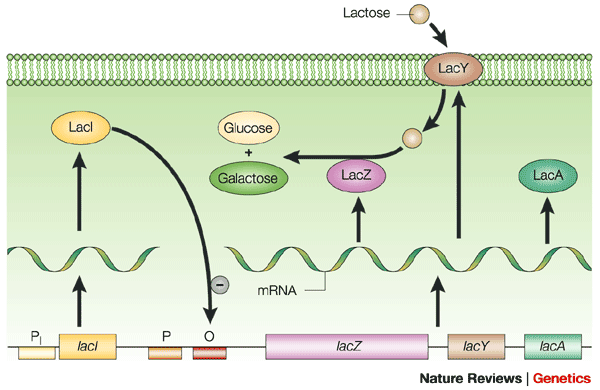
The lac Operon holds three genes that give the cell the ability to take in and use the sugar LACTOSE. [Image Note: Bacteria have two promoter regions, -10 & -35, for a given gene or operon]


For E. coli, glucose is the preferred sugar. When glucose is present, there is no need to use lactose: these genes are not transcribed. When there is no glucose, E. coli has to use other sugars. IF lactose is present, the genes for lactose utilization will be made. Conversely, if there is no lactose, they genes remain locked down.
  • Glucose Present: No transcription
  • Glucose Absent: Minimal transcription
  • Glucose Absent, Lactose Present: Transcription of the lac operon.
NOTE: In this example, there are two ways to control the expression of a gene or operon:
  1. You can block the operator of the gene. This prevents RNA polymerase from making RNA.
  2. You can alter the promoter (or the interaction between transcription factors and DNA) to prevent binding of the Transcription Complex (RNA polymerase).
Negative Transcription Regulation (Repression) in the lac operon: There is a repressor for the lac operon. This is a protein that can bind to the operator of the lac operon (that region immediately downstream from the promoter). This creates a physical block that prevents RNA polymerase from transcribing.

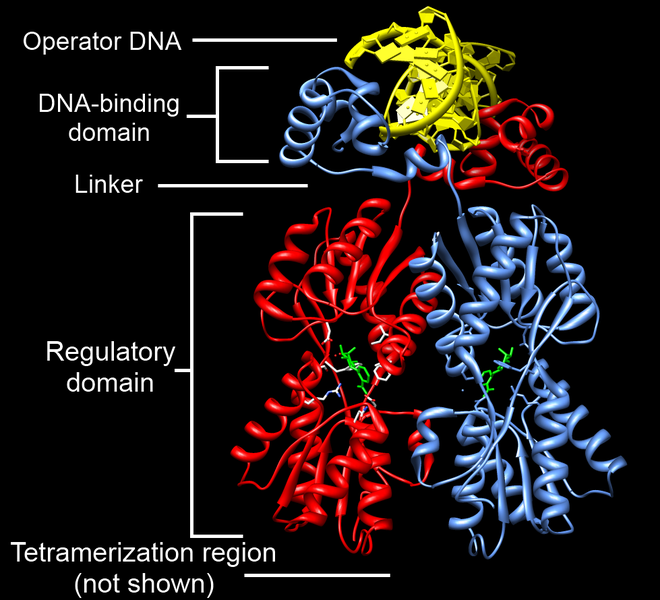
The lac operon repressor (LACI) is a protein that is constitutively (always) expressed. This indicates that the lac operon is normally turned OFF. Notice that the gene for the regulatory protein is upstream from the lac operon.  The lac repressor (LacI) binds to the major groove of the DNA at the operator. As you can see in the annotated image of the repressor, you have a DNA-binding region (active site), and a regulatory domain. The regulatory domain has the ability to bind to Lactose (the inducer).

Lac RepressorYou must have a way to unlock the operon, or to put it another way, to inactivate the repressor. An inducer is a ligand that can bind to a regulatory domain, changing the shape of the regulatory domain, and thus inactivating the DNA-binding domain. In the case of the the lac repressor, the ligand is allolactose (a derivative of lactose). When allolactose binds to the lac repressor, the repressor is inactivated, and the operon cleared. This is seen in the image below.

Therefore, the lac operon is partially regulated by the presence of lactose in the environment. If there is no lactose in the environment, then there is no need to transcribe the three genes needed to use lactose.

Remember, we don't want to expend energy for things we don't need. Below is the size of the three gene products:
  • β-Galactosidase 1,024 Amino Acids
  • β-Galactoside Permease 418 Amino Acids
  • β-galactoside transacetylase 203 Amino Acids
Total Amino Acids, 1645. Using the assumption of 4 ATP per amino acid added to a protein, that makes 6580 ATPs needed just for protein synthesis. With this many amino acids, you are also looking at 4935 nucleotides (remember 3 nucleotides = codon = 1 amino acid), plus at least 3 stop codons. Each nucleotide added to a transcript takes the equivalent of 1 ATP, so you are looking at 4944 ATP minimum to make the transcript. Just to make one example of each protein (gene product), you are looking at 11,524 ATP. Do you just make one example of each protein? NO! Do you have though the idea that this is energy consumptive? Would you make it if there was no lactose around?

Tomorrow we will look at the positive regulation of the lac operon. Remember, you still will not transcribe this operon if glucose is present. You only transcribe when glucose is absent. So how does the operon know when glucose is absent? That will be our discussion tomorrow.

Daily Challenge

In your own words, describe how lactose (allolactose) is used to regulate the transcription of the lac operon. In your discussion, make sure that you explain the concept of an operon, and discuss the differences between eukaryote and prokaryote gene transcription.

Monday, November 11, 2013

Daily Newsletter: November 11, 2013 - Introduction to Gene Regulation

Site LogoDaily Newsletter

November 11, 2013

Introduction to Gene Regulation


Suggested Reading

These brief articles are a supplement to the readings from your textbook on Gene Regulation. You do not have to finish these articles today, but they will help you understand gene regulation at a deeper level. They also make great references for your next milestone paper.

  • Do we express all of our genes at the same time? Why?
  • Do we need all of our genes expressed all the time? Why?
  • Why do we have so many genes?

These are just a few of the questions you need to start asking yourself. Humans have hundreds of thousands of genes. Many are needed all the time (constitutive), but others are only needed when the cell get's certain signals. So how do we control the expression of all this genetic knowledge?

During mitosis, for example, did you see the production of DNA polymerase and the replication complex during the start of G1, or did you only see it after you passed the first restriction point? Do we keep DNA polymerase around just in case we are going to do some nuclear division? or do we unlock its expression only when needed?

Consider: The first restriction point determines if you are going to prep for division. When you have enough cyclin-dependent kinase available, you pass the restriction point. CDK signals the cell to get ready for division. How does this signal work? It changes gene expression (i.e., we activate regulated genes).

Think about the human body and homeostasis. Think about hormones. Are you always producing everything, or do you need to trigger some events? Could that trigger then be a regulated gene?

Remember that you need at minimum the equivalent of 4ATP per amino acid incorporated into a protein. Add to this 1 ATP equivalent for each nucleotide during transcription. You should quickly realize that gene expression is energy expensive.
Your goal today is to start reading about gene regulation, and more specifically, come to an understanding of the necessity of gene regulation.

Daily Challenge

Why do we need gene regulation? Today, reflect on the need and use of gene regulation. Why would an organism need to have some genes that it could turn on or off? Why would you need to control gene expression? Can the environment affect gene regulation? Can gene regulation affect evolution?

Case Study
In BOLO, you will also find a case study dealing with genetics.

Thursday, November 7, 2013

Daily Newsletter: November 7, 2013 - Beyond Mendel

Site LogoDaily Newsletter

October 18, 2012 Beyond Mendel


As discussed in class yesterday, after the rediscover of Mendel's work, people began investigating inheritance in other systems. As research continued, scientists began seeing that the Mendelian ratios did not always work. There were variations.
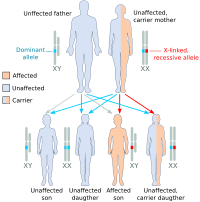
  • Sex linked traits: Many species have what is known as a sex chromosome. Normally, every chromosome of a given set is the same size and shape, and most importantly, they carry the same genetic information. Not so with sex chromosomes. One variation of the chromosome is shorter, and does not carry the same information. When the standard and shorter chromosome (X and Y) are in the same cell, you have a Hemizygotic state. The suffix hemi come from ancient Greek, and means half. This refers to the idea that some of the genes in an XY pairing are haploid, not diploid. If the X has a gene that the Y does not possess, then it is always expressed (as would be the case in haploid organisms).
X-linked DomDominant X linked
    X-linked Dom
  • Epistasis: Epistasis involves a two gene system. While the genotype follows Mendelian Laws, the phenotype does not. The reason is that one gene completely masks the effect of the second gene. Below is an epistatic example. Can you describe how this is different from a standard dihybrid cross?
Epistasis
  • Pleiotrophy: This is when an allele has widespread impact in an organism, and so is not limited to one trait. For example, would a change in microtubles affect only one aspect of a cell? Would it affect only one cell type? Pleiotrophy may also cause problems at different stages of development, such as varying affects at different ages. Here is an example of pleiotrophy.
  • Heterosis: Hybrid Vigor. Inbreeding can depress the Heterosisadaptive strength of a species by allowing recessive traits a greater chance to express. When you begin crossing inbreed strains, you suddenly see an increase in adaptive vigor. This is useful with coordinated breeding of animals and plants, as the hybrid produced is stronger than the parental strains. It also informs our understanding of endangered species, and helps researchers work on ways to increase not only the adaptive vigor an an endangered species, but also the population size (without increasing inbreeding depression).
  • Gene expression from environmental cues: Some genes are only triggered during certain environmental conditions. Remember the concept of signal pathways and signal transduction. The body picks up an environmental signal, and then tells the cells to change in some way. There are two terms you need to understand when dealing with Environmentally Cued Gene Expression:
    • Expressivity: This describes how much gene expression you get in an individual when exposed to the proper cues.
    • Penetrance: This is a population concept. When exposed to a given condition, how many individuals of the population express the gene?


Some additional reading for those interested in genetics:


Blood Typing 

 The ABO blood type system is an example of codominance, meaning that in a heterozygous individual, both alleles are expressed, giving the individual two phenotypes (not a blending).  In other words, the alleles are considered dominant.  The ABO blood type is also multi-allelic, meaning there are more than two alleles for this one gene.  IMPORTANT:  The ABO blood type is derived from a single gene that has multiple alleles, of which two are considered dominant (A type and B type).

The gene (FUT1) for the ABO blood type system is a glycosyltransferase.  This enzyme adds carbohydrates onto proteins during post-translational modification.  The gene is found on chromosome 19. The antigen carrying proteins (the transmembranal protein that is glycosylated) currently has an unknown function.  The following shows the glycosylation patterns of the H antigen (the correct designation for the ABO antigen).
The fucose-galactose-N-acetyl-glucosamine glycosylation seen in O is common throughout the system.  It is the precursor to the other forms.  The FUT1 gene has allelic variation based on several SNPs.  The result is a difference in glycosylation patterns.  Specifically, we see the an additional N-acetyl-glalactosamine on A and an additional Galactose on B.
  • If you have the allele for A, you produce the A glycosylation pattern. 
  • If you have the allele for B, you produce the B gylcosylation pattern.
  • If you have the allele for A and B, you produce both A and B glycosylation patterns.
  • If you have neither the A or B allele, then you produce the precursor O configuration only.
  • If you are Heterozygous A or B, meaning you have the (Aio) or (Bio) genotype, then you will produce the O glycosalation pattern.  Remember though, A and B are dominant to O.
An important discovery for the ABO system was the discovery of Antigen H.  This discovery began in 1952 by Y.M. Bhende.  Dr. Bhende, working in what is now known as Mumbai, India, discovered a patient who reacted to all ABO blood types.  They built antibodies against all ABO blood.   This led to the realization that O blood was antigenic to this patient.  What is now known is that the specific glycosylation of O is an antigen, and is the precursor to the A and B phenotypes.  Antigen H is the antigen found on O blood.  Antigen H is the precursor to antigen A and antigen B, as such, antigen H is found in A, B, AB and O blood.

Individuals who do not produce antigen H, described genotypically as (h,h) (heterozygoun recessive for the H antigen), are intolerant to all ABO blood (they build a reaction against it).  This blood group (h,h) is known as the Bombay Blood Group.  It represents the an additional allelic variation to the ABO blood type system.


Daily Challenge

Even with multiple alleles in a population (consider the ABO, Bombay blood groups) and multiple genes (epistasis), Mendel's laws still hold at the level of the genotype.  Explain how the laws of inheritance still hold true, and how variations such as multiple alleles, co-dominance, incomplete dominance, and epistasis all serve to increase population diversity.

Wednesday, November 6, 2013

Daily Newsletter: November 6, 2013 - Mendel's Second Law of Inheritance

Daily Newsletter

November 6, 2013 -

Mendel's Second Law of Inheritance


Yesterday we talked about inheritance of one genetic trait (gene). But humans (and other organisms) are made up of more than one genetic trait. Every protein made by a cell is encoded in at least one gene (quaternary proteins would be encoded by multiple genes). While most genes are "house keeping" genes, i.e., needed for the organisms survival that don't have many variations among individuals(ribosomes, the genes for glycolysis, respiratory chains, etc...), some genes have greater variance. This is how we get the diversity of life, and more importantly, the uniqueness of individuals (this uniqueness is needed for evolution).

So, what happens if you are interested in more than one trait? This is where Mendel's second law comes into play. He was curious as to whether he could follow the inheritance probabilities of two traits, so he looked simultaneously at two traits in the pea.

NOTE: Going above two traits becomes mathematically more difficult, and we generally don't look at those problems at this level. When you take genetics you may see some of these higher order problems.

Mendel's experiments helped him propose what is now known as the Law of Independent Assortment. We now know that the traits Mendel looked at were found on different chromosomes (DNA molecules). The math would have been horrible if they had been on the same chromosome! As research into genetics progressed, and we realized that genes could be on the same chromosome, Mendel's second law (and the expected probabilities) became the model by which variations were assessed. Gene Mapping utilizes Mendel's probabilities for a dihybrid cross as the starting point.


With the Law of Segregation (first law), Mendel showed that for each individual trait, a pea plant (and by extension a human) has two possible allele that they can carry for a single trait (gene). When ovum and sperm (pollen) are produced, the parent donates only one allele to the ovum or sperm; the parent donates only one allele to the next generation. Therefore a new individual is composed of a set of genes (and alleles) from the mother, and another set from the father.


So, what happens when you look at two different traits (genes)? Ultimately, what Mendel discovered is that the two different traits do no interfere with each other. An allele from the first gene is donated independently, and is uninfluenced by, the allele from the second gene. So, you have a 50/50 chance of donating a given allele from the first gene, and a 50/50 chance of donating an allele from the second plant. [When looking at two distinct traits, we refer to the mating as a dihybrid, i.e., two trait, cross]

The math gets a little harder, but the idea is the same. The easiest way of showing what happens is to look at the Punnet Square for a visual interpretation of the probabilities. Below is a great picture of a Punnet square:
As you can see, on the top we put the Male Genetic Donation, and on the left side we put the Female Genetic Donation. There is a 50/50 chance the male will donate a given allele, same with the female. Look at how this is represented. Male donation is either B or b. Each has its own column. For the female, each possible donation has its own row. You then just cross-reference column and row to find out the possible offspring. The Punnet square also provides a rapid visual. 4 possible offspring, 3 of which are purple.

The Punnet square can be expanded to look at a dihybrid cross (two traits). Below is a good image of a dihybrid Punnet square. Note that the PHENOTYPIC ratio is 9:3:3:1. This is a critical ratio that will be seen repeatedly in biology.Dihybrid Cross

Daily Challenge

Explain the concept of Independent Assortment. I made a point that this does not always occur when genes are on the same chromosome. So, what happens to Independent Assortment when genes (traits) are on the same chromosome? Why is it important?

Tuesday, November 5, 2013

Daily Newsletter: November 5, 2013 - Mendel's First Law of Inheritence

Daily Newsletter

November 5, 2013 -

Mendel's First Law of Inheritence


To understand Mendel, we must first understand some terms and put them into context.
  • Gene - A segment of DNA that holds a sequence of nucleotides that provide the instructions on how to create either RNA or a Protein. These are known as gene products.
  • Chromosome - This is a molecule of DNA and associated proteins. The chromosome is only visible during specific phases of nuclear division. The word chromosome is used loosely (weak sense) as a synonym of DNA.
  • Haploid - A cell that has only one copy of each DNA molecule (chromosome).
    • NOTE: each organism has a known number of DNA molecules (chromosomes).
    • Humans have 23 different DNA molecules (23 different chromosomes).
  • Diploid - A cell that has two copies of each DNA molecule.
    • Humans have 46 chromosomes total: 2 copies of each of the 23 different DNA molecules.
  • Mutation - A change in the nucleotide sequence of DNA.
  • Genetic Variation - Different versions of the same gene generated by mutation. These could be subtle or pronounced alterations.
  • Phenotype - The specific physical form an individual's genetics produces. Generally we start by looking at one well defined physical trait, such as flower or seed color.
  • Allele - Genetic Variation in a single gene that results in different phenotypic expression.
    • There can be many different genetic variations in a population.
    • An individual can only possess a number of allele equal to the # of chromosomal copies.
      • So, a human is diploid, possessing 2 copies of each gene.
      • Humans can therefore have at most 2 alleles for each gene.
      • There can be more than 2 alleles though for the entire human population; each individual can only have a maximum of 2.
    • A haploid individual has only 1 allele for each gene.
  • Homozygous - A diploid organism that has the same allele for a given gene.
  • Heterozygous - A diploid organism that has different alleles for a given gene.
  • Genotype - The specific alleles an individual possesses for a given trait.
The following picture will help you visualize the concept of Alleles, Homozygous, and Heterozygous.Alleles
Mendel's work with the garden pea, Pisum sativum, resulted in two laws of inheritance. The focus of his work was to determine the inheritance pattern of specific traits. For example, if you have a pure breeding strain that produces white flowers, and a pure breeding strain that produces purple flower, what is the percentage of offspring which will possess purple flowers? His work was based on probability mathematics, and as we have discussed previously, mathematical certainty is needed in the establishment of laws.
Mendel's First Law is known as the Law of Segregation. Remember, Mendel did not know about genes or even DNA. He was working solely with gross physical characteristics that could be observed with the naked eye.
Going back to flower color, Mendel first wanted to see what would happen if you took pure-breeding white flowered peas and crossed (mated) them with pure-breeding purple flowered peas (F0 generation with homozygous purple and homozygous white individuals). Many of Mendel's contemporaries held the view that the offspring were produced by a blending of characteristic. What Mendel saw directly contradicted this view. He saw only purple flowers, this contradicted the idea of blending.F1 generation
Mendel decided to self-cross (self-pollinate) this generation of purple flowers (F1 heterozygous individuals). The next generation held both purple and white flowered individuals, but in a very specific ratio - 3:1. He repeated his experiment, and even used different characteristics. The same thing happened: pure-breeding parents produced offspring with a specific trait, and when self-crossed, these produced offspring in which the original parental traits appeared in a 3:1 ratio.F2 Generation
Mendel inferred the following from his mathematical calculations:
  • Each individual possesses two "factors" which determined the specific trait, e.g., Flower Color. (Mendel's Factors = Genes).
  • When an ovum or pollen is produced, it holds only one Factor (Gene).
  • When an ovum and pollen join, the new individual will carry one factor (gene) from the ovum (mother) and one factor (gene) from the pollen (father).
  • There is a 50% chance (probability) that the mother will donante one factor over another, and a 50% chance (probability) that the father will donate one factor over another.
  • You thus have four possible outcomes.
Punnett SquareAn easy way to view these possible outcomes is to use a Punnett square, a simple visual probability tool. The square shown to the right demonstrates the inheritence (genotype and phenotype) probability of pea flower color. On the left hand side of the square you will see the female (pistil) allelic contribution, and on top the male (pollen) allelic contribuition. The mother can donate either B or b; the father can donate either B or b.
If the offspring came from the joining of B from the mother and B from the father, then it will be Homozygous B (dominant) and Purple. An offspring with Bb will be heterozygous and Purple, while an offspring with bb will be homozygous (recessive) and white. There is a 1/4 probability of BB (25%), a 1/2 probability of Bb (50%), and a 1/4 probability of bb (25%). The most common is the heterozygous condition (remember this).
We now understand more regarding the mechanism which Mendel inferred, and have molecular data to support his initial findings. Mendel's factors are genes, and alleles describe the differences between factors. Cells undergo meiosis to produce gametes (sperm/ovum, pollen/ovum, etc...), and it is this process that causes the seperation of genes. We will talk more about meiosis next week.
But why did the offspring of the pure-breeding plants produce only purple flowers?
The traits he picked had variations based on a mutation of a single gene. Today we would call this type of mutation a knock-out mutation, because a function was knocked out. The purple color is produced by a fully functional gene. It produces a functional pigment. The white color is produced because the gene that codes for the pigment is flawed; it can't produce the pigment. What you have is one functional gene product (dominant) that masks a non-functional gene product (recessive). Mendelian genetics become much more murky when you have multiple genes coding for a trait or when you don't have a complete knockout.

Daily Challenge

How does the first law of inheritance affect our understanding of how genes are passed from generation to generation, and how does it affect our understanding of evolution.  Consider the consequences of a single mutation, such as the one seen in Sickle Cell Anemia.  How does that move from generation to generation, and how does natural selection play a role once we understand inheritance?

Thursday, October 31, 2013

Daily Newsletter: October 31, 2013 - Meiosis

Site LogoDaily Newsletter

October 31, 2013 - Meiosis


In mitosis, we saw nuclear division within a somatic cell . When coupled with cytokinesis, we saw that the goal was taking one parental cell and creating two genetically identical daughter cells. With meiosis, we will again experience nuclear division, but with a different goal than mitosis. The goal of meiosis is to produce gametic (reproductive) cells. As such, we will 'always' couple meiosis with cytokinesis.

Goal of Meiosis: From one diploid parental nuclei, generate four genetically unique haploid nuclei.

Goal of Meiosis-Cytokinesis: From one diploid parental cell, generate four genetically unique haploid cells.


The production of gametic cells requires two nuclear division events: a reduction division, and an equatorial division.
Important Note: All forms of nuclear division have the same basic stages. Prophase is the set-up, Prometaphase removes the nuclear envelope & attachment of mitotic spindles, Metaphase is when chromosomes align, Anaphase is when chromosome/chromatid seperate, and Telophase is when the nucleus returns to "norm".

The first meiotic divison is a reduction division, and is referred to as Meiosis I. As the term reduction implies, we are decreasing something. Specifically, during the reduction division the cell is reducing chromosomal number. REMEMBER: a diploid organism (2N) carries two of each chromosome (one maternal set, and one paternal set). During a reduction division, each set of chromosomes are separated and moved to opposite sides (poles) of the cell.

Homologous Chromosomes: This term refers to the two copies of each chromosome. For example: Chromosome 1 in humans is the largest of the chromosomes. Individuals have two copies of chromosome 1: Homologous chromosomesone from their mother and one from their father. These two individual examples of chromosome 1 are considered homologous (agreeing or consistent structure). Homologous chromosomes carry the same genes, but each homolog (one copy) will have a unique set of alleles (one allele for each gene).  Allele: individual variations in a gene produced by mutations that alters the affect of the gene product.

The image to the right is an example of two different homologous chromosomes. Notice that at the same gene is found at same location on each homolog (a member of a homologous pair). As shown in the first homologous pair, one homolog carries allele A for the first labelled gene, while the second homolog carries allele a (e.g., alleles are individual variations in the genetic code of a gene; this could be a simple SNP for example that changes the function of the gene product, or a more substantial variation that fails to produce a gene product).

Homologous chromosomesIMPORTANT NOTE: Remember that what we are seeing are chomosomes. The two chromatids of a given chromosome are the products of DNA replication. The image to the left should help you remember that you start with a Maternal DNA molecule and a Paternal DNA molecule. After DNA replication, these will consense into maternal and paternal chrmosomes. It is critical that you remember the difference between Chromosome and Chromatid.

recombinationProphase 1 (prophase of Meiosis I) is the most critical stage of meiosis. Prior to the reduction division (which occurs in Anaphase 1), a recombination event will occur between the maternal and paternal chromosomes. Recombination is a genetic event in which homologous genes on two homologs are swapped between the molecules. A section of each DNA molecule is cleaved and then bound to a new molecule of DNA. The resulting molecules will still have the same genes, but the alleles (i.e., variations) they carried have been swapped.

Crossover and ChiasmaThis recombination event begins when homologous chromosomes are brought together during prometaphase I. The homologs possess DNA sequence similarities, and are able to bind to each other (the homologs chemically recognize each other). Regions where Cross-Over (recombination) can occur begin to over lap, forming a visible structure known as a chiasma (pl. chiasmata). During cross-over(recombination), alleles are swapped between the two chromosomes, with the end result being genetically unique allele patterns on each chromosome. CRITICAL POINT: the result is two unique chromosomes! This step is critical for maintaining diversity in diploid (eukaryotic) cell systems. Ever generation inheriets a unique genetic composite of maternal and paternal alleles.
This event is one of the most critical ways that eukaryotic organisms ensure the diversity of their populations. Why do you need to maintain diversity?

After this recombination event, Chromosomes will line up along the equatorial line (metaphase plate) so that there is one homolog on either side of the equatorial line. RECALL: in mitosis, chromosomes lined up so that there was a chromatid on either side of the metaphase plate; now in meiosis I, there is a homolog chromosome on either side. Why is this difference in alignment important?


metaphase
Metaphase in Mitosis
Meiosis I
Meiosis I


As you can see in the image of meiosis I, the alignment of chromosomes during Metaphase is critical. During anaphase I, the freshly recombined homologs are separated. The cell moves from a diploid (having 2 sets of chromosomes, 2N), to a haploid state (having only 1 set of chromosomes, 1N). This is the reduction division!
Mitosis II occurs like mitosis, which is classified as an equitorial division. In an equitorial division, the chromatids are seperated. (see the difference?) Meiosis IINOTICE: each cell produced in meiosis I now undergo meiosis II.

During the reduction division (meiosis I), you went from a diploid to a haploid state. This is done by aligning the chromosomes in metaphase so that there is a homolog on either side of the metaphase plate. During anaphase, the homologs are seperated.

During the equitorial division (meiosis II), each chromosome is seperated into the individual chromatids. In metaphase II, chromosomes are aligned so that the chromatids are on either side of the metaphase plate (or to put it another way, they are alinged down the centromere). During anaphase II, the sister chromatids are then seperated.

The result: 4 genetically unique haploid cells!

Daily Challenge

We have discussed the main stages of nuclear division, and you have readings from your textbook and supplemental reading on meiosis. In your own words, describe the process of meiosis, complete with a discussion of synapsis, chisamata, and cross-over. Why is the recombination event so critical to population diversity? How could recombination affect evolution?

Wednesday, October 30, 2013

Daily Newsletter: October 30, 2013 - Somatic Nuclear Division

Daily Newsletter

October 23, 2012 - Somatic Nuclear Division


Mitosis describes nuclear division of a somatic cell. We commonly use the term loosely to describe cell division, but that is an incorrect usage of the word mitosis. Cell division is better described by the term cytokinesis. It is important to use these terms correctly, as it will help you as you go further through biology.

Mitosis describes a nuclear division event, specifically in a somatic (as opposed to a sexual reproductive) cell. Most of the time we think of nuclear division occuring just prior to cytokinesis (cell division), but there are examples of cells that can undergo nuclear division without undergoing cytokinesis (coenocytic fungal cells have multiple nuclei enclosed by a single cellular membrane). For most eukaryotic cells though, mitosis will be followed by cytokinesis. Remember mitosis and cytokinesis are two different events.

Mitosis is also described as somatic nuclear division. The word somatic refers to general body cells. This is to contrast difference between a general cell and a reproductive cell. A reproductive cell, or gametic cell, will undergo a special type of nuclear division known as meiosis, which will be discussed in Thursdays's newsletter. Gametes are needed for sexual reproduction.

The goal of mitosis is to produce two daughter nuclei that are genetically identical. Coupling mitosis and cytokinesis results in the formation of two genetically identical daughter cells.

Prior to mitosis, DNA replication will have already occured. Every molecule of DNA will have undergone replication (DNA synthesis). We will discuss replication later this week.

The process of mitosis occurs in 4 Main Phases (there are additional phases that have been added in recent years). Below is a phrase to remember:

"Prophase sets up the process, metaphase aligns the chromosomes, anaphase seperates the chromosomes, and telophase returns the cell to normal."

These phrase describes the basic action of the four main steps: Prophase, Metaphase, Anaphase and Telophase.  In the past ten years, prometaphase has been included as a stage to help distinguish events that occur as the cell moves from prophase to metaphase.  You must remember that the stages are artificial attempts to describe a continuous process.  Once the M Phase begins (in this case mitosis), it does not stop until completion or the cell receives a signal for apoptosis.

[Review the University of Arazonia's Mitosis Tutorial. This will take you through the main phases, and includes the Prometaphase addition.]Prophase

In Prophase, we see the condensation (packaging) of the chromosomes. We also see the formation of the mitotic spindle. The image to the right shows Early and Late Prophase. In recent years, the term Late Prophase has been renamed as Prometaphase. This was done to indicate the rapid changes that being to take place within the cell, and to indicate the passing of a check point (NOTE: cells go through check (or restriction) points where signals will tell the cell to either proceed or abort the process of nuclear or cellular division. This restriction point deals with whether the mitotic spindle is correctly forming or not (if not, apoptosis).

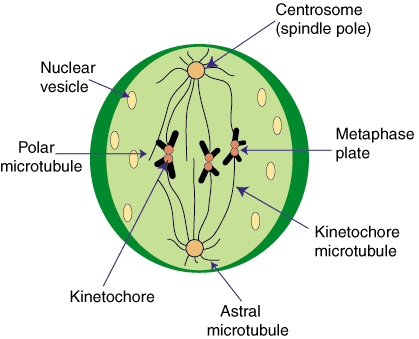
In Prometaphase, microtubules of the mitotic spindle reach toward the centromere of each chromosome, forming the kinetochore. During this period, we will also see the dissolution of the nuclear envelope. The nuclear lamina (intermediate filaments) and nuclear pores begin to dissociate.

During Metaphase, the chromosomes are aligned down the imaginary equitorial line of the cell. This line is equidistant between the centrioles. The alignment is important. If you look at most drawings, the chromosomes are shown as aligning so that their centromeres are on the equitorial line, and individual chromatids are on either side of the line. This is to represent an equitorial division. As each sister chromatid of a chromosome represents a complete DNA molecule, the division of these will result in an equal number of chromosomes on either side of the equitorial line. So, a cell with 46 molecuels of DNA (chromosomes) will produce two dauther nuclei (and then cells) with 46 molecules of DNA (chromosomes). They will be genetically identical.

Beyond showing the arrangment of chromosomes, the image above also shows the different types of microtubules: Kinetochore, Polar and Aster. Aster, meaning star (Greek), comes from the starlike appearance of these microtubules. This starlike arrangment is also seen in the plant genus Aster, which is noted for the radial startlike flower petals. Note: they are sometimes referred to as Astral microtubules (Astral is an English adjetive derived from Aster).

AnaphaseOnce the chromsomes have been arranged, they can be seperated. Anaphase is when there is visible seperation of the chromosomes into daughter chromatids. This link to an Anaphase Image is an excellent reference for what occurs in Anaphase (remember that you have motors that can move down microtubules). The image to the image to the right is a good quick visual of what starts to happen: the seperatation of chromatid. NOTE: At this point, there is no more chromosome; all we have left are the daughter chromatids. It is not uncommon though for people to start referring to these chomatids as chromosomes. As this can lead to a great deal of confusion, I want you to remember that at the end of anaphase we have daugter chromatids, not chromosomes.
Telophase

During Telophase, the cell returns to normal interphase operation. The kinetochore microtubules will be released and begin to dissociate. The nuclear envelope will reform as the nuclear lamella (intermediate filaments) begin to reassociate. Once the protection of the nuclear envelope is reestablished, the DNA will be released from the supercoiled packing that produced the chromatids and chromosomes. As this process continues, cytokinesis can begin.Cytokinesis
Remember, cytokinesis, or the division of the cell, does not have to take place after mitosis. For the vast majority of cells, mitosis and cytokinesis are coupled processes, but not all eukaryotes undergo cytokinesis. In animal cells, the act of cytokinesis is directed by the cytoskeleton, which causes the membrane to be pulled toward the center (remember the location of those polar microtubules?). As the membrane is dynamic, when pulled together, the phospholipid bilayers will "snap" together, or fuse, resulting in a seperation of the membranes.
Plant Cytokinesis
Plants and fungi, which posses cell walls, experience cytokinesis in a dramatically different way. Prior to division, the plant cell will have made numerous vesicles that contain the raw materials needed to create cell walls. These materials are held in an inert state, with inactive enzymes needed to form these materials into walls. As telophase begins, these vesicles begin to line up down the equator of the cell, and begin to fuse (what do you think triggers this action? will it trigger the enzymes?). As the vesicles fuse, cell walls begin to form. As more vesicles fuse (remember the membrane is dynamic), the wall continues to grow (cell plate). Eventually the membrane surrounded wall will fuse with the parental cell wall. Once the cell plate fuses with the parental wall, you have two new daughter cells.
PlasmodesmataNOTE: Plant cell walls are generally impervious to water flow. As a by-product of plant cytokinesis, and the development of the cell plate, you will find holes between the two new daughter cells. Known as plasmodesmata, these membrane lined holes allow for a continuous cytoplasm between cells. This allows for rapid movement of water and nutrients (including plant hormones) between cells (Symplastic Flow).


Study Note

You will notice that above I gave you a number of links. Do you think that they are important for your overall understanding of this topic?

Remember This: The following phrase will help you as we move through genetics. Remember it!

"Base complementarity is the foundation of all genetic processes."

Daily Challenge


Describe the process of mitosis in your own words. Feel free to use images, just reference where you got the image. Remember that this leads to your milestone paper and exam, spend some time to build a personal description of mitosis.

Monday, October 28, 2013

Daily Newsletter October 28, 2013 - The Cell Cycle

Daily Newsletter

October 28, 2013 - The Cell Cycle


Reading:

The Eukaryotic Cell Cycle
This is an excellent overview of the cell cycle. This is considered supplemental to what is in your textbook.


The cell cycle describes the life stages of a cell. It starts just after cytokinesis, and continues until the next cytokinetic (or mitotic) event. The period when a cell is growing between division events is known as interphase.

Cell CycleInterphase is divided into three distinct steps: G1 Phase, S Phase, and G2 Phase.

The G1 Phase stands for Gap 1 Phase, and begins just after cytokinesis. Gap refers to no visible change in the cell. Another good term for G is growth, and that is usually what happens during this phase. The cell is building primary products, compounds such as amino acids, phospholipids, carbohydrates, triglycerides. These are describe as primary products as they are the cellular biochemicals needed to increase the cells size (biomass). Thus we generally consider the G1 phase as the timethe cell increases in size. Another way to say this is that a major goal in this phase is the development of biomass.
[NOTE: In multicellular organisms, some cells will stop mitosis. They are locked in what is known as the G0 phase. The G0 phase is similar to the G1 Phase, but the cell will never level leave this physiological stage. After reading this newletter, I want you to consider a question: Why would you stop in the G0 Phase if you were never going to replicate again?]

When the cell gets a signal to divide, the physiology of the cell changes. Metabolic pathways for creating deoxyribonucleotides are unlocked (dATP, dTTP, dGTP, dCTP). The cell will use these deoxyribonucleotides to synthesize DNA (Replication). The production of enzymes needed to replicate DNA will also be begin. (Think back to cell signaling).

During the S Phase, cellular metabolism is focused on DNA replication (S stands for DNA Synthesis). This is a complex event, takes time, and has consequences if there is an error; so most of the cell's work is dealing with DNA replication.

Once S Phase has begun, the cell has committed its self to the process of Nuclear Division and Cytokinesis. You never replicate DNA without moving toward Nuclear division, DNA replication without nuclear division usually results in cell termination.

After DNA replication, the cell needs to build all of the proteins and compounds used during Nuclear Division and Cytokinesis. This is the goal of the G2 Phase. The G2 Phase will continue until the required components are constructed, and the cell receives the signal to continue. At this point the cell moves into the M phase (which stands for either mitosis or meiosis).


Regulation

The processes of the cell cycle is tightly regulated.
What happens in unregulated or uncontrolled cell growth?

The regulation is based on Signals (yes, we're back to signals). To maintain homeostasis, an organism must replace certain cells during its life time. For instance, humans replace skin and mucous membranes constantly. Hormones, such as insulin-like growth factors, are signals used to make sure the body maintains its self by replacing cells.
CDK
Inside of cells, there is an internal signal system based on the protein family Cyclin Depdendent Kinases (CDK). Note, this is a family of proteins involved in cell cycle regulation (they also have a few other functions). As the name implies, the protein needs a Cyclin to function. For example, CDK2 requires Cyclin E during G1. (NOTE: Cyclinn is a family of protein signal molecules assoiated with the cell cycle).

CDKs are always produced in mitotically active cells. (What term do we use for a protein that is always produced?)
Cells don't always have Cyclin, but instead produce them in response to a signal. [Note: The signals differ depending on if you are dealing with multicellular, colonial or singal celled eukaryotes, so we are not going to get into specifics. As these control vital processes that could cause damage to cells, e.g., think cancer, they have a very complex signal transduction. Think of it this way, the cell has to have get numerous "permissions" before it starts producing Cyclin, so it is highly regulated. For the purpose of this class, we will just say that it is controlled by "Growth Factors".]

CDK Check PointsThroughout the cell cycle, there are time points referred to as Check Points. These check points are where regulation occurs. For example, to move from the G1 Phase to the S phase, you need to produce a set of cyclins to induce the activity of CDKs. The Cyclin-CDK complexes can then phosphorylate proteins. Why would you need to phosphorylate proteins?

During the G1 Phase, the check point determines if you turn on the production of deoxyribonucleotides and the production of replication complex enzymes. There are check points in the G1 Phase, S Phase, G2 Phase, and M Phase. Many of these check points are determinations of the health of the cell, or the correctness of DNA replication and chromosome condensation. The image to the right shows the major check points, as well as the cyclin needed to activate (Cyc D to make deoxyribonucleic acids and the replication complex, Cyce to start the S phase, Cyc A to make sure replication is occuring properly, Cyc B to make sure the cell is ready for mitosis). Note: the check point in mitosis (M phase) is not shown. The M phase check point is to ensure that chromosomes have properly condensed and migrated.
As you can tell, the check points are there to make sure that the process is occuring properly. Consider the Cyclin/CDK system as the Quality Assurance & Quality Control (QA/QC) officer of the cell.

Go Phase (in case you missed it the first time around)
Some cells become non-mitotic at a given point in development. For example, nerve cells stop dividing, as do cardiac muscle cells. When a cell becomes non-mitotic, it shifts from the G1 Phase to the Go Phase. The cell can be locked from mitosis by blocking the genes for either CDK or Cyclin.

Daily Challenge

In your own words, describe the cell cycle. Then answer the following question: How are CDKs related to cancer?

Optional Reading

If your really into the regulation of the cell cycle, try out this article:
Cyclins and Cell Cycle Regulation

Monday, October 21, 2013

Daily Newsletter: October 21, 2013 - DNA Replication

Site LogoDaily Newsletter

October 21, 2013 - DNA Replication


Textbooks have a tendency to make replication one of the most complext topics covered. With a tendency to throw all the current research and understanding at students, they rarely take a step back and try to explain it. This newsletters has two goals: 1) to help biology students understand DNA replication, and 2) to show you want is expected from a Biology Freshman/Sophmore.


Central Dogma of Biology
 Before we get into replication, let's take a step back and look at the three core genetic processes, a.k.a., the Central Dogma. The central dogma describes the flow of genetic information in a cell. The core idea is INFORMATION. You may recall some of our early discussion on DNA, and about base complimentarity and the directionality of the molecule. This will become important rather quickly, but for just this moment, I want you to concentrate on the fact that DNA carries information. Information on how to build RNA and Proteins, both of which will produce the phenotype (expression) of the cell. For this reason, DNA, RNA and Proteins are considered Informational Macromolecules. This means that the sequence of monomers contains infomation, e.g., instructions on how to build RNA and Proteins. Since it is critical, the sequence of nucleotides carries information.
As you can see from the diagram of central metabolism shown above, there are three processes: Replication, Transcription and Translation. Think about those words. They are words used in reference to languages and documents. When you replicate a docuement, you want to ensure that you are getting a faithful (or even exact) copy of the original.

When you transcribe, you are moving from one medium, e.g., spoken word, to another medium, e.g., text. If you watch news shows, they will tell you that transcripts of the show are available. Court reports make transcripts of the trial. You are taking the language from one medium (in our case DNA) to another medium (RNA). The language is still the same (i.e., nucleic acid lanugae), just in a different form. Does the transcript have to be 100% correct? You want it to be, but it is not as exacting as a replication.
Translation is where you change languages. Unless you're fluent in another language, you will need somoene to help translate, or at least a good translation dictionary. Now you are moving the context from one language (nucleic acid) to another language (amino acids).

All of these processes rely on one key feature of nucleic acids: BASE COMPLIMENTARITY. In DNA: A complements T, and G complements C. In RNA: U complements A, and G still complements C.

Replication

In replication our goal is to take one molecule of DNA and make two daughter molecules of DNA that are identical to the first. Even the best replication processes can produce errors, but our goal is to be error free. This takes precision! As DNA is long, we also need this to be a fast process.

The enzyme that is ultimately responsible for replication is DNA Polymerase. [NOTE: there are multiple types of DNA Polymerase, but for now you just need to understand the core concept common to the DNA Polymerase family.] DNA polymerase is only one component of the Replication Complex, which is a complex association of proteins needed to successfully complete the replication event. Your goal at this time is to concentrate on DNA polymerase; we will talk about some of the other components later.
DNADNA is a double stranded molecule, in which the strands are anti-parallel. This means that one strand starts at the 5' end 3' end, while the the other strand is revered. This can be seen in the image to the right. A common way of saying this is that we read DNA in the 3' 5' direction. Why is this important? DNA Polymerase can only read DNA in the 3' 5' direction, and can only build a new strand in the 5' 3' direction. Before we go on, let's look another time at how deoxyribonucleotides are polymerized.

DNA Polymerization
To the left you will see a generic image showing DNA Polymerase adding nucleotides to a growing DNA strand. Look carefully: A deoxyribonucleotide triphosphate (dTTP) is being added. The 5' phosphate of the new nucleotide is what will be used to form the phosphodiester bond. DNA Polymerase requires a free 3' end on which to grow the new DNA strand. To the right is another image that will help you with this concept.Phosphodiester Bond Formation At this point, the critical thing to remember is that DNA Polymerase will need a free 3' end on which to add a new nucleotide.
This requirement to build in only one direction (5' 3') creates a problem for the DNA process: the two strands read in opposite directions, and each must be replicated. It was noticed that one strand appears to replicate continuously, while the opposite strand appears to replicate discontinuously.

The original strand that reads 5' 3' can be used by DNA polymerase to continuously produce the new 5' 3' strand (the antiparallel complement to the original strand). We refer to the continuous synthesis strand as the Leading Strand. The other original strand, which read 3' 5' cannot be copied continuously. A section will have to be exposed, replicated, and then another section exposed. This strand is constructed discontinuously, and is reffered to as the Lagging Strand.DNA ReplicationThe image above shows the leading and lagging strand. Notice that the leading strand is replicating toward the Replication Fork(where the original strands seperate). As more DNA unwinds and opens, DNA synthesis continues down the leading strand.
The lagging strand though has to build in a start-stop action, producing Okazaki fragments. These fragments have to be sealed (phosphodiester bonds) together before DNA can rewind into the α-helix.

In the image above, you will notice a number of enzymes on the lagging strand. These enzymes are required for the initiation of DNA polymerazation, and then sealing the fragments. Looking at the image, you will see an enzyme called Primase, and a structure in red known as a Primer. Another restriction on DNA polymerase is that it must have a free 3' end from which to start building. DNA Polymerase is prevented from building a DNA strand from nothing. Something (a primer) must be in place upon which DNA polymerase can build. The Primer is constructed from RNA, and is a temporary scaffold upon which DNA polymerase can start working.

Eventually the primer will need to be moved. This is where you need to learn a little more about DNA polymerase. There are multiple DNA polymerases in eukaryotic systems. The general work horse of replication is DNA Polymerase III (DNA pol III), which is used to make long strands of DNA. DNA Polymerase I (DNA pol I) is used to replace primers (it is also used in repair functions). Even after the RNA primer is replaced with DNA, there is still a gap between fragments. Ligase is the enzyme used to create a phosphodiester bond between fragments, thus sealing the new sugar-phosphate backbone of the synthesized strand.

The result of DNA replication is that one molecule one DNA was used to create two new molecules of DNA. The two strands of the original DNA molecule became the template from which to build new complimentary strands of DNA. This is referred to as semi-conservative replication, as each new molecule has one strand from the original molecule, and one freshly synthesized complimentary strand.

Daily Challenge

In your own words describe the purpose and process of replication.