Showing posts with label Heterotroph. Show all posts

Tuesday, February 4, 2014

BOLO Microbiology Daily Newsletter February 4, 2014 - Metabolism & Growth

Site LogoMicrobiology Daily Newsletter

February 4, 2014 - Metabolism & Growth


Metabolism and Growth are both essential characteristics of life, and are intimately related to each other.  You may recall that living systems require CHONPS (carbon, hydrogen, oxygen, nitrogen, phosphorous, and sulfur) to make biomolecules.  In addition, we need minerals, trace minerals, and energy in the form of reducing potential (i.e., electrons).  The acquisition of carbon and energy are the primary focus of central metabolism (glycolysis, citric acid cycle, etc...) and photosynthesis.  But what about the other needs?

Amino acids and nucleic acids both need nitrogen.  Nucleic acids need phosphorus in the form of phosphate groups.  Sulfur is needed to form disulfide bridges and a variety of thiols.  Phosphates become a prime regulator of protein function, and ions are needed to establish membrane potentials.  All of these are needed to increase the biomass (growth) of cells.

In looking at microorganisms you need to become accustomed to the metabolic needs and diversity of cells.  Though less than 1% of bacteria are culturable, these organisms have helped us understand the dynamic relationship between nutrition, metabolism and growth.  They have also provided researchers with known genes that can be used to understand potential functions from genetic analysis.

Today, your goal is to understand how variations in growth conditions can affect bacterial growth, both in terms of biomass accumulation and increases in population size (binary fission).


Heterotrophy vs Autotrophy 

These two terms describe the acquisition of carbon. Heterotrophy is used to describe organisms that rely on organic carbon as building block. Autotrophy describes organisms that have the ability to fix carbon dioxide into an organic compound (carbon fixation means adding a CO2 onto an existing organic carbon backbone; this makes the carbon biologically available).

Phototrophy vs Chemotrophy

These two terms describe the acquisition of energy in the form of reducing power.  Phototrophs have the ability to utilize photons to generate high energy electrons that can be used as reducing potential.  Chemotrophs utilize reduced compounds for reducing potential (i.e., energy).

The concept of chemotrophs can be further divided in to chemoorganotrophy, in which cells utilize reduced organic compounds for energy, and  chemolithotrophy, where cells utilize reduced inorganic compounds for energy.

Nitrogen

Molecular nitrogen is the most abundant gas in our atmosphere, but it is not very accessible by most biological organisms.  For nitrogen to become available, it needs to be reduced.  Atmospherically this is accomplished by electrical activity, but far more becomes available through biological means.  Nitrogen fixation is an important chemical pathway, and is the first step in the nitrogen cycle (the movement of nitrogen through ecosystems).  The diagram below provides an explanation of nitrogen fixation:
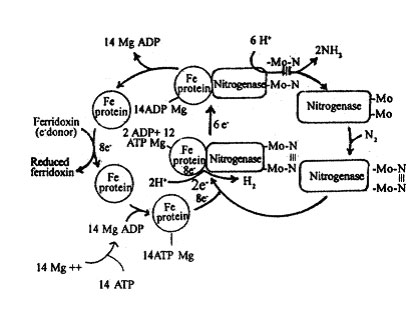
Plant Biotechnology Handbook by Niir Board.
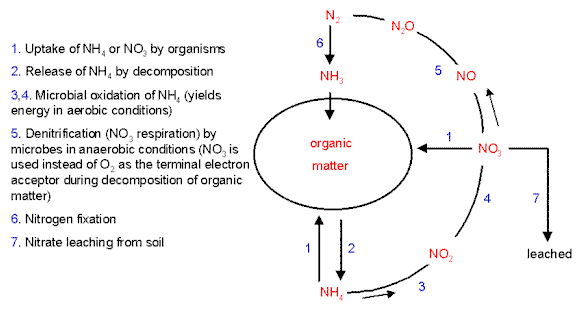
Note the amount of redox reactions needed, and the requirement for Mo (Molybdenum) as a cofactor for the enzyme nitrogenase (looking at the nitrogenase cycle, how is molybdenum used?).  Notice also that Magnesium (Mg) is also needed during the reduction of molecular nitrogen.  Nitrogen has a number of biologically active states:  including NH3, NH4, NO3, NO2, and NO.  The movement of nitrogen through living systems is shown in the diagram below:
Nitrogen fixation.http://archive.bio.ed.ac.uk/jdeacon/microbes/nitrogen.htm
Can humans use raw NH3?  How about bacteria?  Can all bacteria use NH3, or only some?  These questions come to the heart of today's topic.  All bacteria need nitrogen, but they differ in how they acquire nitrogen.  Some can only harvest nitrogen from organic compounds, while others can make use of some of these other compounds.  Bacteria also have to give off nitrogen as waste, but how do they do it?  We convert ammonia to urea, but do bacteria need to make urea?  This also brings up another point about living in a community of different types of bacteria:  the waste of one cell, may be the food for another cell.


Daily Challenge

What determines the metabolic diversity of a bacterial species?  What other conditions do you need to consider when growing bacteria?  How does central metabolism provide raw materials needed for growth?

Monday, January 27, 2014

BOLO Microbiology Daily Newsletter January 27, 2014 - Metabolism Basics

Site LogoMicrobiology Daily Newsletter

January 27, 2014 - Metabolism Basics


Daily Topic: Metabolism Basics
Metabolism is something all students should be familiar with by this point, especially the catabolic processes of gycolysis and citric acid cycles.  Today, as a preparation for the work this week, we will do some reflection and clarification on catabolic metabolic processes.

1.  What is the purpose of metabolism?  If you say to gain energy, you are only half right.  Catabolism is going to have two outcomes:  energy harvesting and production of precursor metabolites.

The processes of glycolysis and citric acid cycle are going to release energy in the form of reducing potential, and many cells are built to harvest that reducing potential.  But the chemical intermediates of the two processes are also critical for building biomolecules.  We call these two processes "central metabolism" because we can build nearly every biomolecule from the precursor metabolites produced.
Cells have to maintain a balance between energy and precursors.  This is one reason why cells never reach the theoretical maximum yield of ATP production.

2.  What is the energy we harvest from these processes?  If your answer is ATP, then you need to reconsider.  ATP does not equal energy to a cell.  ATP is used to phosphorylate structures.  The -2 charge of phosphate will change the electrochemistry of any molecule it attaches to, and in the case of proteins, will induce a change of shape (conformation).  What then is the energy of cells?  Reducing Potential.  Those electrons moved during redox reactions constitute the real energy harvested during glycolysis and citric acid cycle.  It is the reducing potential we will use in electron transport chains to a proton motive force (an electrochemical gradient of hydrogen ions).

In the eukaryotic mitochondria, this proton motive force will be used to make ATP, but not so in bacteria.  Bacterial proton motive force can be used for active transport and flagellar movement directly.  ATP will still be made, as you need the ability to phosphorylate compounds and proteins, but bacteria will make less ATP than eukaryotic mitochondria.

3.  Why does it take 10 steps to break glucose into pyruvate?  During each step of glycolysis, you are inducing minor molecular changes that induce stress in the molecule.  Through these molecular alterations, the cell carefully extracts energy.  If there was a large change, you risk destabilizing the molecule and releasing energy as heat, which is dangerous to the cell.  The cell needs a series of controlled reactions to capture the most energy.


Words of the Day:
There are four words that you need to know when dealing with metabolism.  The terms deal with how energy and carbon are acquired by a cell.

Energy Acquisition:  These terms deal with how the cell acquires reducing potential.
  •      Phototroph
    • The cell uses photons to raise the energy state of electrons.
    • The cell then transfers these electrons to electron carriers and carbon.
    • In essence, they produce reduced compounds from photons.
  •      Chemotroph
    • The cell uses reduced chemical compounds.
    • The term can be divided into two subcategories:
      • Chemolithotroph - use reduced inorganic compounds.
      • Chemoorganotroph - use reduced organic compounds.
Carbon Acquisition:  This is how the cell acquires carbon for the production of biomolecules.
  • Autotrophic
    • The cell has the ability to take Carbon Dioxide and reduce it to form glucose or another sugar.
    • The process is known as carbon fixation.
    • The cell provides the organic structures needed by the cell.
  • Heterotrophic
    • The cell uses organic structures (or reduced carbon) from external sources (e.g., glucose, amino acids, lipids).
    • These organic structures are converted to other biomolecules as needed.
Each organism is given a name based upon it's principle means of carbon and energy acquisition.  For example:

  • Photoautotroph
    • Photons used to raise energy states of carbon compounds.
    • Cell can fix carbon
  • Photoheterotroph
    • Photons used to raise energy states of carbon compounds.
    • Cells acquire organic structures from external sources.
  • Chemolithoautotroph
    • Reduced inorganic compounds primarily used for reducing potential.
    • The cell can fix carbon.
  • Chemoorganoheterotroph
    • Reduced organic compounds primarily used for reducing potential.
    • The cell acquires organic structures from external sources.


Daily Challenge:  Reflection
What do you remember of metabolism?  Describe what you remember.  Does the information in this newsletter place metabolism into a new perspective for you?  How?  Do you remember the terms listed above?  Describe what you remember.  How do these terms help us to classify cells?  Reflect on this statement:  That the metabolic function of a cell is the most important aspect of a cell.

Monday, October 1, 2012

Special Edition: October 1, 2012 - Week 7 Objectives (Energy Harvesting)

Site logoSpecial Edition

October 1, 2012 - Week 7 Objectives

(Energy Harvesting)


This week you will see a change in the weekly objectives. Throughout the semester, through Surveys, I have been asking you which topics you feel comfortable about and which ones you feel are important. At the end of the week we have revisited these topics. Now after your first exam and paper, I want you to start looking at the material and looking at what you think is important.

Don't worry, you won't be alone in this. Each week, there will be a forum for you to use to discuss the Learning Goals for the week. You will still receive a weekly update, but it is up to you to start talking about what you see as important. At the end of the week, I will combine the goals that you have selected into an end of the week review, similar to the ones you've seen before. To start you off, each week, there will be some opening discussions about the weekly topic.

Energy Harvesting

Organisms have two critical needs: Carbon and Energy. Carbon is the backbone of all organic, and hence biochemical, compounds. Energy is the capacity to do work. Cells will need other compounds, such as oxygen, hydrogen, nitrogen, phosphorus and sulfar (as well as many more), but carbon is the critical atom when building biopolymers. Biologists use terms to help identify ways of acquiring carbon and energy.

Carbon Acquisition: Heterotroph vs Autotroph

Heterotrophs acquire reduced carbon compounds, generally in the form of biomolecules. If the organism can use sugars, lipids and proteins as carbon sources, then they are heterotrophs.

Autotrophs have the ability to use oxidized carbon, usually from CO2. They have biochemical pathways that allow them to FIX carbon, that is reduce CO2.
Energy Acquisition: Chemotrophs vs. Phototrophs

Chemotrophs harvest energy from reduced compounds. Chemolithotrophs (Bacteria and Archaea) can use reduced minerals. Chemoorganotrophs (Archaea, Bacteria and Eukarya), harvest energy from reduced organic compounds.

Phototrophs can use light energy (photons) to excit special pigments, producing reducing potential. They can convert this into chemical bonds (chemical energy). In essence, they use light to produce reduced compounds.

This week, we will focus on organisms that follow the Chemoorganoheterotrophic life style; that means we are looking at organisms that acquire energy and carbon from reduced organic compounds.

These organisms will use biochemical pathways to extract energy, and the intermediate carbon compounds (precursor metabolites) can be used as building block of other biomolecules.

Your goal this week is to understand the reactions in the biochemical pathways. You do not have to memorize the pathways, but you need a good/strong familiarity with the pathways.

Learning Goals

Looking over the chapter, the information above, and at the newsletters throughout the week, what do you see as your learning goals for this week?
Link to Forum