Showing posts with label Signal Transduction. Show all posts

Wednesday, October 16, 2013

Daily Newsletter: September 21, 2012 - Signal Amplification

Daily Newsletter

September 21, 2012 - Signal Amplification


Resource

Signal Amplification - An animated tutorial produced by McGraw-Hill Publishing. (click on the link)
Secondary Messangers - A section from Cell Molecular Biology by Lodish H, Berk A, Zipursky SL, et al. (2000) from the National Center for Biotechnology Information's Bookshelf. (click on link)

Another important secondary messanger system is the IP3 (Inositol 1,4,5-triphosphate) pathway. A primary purpose of this pathway is to release Ca2+ that is stored in the Endoplasmic Reticulum. Ca2+ becomes an activator of various proteins. An interesting aspect of this system is that IP3 is derived from phosphatidylinositol 4,5-bisphosphate (PIP2), a phospholipid found in cell membranes. PLC cleavage of PIP2 to IP3 and DAG initiates intracellular calcium release and PKC activation. The system then uses a membrane component as the signal agent. The system also requires a second lipid component of the membrane known as diacylglycerol (DAG). To the right is a general schematic of the system from Wikipedia Commons.
 
Phospholipase C is the enzyme that converts PIP2 into IP3. It is also generally the signal receptor. IP3 is water soluble, and will bind to the IP3 receptor on the Endoplasmic Reticulum, opening CA2+ channels. Calcium ions are then able to activate Protein Kinase C with the help of DAG. At this point, we have phosphorylation of substrates (mainly other proteins).
The signal increases the presence of IP3 in the cell, which changes calcium ion concentrations in the cells. An increased [CA2+] provides a greater probability that Protein Kinase C will be activated, resulting in a physiological change to the cell.

Tuesday, October 15, 2013

Daily Newsletter: October 15, 2013 - Direct vs. Indirect Signals

Daily Newsletter

October 15, 2013 - Direct vs. Indirect Signals


Signal transduction involves a signal contacting an appropriate receptor which ellicits a cellular effect. The transduction is thus the changing of signal into an effect. Transduction can be either direct or indirect.
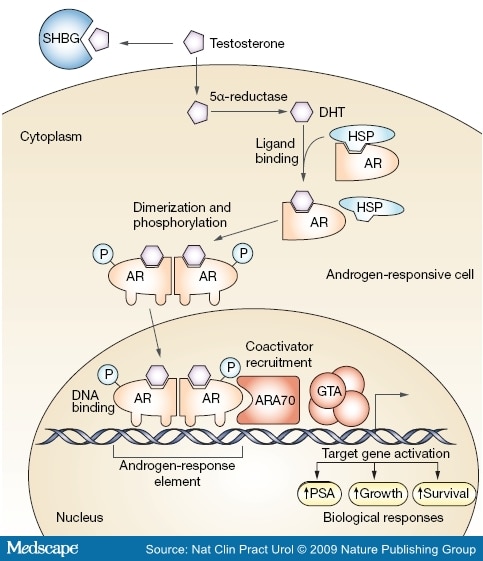
A direct transduction event implies that the receptor ellicits an immediate effect on the cell. A good example of this is the Androgen (Testosterone) Receptor. The image below is a good image of the basic signal transduction pathway. Testosterone is lipid soluble, so can easily move through the membrane. Once inside of the cell, it is changed to dihydroxytestosterone (DHT). This binds to the receptor, and then the receptor-ligand complex is moved into the nucleus. Inside of the nucleus it directly affects the transcription of genes. In this case, the receptor-ligand complex has a direct effect on the cell.

Indirect signal transduction will involve the creation of a secondary messanger. The receptor-ligand complex will create a condition where an intracellular chemical signal is created. One primary signal binding to the receptor can then be amplified within the cell by creating this secondary messanger. Below is a general diagram showing the use of a G-Protein interface. The Ligand-Receptor complex directly activates the G-Protein. The activated complex then activates a specific effector in the cell membrane.
Cartoon depicting the Heterotrimeric G-protein activation/deactivation cycle in the context of GPCR signaling


In the above image, there are four views of the Receptor-G-Protein complex. In the top image of the cycle, the Resting State, there is no ligand bound to the receptor. When the ligand binds (the next image in the cycle), GTP binds to the Gα subunit. This causes the Gα subunit to detach from the rest of the G-protein (Gβγ Subunit). The subunits then bind to Effectors.
A very prevelant effector enzyme is AdenylatAdenylate Cyclase actione Cyclase. This enzyme takes ATP (Adenosine Triphosphate) and removes two phosphates. The remaining phosphate binds back to the ribose sugar at the 3' carbon, creating a ring structure (cycle) between carbon 5' and 3'. This is known as cyclic AMP (cAMP). cAMP is a very common secondary messanger. It can be produced in bulk and can bind to a variety of enzymes.

A good example of a cAMP regulated protein is Protein Kinase A (PKA).  This is a cAMP Dependent Protein Kinase.  The function of this family of proteins varies depending upon the cell (i.e., the current proteome of the cell).  For example, in adipose tissues, PKA activates pathways for lipolysis (breakdown of triglycerides), while in skeletal myofibers (myocyte or muscle cell) you see activation of glycogenolysis (breakdown of glycogen), inhibition of glycogenosis (making of glycogen), and increased rates of glycolysis.

Why would phosphorylation affect protein activiation? Phosphates are large with a -2 charge. Binding a phosphate to a protein will force the protein to change shape (configurational change).
Below is an example of indirect signal transduction via a G-protein:


Epinephrine-stimulated cAMP synthesis

Here is another picture of the G-protein to help you visualize the process.


Daily Challenge

Using Testosterone and Epinephrine as examples, explain the difference between direct and indirect signal transduction


Here are a few videos to help you better understand the processes discussed. 


Monday, October 14, 2013

Daily Newsletter: October 14, 2013 - Basics of Cell Communication

Daily Newsletter

October 14, 2013 - Basics of Cell Communication


This week, we come to the end of building our mental picture of the fundamental unit of life: the cell.  What we have done up to now is look at the building blocks that make up cells: the phopholipid bilayer with all of the associated membrane proteins; how proteins are formed, and how they work; how cells acquire energy and carbon; and now, how they interact with their environment.

Cells must be able to sense their environment and respond to environmental stimuli.  The environment could be the intersitial fluid bathing the cells of your body, the moist soil around a plant root hair, or even the old cheese in your refrigerator that is now starting to mold.  Remember that all cells strive for homeostasis, and being able to respond to changes in the environment helps them to maintain and balance their dynamic metabolic equilibrium.

In order to maintain homeostasis, cell require some mechanism to receive environmental signals, and then process those signals into a response. All cells, prokaryotes and eukaryotes, have this ability. Beyond just responding to the environment, we now know that cells, even bacteria and archaea, possess the ability to signal each other. In multicellular organisms, we will talk about the coordination of metabolism and growth using chemical signals. In humans, from the embryo stage til death, cells are constantly talking to each other.

Signal reception occurs in all known organisms (from picking up environmental to cellular signals). For instance, in bacteria, we know of a signal phenomena known as Quorum Sensing. With this signal system, bacteria release chemicals as they grow which other individuals of the same species (and some times other species) pick up; when the concentration of the chemical reaches a critical point, cellular changes can be observed in the community. Basically, as the population increases, cells begin to change.

But how do cells pick up signals? Signal recognition begins with receptors (generally protein in nature; many are glycoproteins).

For a cell to pick up, or register, a signal, it must build a receptor for that signal.
(IMPORTANT NOTE: a cell that lacks a receptor for signal X can not register signal X; they are deaf to the signal). This sets up another question: what is a signal?

Most of the signals we will talk about are chemical signals (aka, Ligands), meaning we have a chemical compound that will "fit" a receptor, activating it. There are other signals though: light can be a signal (photoreception), temperature (thermoreception), and even mechanical such as touch (mechanoreception). As mentioned, out discussions for this week will focus on chemical signal pathways.
By far, the most common type of signal system will involve chemicals. Hormones are chemical signals, neurotransmitters are chemical signals, even carbon dioxide is used as chemical signal in the human body. Because there are so many different chemical signals, we have a generic word for any compound that could bind and activate a receptor protein: Ligand. As a general word, ligand is used when we discuss the basic concepts of signal systems. (NOTE: In biology we have a number of GENERIC words that are used in discussing basic pathways or models. Ligand is one of those terms).
At their most basic, a chemical signal system (or pathway) will be comprised of a Ligand and a Receptor. When a ligand binds to a receptor (ligand-receptor complex), the receptor changes shape (conformation), which elicits a physiological response in the cell. Remember: The receptor is based on a  protein, and when proteins change shape, they have an effect on the cell. So the basic signal system will be: Ligand binds to receptor, receptor changes shape, cellular response occurs. This is known as Signal Transduction.External reactions and internal reactions for signal transduction

Ligands are chemical signals, and receptors are based on proteins. The receptor is folded so that it forms a binding space (active or binding site*) where the ligand can dock and bind. A common thought is that every receptor has a specific ligand, and that nothing else binds to the receptor. A lovely fiction.

To the right is an image of the μ-Opioid receptor (μ is the Greek Letter Mu). μ-Opioid ReceptorThis receptor is found in human neural tissue, and provides analgesic effects and feelings of euphoria. It can also cause respiratory depression and reduced GI motility. The main ligands for this receptor are enkephalins and β-endorphin. Yes, this receptor set has two potential ligands. It also has a list of agonistic and antagonistic compounds that can bind to the receptor.

When we speak of receptors and ligands, we talk about the affinity of the receptor for a particular ligand. Remember, we have folded the protein to create a 3-D shape. In the case of the μ-Opioid receptor, the folded protein has a notch where the ligand can slip in. This notch will have chemical properties complementary to the ligand.

A high affinity would imply that the physical shape and chemical properties of the notch are a good match to a given ligand. In this case, beta-endorphin is a strong chemical and physical match to the binding site (notch) of the μ-Opioid receptor. Dynorphins, which are another type of neurotransmitter (ligand) in the brain, have a low affinity for the μ-Opioid receptor's binding site, meaning the shape and chemical properties are not a good match.

This sets up another aspect of receptors: agonists and antagonists. These terms represent chemical mimics of the natural ligand(s) of a given receptor. Agonists are chemical mimics that bind to a receptor and trigger a cellular response; in other words they work like the ligand. Antagonists on the other hand are chemical mimics that bind to a receptor and block a cellular response. Active and inactive μ-opioid receptors.In fact, antagonists can stay bound and prevent activation of the receptor. A well known agonist for μ-Opioid receptor is morphine. Morphine can bind to the μ-Opioid receptor and active the cellular response that leads to analgesic effects, feelings of euphoria and respiratory depression. To the left is an image depicting agonistic and antagonistic bindings possible with the μ-Opioid receptor. NOTE: The agonist relationship implies an activation of the cellular response, while the antagonistic relationship implies an inactivation of the cellular response.

Morphine is a powerful analgesic with many well known side effects. One of the most dangerous of these side effects is physical addiction and an increased tolerance for the drug (you need more and more to get the same effect over time). This provides a good example of another principle of receptors: Regulation.

Down Regulation: When a cell receives too much signal, it will begin to down regulate the receptors. This means that the cell stops producing the quantity of the specific receptor it usually makes. For membrane bound receptors, over time, as the membrane is repaired and refurbished (a constant dynamic process), the number of expressed receptors drops. The result is that the cell is less sensitive to the signal. Why does a cell do this? Think of it as a person being exposed to loud noises. If it happens once, for a short period of time, the body can compensate. What if the person is continuously exposed to the loud noise? Eventually they become less sensitive to sound, i.e., they become functionally deaf. The same thing is happening to a cell that is overexposed to a ligand. To protect themselves, they produce less and less of the given receptor. In some cases this becomes an irreversible loss of the receptor from the cell. In the case of the μ-Opioid receptor, your body produces only small temporary doses of β-endorphin. With morphine, you have a large dose, and it is usually for a long duration. The longer the duration (over a week), the more likely you will have desensitization (down regulation) of the receptors.

Up Regulation: The reverse of down regulation is up regulation. If a cell is not getting enough signal, it will start building more receptors. In this case, there is a deficency in the amount of the ligand preset. The cell is compensating by building more receptors.

Both Down Regulation and Up Regulation are examples of Negative Feedback.
*NOTE: Receptors and Enzymes are both proteins. They both have a site where a ligand (receptor) or substrate (enzyme) can bind. As with receptors, we will see that enzymes have an affinity for their substrate, and like receptors, other chemicals can bind into the enzyme. In addition, like ligand-receptor, when a substrate binds into an enzyme, the enzyme will change shape.

Words of the Day: Paracrine & Autocrine

Prepare definitions for these two words and put them in your notes.

Daily Challenge

Below is a diagram of the Insulin Receptor and Signal Transduction. Review the image and information in your text, then write a forum post describing the nature of the Ligand and Receptor, and how a signal can change the physiology (active metabolic pathways) of a cell.
Effect of insulin on glucose uptake and metabolism.

Friday, September 21, 2012

Site logoDaily Newsletter

September 21, 2012 - Signal Amplification


Resource

Signal Amplification - An animated tutorial produced by McGraw-Hill Publishing. (click on the link)
Secondary Messangers - A section from Cell Molecular Biology by Lodish H, Berk A, Zipursky SL, et al. (2000) from the National Center for Biotechnology Information's Bookshelf. (click on link)

Another important secondary messanger system is the IP3 (Inositol 1,4,5-triphosphate) pathway. A primary purpose of this pathway is to release Ca2+ that is stored in the Endoplasmic Reticulum. Ca2+ becomes an activator of various proteins. An interesting aspect of this system is that IP3 is derived from phosphatidylinositol 4,5-bisphosphate (PIP2), a phospholipid found in cell membranes. PLC cleavage of PIP2 to IP3 and DAG initiates intracellular calcium release and PKC activation. The system then uses a membrane component as the signal agent. The system also requires a second lipid component of the membrane known as diacylglycerol (DAG). To the right is a general schematic of the system from Wikipedia Commons.
 
Phospholipase C is the enzyme that converts PIP2 into IP3. It is also generally the signal receptor. IP3 is water soluble, and will bind to the IP3 receptor on the Endoplasmic Reticulum, opening CA2+ channels. Calcium ions are then able to activate Protein Kinase C with the help of DAG. At this point, we have phosphorylation of substrates (mainly other proteins).
The signal increases the presence of IP3 in the cell, which changes calcium ion concentrations in the cells. An increased [CA2+] provides a greater probability that Protein Kinase C will be activated, resulting in a physiological change to the cell.

Daily Challenge

Explain the concept of signal amplification either using cAMP or IP3 as your example system.
Link to Forum
Link to Optional Challenge: September 20, 2012 - Lecture Review Forum

Thursday, September 20, 2012

Daily Newsletter: September 20, 2012 - Direct vs. Indirect Signals

sDaily Newsletter

September 20, 2012 Direct vs. Indirect Signals


Signal transduction involves a signal contacting an appropriate receptor which ellicits a cellular effect. The transduction is thus the changing of signal into an effect. Transduction can be either direct or indirect.
A direct transduction event implies that the receptor ellicits an immediate effect on the cell. A good example of this is the Androgen (Testosterone) Receptor. The image below is a good image of the basic signal transduction pathway. Testosterone is lipid soluble, so can easily move through the membrane. Once inside of the cell, it is changed to dihydroxytestosterone (DHT). This binds to the receptor, and then the receptor-ligand complex is moved into the nucleus. Inside of the nucleus it directly affects the transcription of genes. In this case, the receptor-ligand complex has a direct effect on the cell.androgen receptor
Indirect signal transduction will involve the creation of a secondary messanger. The receptor-ligand complex will create a condition where an intracellular chemical signal is created. One primary signal binding to the receptor can then be amplified within the cell by creating this secondary messanger. Below is a general diagram showing the use of a G-Protein interface. The Ligand-Receptor complex directly activates the G-Protein. The activated complex then activates a specific effector in the cell membrane.
Cartoon depicting the Heterotrimeric G-protein activation/deactivation cycle in the context of GPCR signaling
In the above image, there are four views of the Receptor-G-Protein complex. In the top image of the cycle, the Resting State, there is no ligand bound to the receptor. When the ligand binds (the next image in the cycle), GTP binds to the Gα subunit. This causes the Gα subunit to detach from the rest of the G-protein (Gβγ Subunit). The subunits then bind to Effectors.
A very prevelant effector enzyme is AdenylatAdenylate Cyclase actione Cyclase. This enzyme takes ATP (Adenosine Triphosphate) and removes two phosphates. The remaining phosphate binds back to the ribose sugar at the 3' carbon, creating a ring structure (cycle) between carbon 5' and 3'. This is known as cyclic AMP (cAMP). cAMP is a very common secondary messanger. It can be produced in bulk and can bind to a variety of enzymes. Many kinases (enzymes that add phosphates to other proteins, aka phosphorylation) are activated/deactivated by cAMP. So eukaryotic cells use this system to amplify the original signal to produce a large number of cAMP in order to affect protein activiation.
Why would phosphorylation affect protein activiation? Phosphates are large with a -2 charge. Binding a phosphate to a protein will force the protein to change shape (configurational change).
Below is an example of indirect signal transduction via a G-protein:
Epinephrine-stimulated cAMP synthesis

Daily Challenge

Using Testosterone and Epinephrine as examples, explain the difference between direct and indirect signal transduction
Link to Forum

Reference

The image of Epinephrine stimulated cAMP synthesis comes from Encyclopedia Britanica.
Encyclopedia Britanica. (2008). Epinephrine-stimulated cAMP synthesis. Encyclopedia Britanica, http://www.britannica.com/EBchecked/topic/1522055/G-protein-coupled-receptor-GPCR?overlay=true&assemblyId=124084, accessed September 12, 2012.
Other images are from Wikipedia Commons with the full reference embedded as a pop-out, or have the reference shown in the image.

Wednesday, September 19, 2012

Daily Newsletter: September 18, 2012 - Basics of Cell Communication

Site logoDaily Newsletter

September 18, 2012 Basics of Cell Communication


Cells must be able to sense their environment, and respond to environmental stimuli. Cells must have some mechanism to receive environmental signals, and process those signals into a response. All cells, prokaryotes and eukaryotes have this ability. Beyond just responding to the environment, we now know that cells, even bacteria and archaea, possess the ability to signal each other. In multicellular organisms, we will talk about the coordination of metabolism and growth using chemical signals. In humans, from the embryo stage til death, are cells are constantly talking to each other.
Signal reception occurs in all known organisms (from picking up environmental to cellular signals). For instance, in bacteria, we know of a signal phenomena known as Quorum Sensing. With this signal system, bacteria release chemicals as they grow which other individuals of the same species (and some times other species) pick up; when the concentration of the chemical reaches a critical point, cellular changes can be observed in the community. Basically, as the population increases, cells begin to change.
But how do cells pick up signals? Signal recognition begins with protein receptors. For a cell to pick up, or register, a signal, it must build a receptor for that signal. (IMPORTANT NOTE: a cell that lacks a receptor for signal X can not register signal X; they are deaf to the signal). This sets up another question: what is a signal?
Most of the signals we will talk about are chemical signals (aka, Ligands), meaning we have a chemical compound that will "fit" a receptor, activating it. There are other signals though: light can be a signal (photoreception), temperature (thermoreception), and even mechanical such as touch (mechanoreception). As mentioned, out discussions for this week will focus on chemical signal pathways.
By far, the most common type of signal system will involve chemicals. Hormones are chemical signals, neurotransmitters are chemical signals, even carbon dioxide is used as chemical signal in the human body. Because there are so many different chemical signals, we have a generic word for any compound that could bind and activate a receptor protein: Ligand. As a general word, ligand is used when we discuss the basic concepts of signal systems. (NOTE: In biology we have a number of GENERIC words that are used in discussing basic pathways or models. Ligand is one of those terms).
At their most basic, a chemical signal system (or pathway) will be comprised of a Ligand and a Receptor. When a ligand binds to a receptor (ligand-receptor complex), the receptor changes shape (conformation), which elicits a physiological response in the cell. Remember: The receptor is a protein, and when proteins change shape, they have an effect on the cell. So the basic signal system will be: Ligand binds to receptor, receptor changes shape, cellular response occurs. This is known as Signal Transduction.External reactions and internal reactions for signal transduction

Words of the Day: Paracrine & Autocrine

Prepare definitions for these two words and put them in your notes.

Daily Challenge

Below is a diagram of the Insulin Receptor and Signal Transduction. Review the image and information in your text, then write a forum post describing the nature of the Ligand and Receptor, and then the effects on the cell.
LINK TO FORUM
Effect of insulin on glucose uptake and metabolism.