Showing posts with label Photosynthesis. Show all posts

Friday, October 11, 2013

Daily Newsletter: October 11, 2013 - Light Dependent Reactions


Daily Newsletter

October 11, 2013 -  Light Dependent Reactions


We have looked at the harvesting of electrons by phototrophs (specifically in cyanobacteria and chloroplasts).  You will recall the image to the right. It shows the two photosystems, and the generation of NADPH and ATP.
Thylakoid Membrane
Recall the two photosystems are based upon pigment reaction centers.

The chloroplast of the the plant has two know Photosystems: P680 (Photosystem II) and P700 (Photosystem I).
  • Photosystem II
    • Used to Generate ATP (chemiosmosis)
    • Water is split to recharge the P680 reaction center with electrons and hydrogens.
    • Donates electrons to Photosystem I
  • Photosystem I
    • Can operate either Cyclic or Non-Cyclic
    • Non-Cyclic
      • Excited electrons are given to NADP+
      • Electrons accepted from Photosystem I to recharge the P700 reaction center.
    • Cyclic
      • Excited electrons are used to make ATP (chemiosmosis)
      • Electrons are returned to Photosystem I (recycled) to recharge P700 reaction center.
Remember: The photosystems are complex arrangements of chlorophyll pigments found in the thylakoid membrane. When electrons are used to make ATP, the electrons will be passed between electron carriers that act as proton pumps. The electrons are used to build and maintain a proton motive force, which will directly be used to make ATP. So all electron movement is occurring due to electron carriers in the membrane.
Now, what does all this mean for a plant? Throughout, we have talked about absorbance, but what is it? Simply put, absorbance describes the amount of light (photons) that is intercepted (absorbed) by the pigment. Each pigment has an absorbance spectrum, which is the wavelengths of light that the pigment can absorb.


Absorbance Spectrum Chlorophyll A and B To the right you will see the absorbance spectra of chlorphyll A and chlorophyll B. Both of these pigments are chlorophyll, thus we see them as green (but different shades of green). Each has a slightly different absorbance maximum; that would be the peaks on the graph (note the Y-axis is absorbance). So, Chlorophyll A absorbs strongly at 410nm, 430nm and 662nm, but best at 430 nm. Chlorophyll B absorbs best at 453. But there are more than just two pigments found in plants (and other photosynthetic organisms.

Plant Pigments AbsorptionThe graph to the left shows more pigements. Five pigments in all are shown. Notice that some, such as phycoerythrin and phyocyanin have absorption maxima at 550 and 610 respectively. Phycoerytrhin appears to the human eye as red (erythrin = red) and Phycocyanin is light blue (cyanin = blue). Carotene is characteristically orange. All of these, and more, can be found in plants. Why would a plant have so many different pigments?

To absorb as much light as possible. That is the #1 best answer!

Through evolution, plants have also mixed different pigments for other purposes, such as floral color attracting pollinators. For example, did you know that some flowers have UV pigments? Look at this image of the evening primrose. Evening PrimroseTo the left is what humans see, a full yellow flower; but under UV light, there is a large bullseye in the center. Insects see the bullseye, not the yellow flower. So pigments can be multipurpose.


Plants, and most other photosynthetic organisms, maintain multiple pigments to harvest as much light as they can. The ratio of pigments establishes the Action Spectrum of the plant, the wavelengths of light where they will have the highest yields of NADPH and ATP. This ratio of pigments will also produce distinctive colors. Are all plants green? Coleus Have you seen any shaded yellow? How about plants that have leaves with multiple colors? Here is a good example with Coleus. As you can see, there are different leaf coloration. Each variety would have different action spectrum, as each have a different pigment ratio. Why do you think plants would need different action spectrum? (Think survival strategy).

Consider a forest: You have a canopy of tall trees, then some intermediate sized trees and shrubs, then ground plants. Do shade plants have action spectra that differ from those of the canopy? Consider a plant that is being "shaded"; what does it mean to be "shaded"? You still get light, but is the light the same full spectrum light that the canopy is getting?

 
Going deeper into chloroplasts and the ancestral cyanobacteria, we find that there are distinct linages of chloroplasts.  Each lineage has different primary pigments, but you can find the biosynthetic pathways for all pigments in the cyanobacteria.  Below is a table published on the Wikipedia page for Chloroplasts.  The author of the image did an amazing job representing the various chloroplast lineages and demonstrating the pigments found in each lineage.  A clever point here is that the image author used the color reflected by the pigment (related to absorbance spectrum) and the organism (action spectrum) to provide a visual reference.  Make note that all the pigments can be found in cyanobacteria.


Daily Challenge

In your own words, discuss the concepts of absorbance spectrum and action spectrum. Show how they are related concepts, but describe different aspects of light absorption. Make sure you address the following questions:
  • Why do phototrophs need so many different pigments?
  • What does a single phototroph need more than one?
  • What is the difference between land plants and red algae that would have them being successful with different pigments?

Wednesday, October 9, 2013

Daily Newsletter: October 9, 2013 - Harvesting Photons

Daily Newsletter

October 9, 2013 Harvesting Photons


In photosynthesis, the cell will generate reducing power by using a photon to excite an electron. You will recall from chemistry that that electron excitation occurs when an electron jumps to a higher energy state (a higher shell).

Photoexciation is one of the principle ways to excite an electron, and we can do this in a modern lab fairly easily. In nature though, you require a structure that can "focus" the photon's energy. Chlorophyll provides such a structure. As a pigment, the structure of chlorophyll is built to absorb specific wavelengths of light, and then excite a set of electrons.
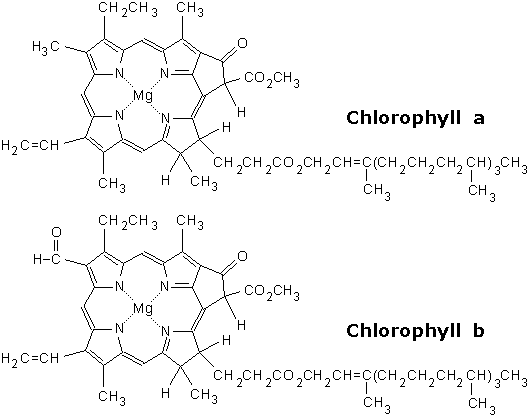
Note that at the center of the chlorin ring (the organic ring structure) is a Magnesium ion, which can be considered the focal point of the photoexciation. Remember our discussions about the respiratory chain, specifically NADH dehydrogenase? Fe-S complexes were used for redox reactions with the protein. Magnesium, like iron, can easily go through redox reactions. As a point of reference, visualize the photon exciting the magnesium ion.

Chlorphylls are arranged in systems, and once photoexcitation has occurred, the energy is transferred by resonant energy transfer to a Reaction Center.
Resonant energy transfer? What's that?
This is a concept from quantum physics. It describes how energy is transferred between chromophores (e.g., Chlorophyll). One chromophore is struck by a photon and is excited. Instead of giving off light (i.e., fluorescence), the chromophore transfers the energy to a neighboring chromophore (if you are curious, this occurs through dipole-dipole coupling). As with any energy transfer, the 2nd law of thermodynamics applies. The amount of energy lost is inversely proportional to the distance between chromophores (it is very energy efficient between close neighbors). The important thing to remember here: we don't move electrons, we just transfer energy. This is possible due to the structure of the chromophores (i.e., pigments).

Energy is passed between chromophores in an antennae complex toward a reaction center. The reaction center is formed by a pair of chlorophyll molecules, and is chemically active, i.e., the reaction center can undergo redox reactions. There are two specific reaction centers known in plants, the P680 and P700. These names refer to the maximum red absorbance wavelength for these two molecules. The P680 reaction center is found Photosystem II, while P 700 is found in Photosystem I. (Photosystem is the name given to a reaction center and the associated electron transport chain. The naming is historic: Photosystem I was found before Photosystem II).


The reaction centers gather the energy absorbed by the surrounding chlorophyll. These reaction centers then undergo a charge separation, which is a form of redox reaction that donates high energy electrons to a waiting quinone. The image below is of photosystem II.

There are a few important points in this image:
1) Notice in the center there is a group f structures with the code Pheo. This represents a Phenophytin, which is a chlorophyll without the magnesium in the center.
The paired chlorophylls become a paired phenophytin. This change (loss of the magnesium) is a where the absorbed energy is converted to a redox potential. The energy is handed off to a quinone (Q).
You will recall ubiquinone, which we saw in the eukaryotic respiratory chain. Ubiquinone was a type of quinone. So this is a hydropobic mobile electron carrier (i.e., it can travel in the lipid portion of a phospholipid bilayer). The quinones take the harvested reducing potential to electron carriers for processing.

2) Notice that the reduction of the quinone requires Fe. Recall that Fe-S complexes were used in the respiratory chain for redox reactions. Iron is again used to help faciliate redox reactions.

3) Photosystem II has a way to recharge the system with electrons and hydrogen. The reaction center of photosystem II has hydrolytic ability; it can break water. The hydrogens, and their electrons, join photosystem II, recharging the reaction center (they convert pheophytin back to chlorophyll). In the process, they release oxygen (O2).

This is critical: the individual pigments do not undergo redox reaction; instead they transfer energy to neighboring chromophores (i.e., pigments). The reaction center undergoes redox reactions, passing electrons to ubiquinone. The reaction center lost electrons, and must replace these electrons. Photosystem II handles this replacement by using H2O. (Connection: H2O was created due to the reduction of the final electron acceptor O2. Now H2O is used to replace the missing electrons in the P680 reaction center, and O2 is given off).

The harvested electrons will be used to either make ATP (chemiosmosis) or to reduce NADP+ to NADPH + H+.

NOTE: Photosynthesis uses Nicotinamide Adenine Dnucolotide Phosphate. NAD+ is used in catabolic reactions, while NADP+ is found in anabolic reactions.

Photosystem II & I - Non-cyclic

Photosystem II

Daily Challenge

Explain in your own words how photon energy is harvested and converted into reducing power. Include in your discussion a description of the above electron transport system involved in producing NADPH + H+ and ATP.

Monday, October 7, 2013

Daily Newsletter: October 07, 2013 - Introduction to Photosynthesis

Daily Newsletter

October 07, 2013 Introduction to Photosynthesis


For this discussion, we will focus on Photosynthesis in eukaryotes, specifically in the chloroplast.

Chloroplast

Like the mitochondria, the chloroplast is an endosymbiont.  The cyanobacteria (photosynthetic bacteria) is the prokaryotic relative of the modern chloroplast.  The cyanobacteria became an endosymbiont after the formation of the mitochondria (remember, all eukaryotes carry mitochondria (or at least mitochondrial DNA), but only photosynthetic eukaryotes have chloroplasts).  There are different lineages of chloroplasts, just as there are different lineages of mitochondria.  NOTE:  Cyanobacteria is a phyllum of bacteria.  The chloroplast is considered a part of that phyllum.

Figure 1: The Chloroplast - http://en.wikipedia.org/wiki/File:Chloroplast_II.svg
The structure of the chloroplast has been maximized for photosynthesis. As can be seen in the image to the right (figure 1), you have an organelle that is composed of multiple membrane compartments.

The outer chloroplast membrane is eukaryotic in nature, while the inner membrane is bacterial in origin and composition.  In some plants, there is even a peptidoglycan cell wall (bacterial cell wall) between the outer and inner membrane.

Inside of the inner membrane, the chloroplast can be divided into the Stroma and the Thylakoid Membranes.

The stroma is the fluid filled inner compartment of the chloroplast, while the thylakoid membrane is an internal membrane that specializes in the harvesting light (photons) and converting the energy into reducing power.The thylakoid membrane is divided into two main types:  Stromal Thylakoids (aka Lamellae or Frets) and Granal Thylakoids.  The granal yhylakoids make up the stacks of thylakoids known as Granum, while the stromal thylakoids create supporting structure.  The entire system of thylakoid membranes is suspended inside of the stroma.

The thylakoid membrane system has its origin in the Cyanobacteria (see figure 2).  The cyanobacteria are one of the bacterial groups able to create internal membranes.  They form Photosynthetic Lamellae, which are the precursors to the thylakoid membrane. This lamellae provides an increased surface area for pigments (phycobilisomes).  This increases the chance that a photon will strike a pigment in the correct orientation.  If it were not for the increased surface area, the bacterium would have very little energy to carry out carbon fixation.  (Remember:  To get enough energy, a phototroph needs an increased surface area).

Figure 2: Cross-Section Structure of Cyanobacteria-http://images.tutorvista.com/content/kingdoms-living-world/cyanobacteria-cell-structure.jpeg

Photosynthesis

Photosynthesis is divided into two stages:  the Light Dependent Reactions and the Calvin Cycle (aka Light Independent or Dark reactions).

The light dependent reactions involve the pigments (photosystems) and proteins of the thylakoid membranes.  Within the system of thylakoid membranes, NADPH + H+ and ATP will be produced.  You will see the formation of a proton motor force, which will be used to make ATP.  Note that we are not using NAD+, but instead NADP+.  As a generality, NAD+is the electron carrier used in catabolic reactions, while NADP+ is the electron carrier used in anabolic reactions (why?  does it have to do with the enzymes being used?).

The energy (reducing power and ATP) created during the Light Dependent Reactions will be used in the Calvin Cycle to reduce carbon compounds, with the end result being the production of glucose. In your studies of biology, you may have seen the following reactions:
Cellular Respiration
C6H12O6 (s) + 6 O2 (g) → 6 CO2 (g) + 6 H2O (l) + heat
Photosynthesis
light + 6CO2 + 12H20 --> C6H12O6 + 6O2 + 6H2

They look simple, but as we have discussed with cellular respiration, it takes many steps to get to the final product. Likewise, with photosynthesis, we are not going to complete this general reaction in one step. One common misconception is that Cellular Respiration is the reverse of Photosynthesis. On the surface they may appear to be reversals, but you're not going to see cellular respiration solely in reverse (there are times that you will see some reactions from glycolysis).  


Daily Challenge 

Compare the origin, structure and function of the chloroplast and mitochondria. The mitochondria had a folded inner membrane, and in the chloroplast, there is an entire system of internal membranes. Why is surface area so critical to the functions of these organelles?  Why do critical reactions (Calvin Cycle and Citric Acid Cycle) take place within these organelles?  If we but chloroplasts into a human, could they become photoautotropic?

Friday, October 12, 2012

Daily Newsletter: October 12, 2012 - C4 and CAM Plants

Daily Newsletter

October 12, 2012

C4 and CAM Plants


As mentioned before, photorespiration is a problem for plants. Instead of adding CO2 to Ribulose 1,5-Bisphosphate, O2 is added. The equation is:
RuBP + O2 → Phosphoglycolate + 3-phosphoglycerate + 2H+
What we wanted was two 3PG, not one. This means we will have difficulty recovering RUBP. RuBisCo is still the enzyme that catalyzes this reaction. The enzyme normally uses CO2, but if there is a high concentration of O2, RuBisCo will add oxygen.

For most plants, this is not a big problem, but it can be a major problem for some fast growing plants or those in dry environments. There are two evolutionary adapations that are present in some plants to help them avoid photorespiration. In both cases, the adaptation deals with the carbon fixation step (we are going to isolate RuBisCo from Oxygen).
C4 Plants
C4 plants spatially isolate RuBisCo from gas exchange occuring in a plant's leaf. All cells have to experience gas exchange, and in plants there are air filled spaces between cells. Plants have specialized structures known as Stomata that allow them to exchange gases within the leaf with atmospheric gasses. The problem with atmospheric gas is that there is more Oxygen than Carbon Dioxide. C4 plants have cells that are specialized in the Calvin Cycle. These specialized Calvin Cycle cells(Bundle Sheath Cells) are protected from gas exchange with atmospheric gasses by the Mesophyll Cells. The Mesophyll Cells can bind CO2 to PEP (Phosphenolpyrvate) to form a 4 carbon structure (hence the name C4). This is either Malate or Aspartate, which then enters the Bundle Sheath Cells. In the Bundle Sheath, it releases CO2 when is then used in the Calvin Cycle. By binding CO2 in the Mesophyll Cell, you can build up a concentration of CO2 in the Bundle Sheath Cell. In this way, photorespiration is prevented.

CAM (Crassulacean Acid Metabolism) plants have a temporal seperation. CAM PlantsDuring the day, they keep their stomata closed to prevent moisture loss, but at night they open their stomata for gas exchange. At night, the cells bind CO2 to PEP, making Malic Acid. It store Malic Acid, and then during the day converts Malic acid back into PEP and CO2. It is during the day that we get the power for the Calvin Cycle, so we store CO2 in Malic Acid until we can get the energy for the Calvin Cycle.
Daily Challenge

In your own words, describe the C4 and CAM adaptations to the Calvin Cycle. Include in your discussion the evolutionary significance of these modifications.
Link to Forum

Thursday, October 11, 2012

Daily Newsletter: October 11, 2012 - Calvin Cycle

Daily Newsletter

October 11, 2012 Calvin Cycle


Happy 10/11/12

The energy created during the Light Dependent Reactions will be used in the Calvin Cycle to reduce carbon compounds, with the end result being the production of glucose. In your studies of biology, you may have seen the following reactions:
Cellular Respiration
C6H12O6 (s) + 6 O2 (g) → 6 CO2 (g) + 6 H2O (l) + heat
Photosynthesis
light + 6CO2 + 12H20 --> C6H12O6 + 6O2 + 6H2

They look simple, but as we have discussed with cellular respiration, it takes many steps to get to the final product. Likewise, with photosynthesis, we are not going to complete this general reaction in one step. One common misconception is that Cellular Respiration is the reverse of Photosynthesis. On the surface they may appear to be reversals, but you're not going to see cellular respiration solely in reverse (there are times that you will see some reactions from glycolysis).

As we learned yesterday, we can break the Calvin Cycle into three stages: Carbon Fixation, Reduction and Regeneration. Calvin Cycle
The diagram to the right gives a little more detail on these stages. Yesterday, we discussed the carboxylation of ribulose 1,5-bisphosphate (Carbon Fixation). The product of that reaction, Phosphoglycerate (PGA) is the the substrate for the reduction stage of the Calvin cycle. As the diagram shows, this is where ATP and NADPH is used. The reduction stage ends with the production of Glyceraldehyde 3-P (G3P). Two out of every 12 molecules of G3P created will be used to make a hexose (e.g. glucose). The other 10 molecules of G3P will be used to regenerate the 5 carbon RuBP. The conversion of G3P to RuBP is the regeneration step.

Note that the calvin cycle must run multiple times to get a single glucose molecule. 6 RuBP must be carboxylated. 12 PGA must be reduced. 10 G3P must be regenerated. It is not as simple as glycolysis and citric acid.

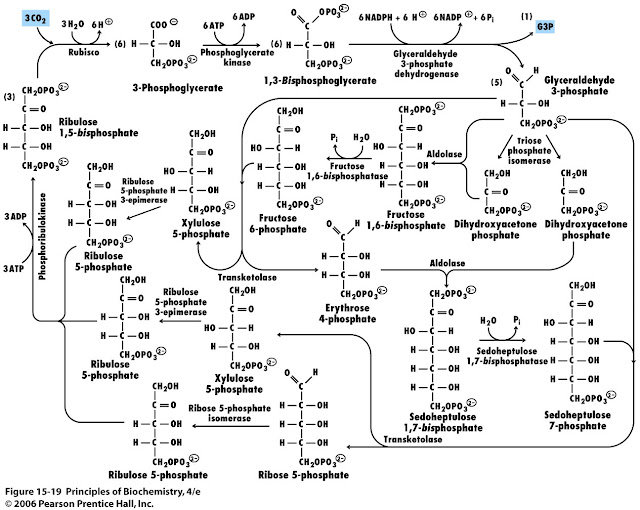
The following diagram gives you some of the complexity of the Calvin cycle. You are not expected to memorize this, but with your growing knowledge of reactions, you may find you can follow it.
Calvin Benson Cycle
If you notice, the set of reactions at the top of the image show the Carbon Fixation and Reduction steps. Everything else deals with regeneration. (think about it: how do you change 10 3-carbon compounds into 6 5-carbon compounds?). Recall that with glycolysis and citric acid, the intermediates were used for other reactions. The same thing is happening here. These intermediates of the regeneration stage can be used for other chemical processes.

Daily Challenge

In your own words, describe the Calvin (Calvin-Benson) Cycle. Explain how it works, and where the energy from the Light Dependent reactions will be needed.
Link to Forum

Wednesday, October 10, 2012

Daily Newsletter: October 10, 2012 - Carbon Fixation

Daily Newsletter

October 10, 2012 Carbon Fixation


Over the last two days, we have discussed how light is used to provide reducing potential (NADPH + H+) and ATP to power the Light-Independent Reactions. What we have discused is Phototrophy, the conversion of light energy into chemical energy (i.e., reducing potential and ATP). Now we turn our attention to how this energy is used: carbon fixation and the production of glucose through the Calvin Cycle.
Calvin CycleThe Calvin Cycle is a comples set of reaction that can be broken down into three main stages: Carbon Fixation, Reduction, Regeneration. The diagram to the right is a very minimized cartoon of the Calvin Cycle, provided only to acquait you with the three stages.
One of the most important reactions in biology is the carbon fixation step of the Calvin Cycle. This is not hyperbole. This one stage of the Calvin cycle is the major way that CO2 is maid available to living systems. CO2 is a highly oxidized compound, and is considered an inorganic compound. It is also very stable. We have to some how take this compound and add it to an organic structure, thereby making it available to other living systems. This is the critical step in autotrophy.

[NOTE: Some bacteria can use other biochemical pathways for carbon fixation, but the vast majority of carbon fixation will occur in reactions similar to that which occurs in the Calvin Cycle.]

Consider what it means to have bioavilable carbon (i.e., carbon usable by non-autotrophic organisms). Consider what you ate today? Did it consist of starches, vegetables, animals? Did it have protein, carbohydrates, lipids? All of these are organic (biochemical) molecules. They are all made of carbon, and we can consider them derivatives of Carbon Fixation. You may have heard that all of our energy comes from the sun; well the carbon fixation reaction is where we get the carbon to hold that energy.
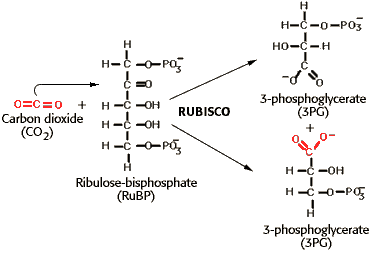
Above is a great diagram of the carbon fixation step in the Calvin Cycle. CO2 is added to the second carbon (carboxylation). There is an unstable intermediate that is formed, which spontaneously splits into two molecules of 3-Phosphoglycerate (3GP).

Ribulose 1,5 Bisphosphate Carboxylase (RuBisCo) is the enzyme that catalyzes the carbon fixation step. This enzyme is often cited as the most abundant enzyme on the planet, which is most like the case. No one though could doubt that it is the single most important enzyme, for without this, we would not have the quantity of organic carbon that is needed to support life as we know it.

Carbon Cycle

One area of study in ecosystem ecology is the cycling of nutrients through the environment, and one of the most critical cycles is the Carbon Cycle. The diagram below is a simple depiction of the carbon cycle, and Carbon Cycleshows the routes that carbon can go through between biotic (living) and abiotic (non-living) systems. The focus is to look at the CO2 cycle in the diagram. CO2 is incorporated into plants through photosynthesis. Animals eat the plants, extract energy and carbon, and release CO2 (Glycolysis & Citric Acid Cycle). Plants also respire (they have mitochondria), and decay organisms (bacteria and fungi) also respire. This is the most dynamic aspect of the carbon cycle.
Is there other carbon? Yes! There are fossil fuels, limestone deposits, and other geological carbon sinks. But it is the relationship between photosynthesis and respiration that is the strong and dynamic feature of the carbon cycle. The step of Carbon Fixation is the critical reaction.

RuBisCo

Ribulose 1,5 Bisphosphate Carboxylase is a fascinating enzyme, and has been the subject of a great deal of research. As the name implies, the substrate is a five carbon sugar (ribulose) that contains two phosphate, bound to the 1st and 5th carbon respectively. It's action is to add a carboxyl (CO2) group to the ribulose 1,5-bisphosphate.

It is also an enzyme that can carry out the reverse reaction, and can do so quite easily (which is a problem). This is one of the few enzymes where equilibrium becomes important. There is a problem known as photorespiration where RuBisCo reverses, and starts releasing CO2. We will see on Friday that there are evolutionary changes which have prevented this in some plants.

Daily Challenge

In your own words, discuss the connection between this step and the events of glycolysis and the citric acid cycle. Where did decarboxylation take place? Why is RuBisCo and the carbon fixation reaction so critical?
Link to Forum

Tuesday, October 9, 2012

Daily Newsletter: October 9, 2012 - Light Dependent Reactions

Daily Newsletter

October 9, 2012 Light Dependent Reactions


Thylakoid Membrane
Yesterday, we discussed how plants harvest energy from photons and convert that into chemical energy. You will recall the image to the right. It shows the two photosystems, and the generation of NADPH and ATP.
Recall the two photosystems are based upon pigment reaction centers.

The chloroplast of the the plant has two know Photosystems: P680 (Photosystem II) and P700 (Photosystem I).
  • Photosystem II
    • Used to Generate ATP (chemiosmosis)
    • Water is split to recharge the P680 reaction center with electrons and hydrogens.
    • Donates electrons to Photosystem I
  • Photosystem I
    • Can operate either Cyclic or Non-Cyclic
    • Non-Cyclic
      • Excited electrons are given to NADP+
      • Electrons accepted from Photosystem I to recharge the P700 reaction center.
    • Cyclic
      • Excited electrons are used to make ATP (chemiosmosis)
      • Electrons are returned to Photosystem I (recycled) to recharge P700 reaction center.
Remember: The photosystems are complex arrangements of chlorophyll pigments found in the thylakoid membrane. When electrons are used to make ATP, the electrons will be passed between electron carriers that act as proton pumps. The electrons are used to build and maintain a proton motive force, which will directly be used to make ATP. So all electron movement is occurring due to electron carriers in the membrane.
Now, what does all this mean for a plant? Throughout, we have talked about absorbance, but what is it? Simply put, absorbance describes the amount of light (photons) that is intercepted (absorbed) by the pigment. Each pigment has an absorbance spectrum, which is the wavelengths of light that the pigment can absorb.


Absorbance Spectrum Chlorophyll A and B To the right you will see the absorbance spectra of chlorphyll A and chlorophyll B. Both of these pigments are chlorophyll, thus we see them as green (but different shades of green). Each has a slightly different absorbance maximum; that would be the peaks on the graph (note the Y-axis is absorbance). So, Chlorophyll A absorbs strongly at 410nm, 430nm and 662nm, but best at 430 nm. Chlorophyll B absorbs best at 453. But there are more than just two pigments found in plants (and other photosynthetic organisms.

Plant Pigments AbsorptionThe graph to the left shows more pigements. Five pigments in all are shown. Notice that some, such as phycoerythrin and phyocyanin have absorption maxima at 550 and 610 respectively. Phycoerytrhin appears to the human eye as red (erythrin = red) and Phycocyanin is light blue (cyanin = blue). Carotene is characteristically orange. All of these, and more, can be found in plants. Why would a plant have so many different pigments?

To absorb as much light as possible. That is the #1 best answer!

Through evolution, plants have also mixed different pigments for other purposes, such as floral color attracting pollinators. For example, did you know that some flowers have UV pigments? Look at this image of the evening primrose. Evening PrimroseTo the left is what humans see, a full yellow flower; but under UV light, there is a large bullseye in the center. Insects see the bullseye, not the yellow flower. So pigments can be multipurpose.


Plants, and most other photosynthetic organisms, maintain multiple pigments to harvest as much light as they can. The ratio of pigments establishes the Action Spectrum of the plant, the wavelengths of light where they will have the highest yields of NADPH and ATP. This ratio of pigments will also produce distinctive colors. Are all plants green? Coleus Have you seen any shaded yellow? How about plants that have leaves with multiple colors? Here is a good example with Coleus. As you can see, there are different leaf coloration. Each variety would have different action spectrum, as each have a different pigment ratio. Why do you think plants would need different action spectrum? (Think survival strategy).

Consider a forest: You have a canopy of tall trees, then some intermediate sized trees and shrubs, then ground plants. Do shade plants have action spectra that differ from those of the canopy? Consider a plant that is being "shaded"; what does it mean to be "shaded"? You still get light, but is the light the same full spectrum light that the canopy is getting?

Daily Challenge

In your own words, discuss the concepts of absorbance spectrum and action spectrum. Show how they are related concepts, but describe different aspects of light absorption.
Link to the Forum

Monday, October 8, 2012

Daily Newsletter: October 8, 2012 - Harvesting Photons

Site LogoDaily Newsletter

October 8, 2012 Harvesting Photons


This week brings us to Photosynthesis. The focus will be on eukaryotic photosynthesis, which takes place in the chloroplast. The activity of photosynthesis is broken down into two major sets of reactions: Light Dependent and Light Independent.
During the Light Dependent reactions, photons will be used to excite electrons in various pigments. These excited electrons will be used to produce reduced electron carriers (NADPH + H+) and ATP. During the light independent reactions, CO2 will be reduced and incorportated into organic compounds (carbon fixation). This will lead to the formation of glucose though the Calvin Cycle (metabolic pathway).
Today, your goal is to understand how photons are used to excite pigment electrons.

In photosynthesis, the cell will generate reducing power by using a photon to excite an electron. You will recall from chemistry that that electron excitation occurs when an electron jumps to a higher energy state (a higher shell).

Photoexciation is one of the principle ways to excite an electron, and we can do this in a modern lab fairly easily. In nature though, you require a structure that can "focus" the photon's energy. Chlorophyll provides such a structure. As a pigment, the structure of chlorophyll is built to absorb specific wavelengths of light, and then excite a set of electrons.
Note that at the center of the chlorin ring (the organic ring structure) is a Magnesium ion, which can be considered the focal point of the photoexciation. Remember our discussions about the respiratory chain, specifically NADH dehydrogenase? Fe-S complexes were used for redox reactions with the protein. Magnesium, like iron, can easily go through redox reactions. As a point of reference, visualize the photon exciting the magnesium ion.

Chlorphylls are arranged in systems, and once photoexcitation has occurred, the energy is transferred by resonant energy transfer to a Reaction Center.
Resonant energy transfer? What's that?
This is a concept from quantum physics. It describes how energy is transferred between chromophores (e.g., Chlorophyll). One chromophore is struck by a photon and is excited. Instead of giving off light (i.e., fluorescence), the chromophore transfers the energy to a neighboring chromophore (if you car curious, this occurs through dipole-dipole coupling). As with any energy transfer, the 2nd law of thermodynamics applies. The amount of energy lost is inversely proportional to the distance between chromophores (it is very energy efficient between close neighbors). The important thing to remember here: we don't move electrons, we just transfer energy. This is possible due to the structure of the chromophores (i.e., pigments).

Energy is passed between chromophores in an antennae complex toward a reaction center. The reaction center is formed by a pair of chlorophyll molecules, and is chemically active. The reaction center can undergo redox reactions. There are two specific reaction centers known in plants, the P680 and P700. These names refer to the maximum red absorbance wavelength for these two molecules. The P680 reaction center is found Photosystem II, while P 700 is found in Photosystem I. (Photosystem is the name given to a reaction center and the associated electron transport chain. The naming is historic: Photosystem I was found before Photosystem II).


The reaction centers gather the energy absorbed by the surrounding chlorophyll. These reaction centers then undergo a charge separation, which is a form of redox reaction that donates high energy electrons to a waiting quinone. The image below is of photosystem II.

There are a few important points in this image:
1) Notice in the center there is a group f structures with the code Pheo. This represents a Phenophytin, which is a chlorophyll without the magnesium in the center.
The paired chlorophylls become a paired phenophytin. This change (loss of the magnesium) is a where the absorbed energy is converted to a redox potential. The energy is handed off to a quinone (Q).
You will recall ubiquinone, which we saw in the eukaryotic respiratory chain. Ubiquinone was a type of quinone. So this is a hydropobic mobile electron carrier (i.e., it can travel in the lipid portion of a phospholipid bilayer). The quinones take the harvested reducing potential to electron carriers for processing.

2) Notice that the reduction of the quinone requires Fe. Recall that Fe-S complexes were used in the respiratory chain for redox reactions. Iron is again used to help faciliate redox reactions.
3) Photosystem II has a way to recharge the system with electrons and hydrogen. The reaction center of photosystem II has hydrolytic ability; it can break water. The hydrogens, and their electrons, join photosystem II, recharging the reaction center (they convert pheophytin back to chlorophyll). In the process, they release oxygen (O2).
This is critical: the individual pigments do not undergo redox reaction; instead they transfer energy to neighboring chromophores (i.e., pigments). The reaction center undergoes redox reactions, passing electrons to ubiquinone. The reaction center lost electrons, and must replace these electrons. Photosystem II handles this replacement by using H2O. (Connection: H2O was created due to the reduction of the final electron acceptor O2. Now H2O is used to replace the missing electrons in the P680 reaction center, and O2 is given off).

The harvested electrons will be used to either make ATP (chemiosmosis) or to reduce NADP+ to NADPH + H+. NOTE: Photosynthesis uses Nicotinamide Adenine Dnucolotide Phosphate. NAD+ is used in catabolic reactions, while NADP+ is found in anabolic reactions.

Photosystem II & I - Non-cyclic

Photosystem II

Daily Challenge

Explain in your own words how photon energy is harvested and converted into reducing power. Include in your discussion a description of the above electron transport system involved in producing NADPH + H+ and ATP.
Link to Forum