Showing posts with label Enzyme. Show all posts

Wednesday, September 25, 2013

Daily Newsletter: September 25, 2013 - Enzymes

Daily Newsletter

September 25, 2013 Enzymes


Enzymes are the workhorses of the cell. They catalyze reactions, meaning they decrease reaction activation energy. It is critical to learn how enzymes function. To start with, here are some things you need to remember.
  • First thing to remember, Enzymes are Proteins!
    • So they are constructed on ribosomes.
    • Their structure is determined by electrostatic interactions.
    • Their shape can change when things bind to it.
    • They can be denatured.
  • Second, they act as catalysts.
    • They lower activation energy by bringing molecules together in the correct alignment, and can induce molecular tension to cause the reaction.
    • Though their shape may change during the chemical reaction, the enzyme is left essential unchanged at the end of the reaction.
Enzymes work by binding the substrate of the reaction, and then inducing molecular tension. Remember, when something binds to a protein, the electrostatic interactions around the protein change, resulting in a conformational (shape) change in the protein. It is this shape change that will induce molecular tension. Molecular tension could be due to physical strain, electrostatic interaction, or even the formation of temporary chemical bonds.

Every enzyme has an active site. This is the place where the substrate(s) will bind to the enzyme. The active site must have a shape that loosely fits the substrate, and the electrochemical pattern of the active site must compliment the electrochemical pattern of the substrate. When they bind, you get an Enzyme Substrate complex. Below is a basic cartoon about the process:
This enzyme-substrate complex is critical, and it is likely that you will see the development of an intermediate during the process. As the substrate "binds" to the active site, the overall enzyme will change shape. This conformational change is part of how the enzyme lowers the activation energy of the reaction. In the case of a synthesis, the enzyme will force the two compounds into close association, while in a break-down reaction, the enzyme may appear to bend the molecule at a breaking point. Here is a quick video that shows the brief conformational change that helps to induce the reaction: http://youtu.be/V4OPO6JQLOE


Conformational changes alone are not the only part in inducing a reaction. You will also find that proteins can have prosthetic groups that aid them in their action. For example, you can a Heme group with Iron that can hold Oxygen in red blood cells. Some digestive enzymes use Chromium to help in their action. Many metabolic pathways will contain Electron Carriers needed for redox reactions.

Enzyme Regulation
Cells are filled with enzymes, and they are constantly working to maintain cellular homeostasis. Some of the enzymes though are produced in an inactive form. We need them, but not always. We are also able, though chemical signals, to turn off some enzymes. Last week, we looked at signal transduction, converting a chemical signal into a change in cellular physiology. We saw the action of protein kinases and other primary and secondary signals. One purpose of the protein kinases was to alter the activity of proteins in the cell.

Beyond an active site, many enzymes have an allosteric site (regulatory site). This is located away from the active site. When the regulatory compound "binds" to the allosteric site, the enzyme changes shape. Most critically, the enzyme alters the shape of the active site. An allosteric activator is a signal that opens the active site, while an inhibitor closes the active site. The image to the right shows an enzyme in the active and inactive state. Notice that the active site changes when the allosteric activator is bound to the enzyme. In the case of this enzyme, there are two different ways to regulate: Phosphorylation, which would have occured due to a chemical signal such as cAMP, and the binding of ATP at an allosteric site.
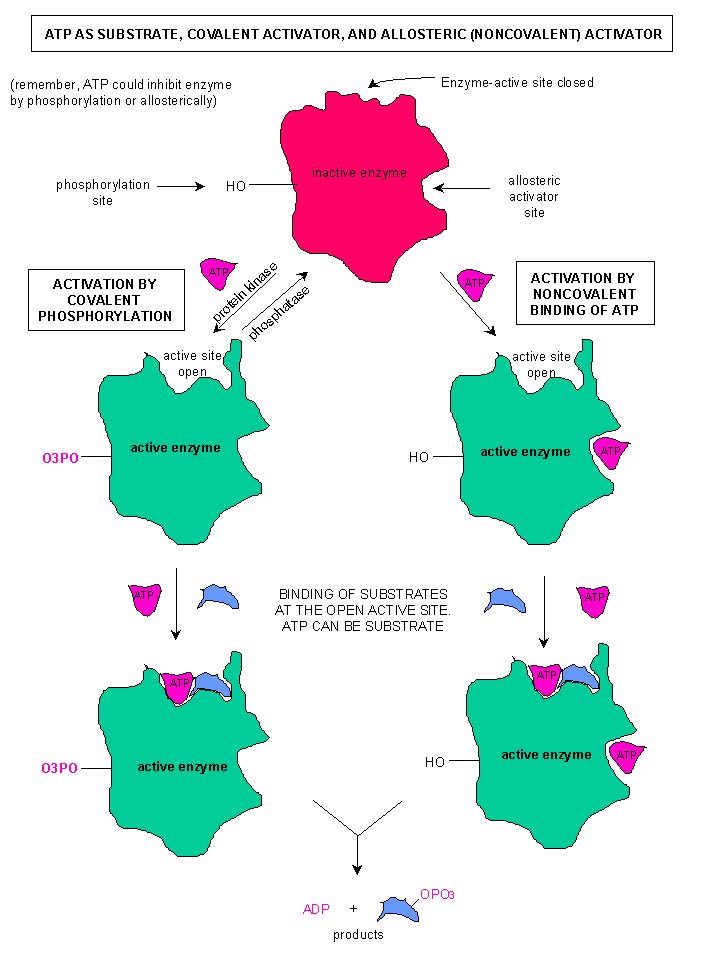
Enzyme RegulationIt is not uncommon to have multiple ways to regulate an enzyme, and some enzymes that can be activated and deactivated as needed. A good example of this is with the enzyme Phosphofructokinase, a critical enzyme in glycolysis. This enzyme catalyzes an energy consumptive reaction that is a "no turning back" point in glycolysis.

Before we talk about phosphofructokinase, we need to talk a little of why we regulate proteins. Two memes I want you to remember: Cells are masters at energy conservation & Cell do not carry out unneccessary reactions. Both concepts are related, and they will help you understand why proteins are regulated. While there are energy consumptive pathways, the main reason we regulate proteins and pathways is due to products. Remember our discussion of equilibrium. We need to use products (products must become the next substrate). If we build up product, the reverse reaction becomes more likely. To ensure that we do not shift equilibrium, we try to avoid product build up. So, we want to stop reactions when we have an adequate to abundant supply of a compound.

The goal of our energy harvesting pathways, of which glycolysis is part, is the production of ATP. So ATP becomes a regulator. Phosphofructokinase has an allosteric site that is specific for ATP. When there is an abundant supply of ATP, some of the ATP binds to phosphofructokinase and changes its shape. Specifically, it closes the active site. PhosphofructokinaseThe presence of AMP in the cell is a singal that we need to unlock our energy harvesting pathways, specifically, unlock phosphofructokinase. In this case, AMP acts as an activator to reverse the inhibitory effect of ATP. To the left is a diagram of phsophofructokinase. The area labeld "Regulatory Site" is the Allosteric site.
In lecture, we will discuss inhibition at the active site.

Additional Resources

Enzymes at Blobs.org - This site has a good review of enzymes, including regulation, inhibition, kinetics and enzyme function at different temperatures. The images presented on the site are extremely helpful.

Daily Challenge

Discuss the concept of enzymes using angiotensin converting enzyme (ACE) as your example. ACE is a medically important enzyme that is involved in an imporant signal system in the body that helps to regulate water balance and the kidneys. There is a group of drugs known as ACE inhibitors that affect the activity of this enzyme. Your goal is to discuss the enzyme, including its regulation and inhibition.

Note:  ACE converts the plasma protein Angiotensin I into Angiotensin II (consider this the active form).  Angiotensin II has numerous effects, including causing the kidneys to retain sodium and water, increasing blood volume, and thus increasing blood pressure.  ACE Inhibitors are used with people who have high blood pressure.

Monday, September 23, 2013

Daily Newsletter: September 23, 2013 - Adenosine Triphosphate

Daily Newsletter

September 23, 2013 Adenosine Triphosphate


You have most likely heard ATP referred to as the "energy currency" of the cell. In fact, your textbook uses this analogy: "Just as it is more effective, efficient, and convenient for you to trade money for a lunch than to trade your actual labor, it is useful for cells to have a single currency for transferring energy between different reactions and cell processes."
This is a lovely fiction that does not serve molecular biologists. It is a convenient expression, but it conveys a very serious misconception.

Nucleotide triphosphates (ATP, GTP, CTP, TTP and UTP) have their foundation in the nucleotide structure, with the addition of extra phosphate groups. Adenosine Triphosphate is the most prevalent nucleotide triphosphate, and is found as a cofactor in a number of enzymatic reactions. The picture below show the general structure of ATP.

NOTE: the nucleotide triphosphates use RIBOSE as the sugar. If the nucleotide triphosphate utilized deoxyribose, we add the letter "d" in front of the abbreviation; so dATP represents a deoxyribo-nuclotide. The only time the cell ultilizes dATP, dGTP, dCTP and dTTP is during the process of replication (DNA synthesis).

You have three phosphate groups, each with a negative charge, covalently bonded to each other. The phosphate groups naturally want to repel each other, but they are held together by one of the strongest bond types (covalent bonds). What does this mean? Molecular tension! But it must be noted that ATP is chemically stable. It does not spontaneously loose phosphates (if it did, you would also release heat). It takes enzymatic action to remove the phosphate (i.e., we have to break the covalent bond). When a phosphate is removed from ATP, it is generally attached to another molecular structure (enzymes, sugars, etc...). The exception to this will be in building nucleic acids.

Chemist vs. Biologist


In yesterday's newsletter, a distinction was made between the perspective of chemists and biologists. If you look in most books that deal with biology, you will find the following euqation for ATP:
ATP + H2O → ADP + Pi ΔG˚ = −30.5 kJ/mol (−7.3 kcal/mol)
This is a look at ATP hydrolysis in isolation. Do you remember how ΔG is calculated? Look at the units. kJ (kilo-Joules) or kcal (kilocalories). We are basing this on an isolated reaction and measuring heat. When you look at the ΔG when there are metal ions present, you get a different number. You should also be familiar with ΔG, or Gibbs Free Energy, which is a measure of the amount of work that can be acheived by the energy release. A ΔG˚ = −30.5 kJ/mol is big, and implies that there is a great deal of energy released (the molecule can perform work).

Biologists though recognize that ATP is not in isolation. The intracellular fluid compartment (cytosol) contains ions, and more importantly metal ions, especially Mg2+ (causes major changes in hydrolysis ΔG). Inside of cells, the ΔG˚ of ATP hydrolysis is higher, approximately -50 kJ/mol (-12 kcal/mol). If we released this much energy every time ATP was hydrolyzed, the cell would boil! But, we use this energy for something else: binding the phosphate to another substrate (phosphorylation). When we phosphorylate a compound, we are building a covalent bond between the phosphate and the compound. This requires energy.1 About half the free energy is going to be used to make this covalent bond between the phosphate and the substrate. What happens with the rest? The second law of thermodynamics tells us that some of it is lost (this is an energy transfer after all...we broke one bond to build another), but the bond it self will hold some as well. Remember, chemical bonds are Potential Energy. When phosphate is removed, there will be another change in free energy (every reaction has a ΔG).

So what is the misconception with "energy currency"?
To answer this, we need to ask two other questions: why do we think of ATP as having High Energy Bonds and what is enery to a cell?

Why do we think of ATP in terms of High Energy Bonds? The answer is in the discussion above. The phosphoanhydride bonds (covalent bonds between the phosphate groups) have a high ΔG when they are hydrolyzed. This is why they have been called "high energy bonds". But in biology, the energy is used to immediately allow the phosphate group to bind to a new substrate (Phosphorylation). Put another way, the work that is done is in forming the covalent bond between the phosphate and the new substrate! The ATP is NOT a battery that energizes a curcuit.

ATP is always used in coupled reactions.

What is energy to a cell? Ask yourself, in building bonds in chemistry, what is the energy? If you want to change the energy state in a molecule, what do you do? Isn't it all about the electrons. Ultimately, the energy cells really use will be found with electrons, specifically through redox reactions. We will see that reducing potential is the energy the cells are harvesting and storing. This will be our discussion tomorrow.

Now we come to the big question: What does ATP do?
The concept of ATP as an "energy currency" comes from ATP turning on enzymes or assisting an enzyme during a "power steps" in a metabolic pathways. But ATP does not add energy; it just rearranges charge distribution around a molecule (electrochemistry). Remember, the phosphate group is negatively charged (-2).
When you add a phosphate group to a protein, you change the electrical signature around that portion of the protein (same will be true of other molecules as well). This includes the ability to form new hydrogen bonds, which can alter both secondary and tertiary structures. What will happen to the protein? It will change shape (conformational change). The work that ATP enables (and again this relates back to the free energy) is it's ability to cause conformational changes and induce molecular tension (instabilities).

Protein Phsophorylation
Above  is a general diagrapm showing a phosphorulation event. Notice how the phosphate group has interacted through van der Waals forces to change the tertiary structure of the protein.

The image below is a variant example of how ATP interacts with proteins. In this case, we see the the interaction of Myosin and Actin during muscle contraction. Focus your attention on the myosin molecule in blue. Notice that the "head" of the myosin changes conformation (shape) as ATP binds and is hydrolyzed. This is an important concept. When ATP binds, and hydrolysis occurs, a conformation change occurs. When ADP and Pi leave, the molecule resumes its "resting" conformation. In this case, it is the binding of the entire ATP molecule (with multiple negative charges) and subsequent hydrolysis which causes the conformational change. It still comes down to changing the electrical profile of the molecule (NOTE: there are more conformational changes occuring than are seen in this).  Myosin Cross Bridge (Moving Myosin Heads Bind to Actin)
.

As we will see in upcoming weeks, this change of shape is critical to enzyme function. You have already encountered this once before, with the Sodium/Potassium ATPase.

Daily Challenge

Today, I want you to discuss the function of ATP. Do not describe it as an energy currency, instead describe how the addition of phosphates cause a change in the electrochemistry of a protein, and how that affects the conformation of the protein. Use Myosin in muscle cells as your example. We have not covered Myosin, but it is a very easy model for how ATP acts.

This is an easy to follow walk through of the interaction of ATP and Myosin.  The site also contains further references.  
Myosin ATPase activity: the 'powerstroke' cycle


Reference

1. Berg JM, Tymoczko JL, Stryer L. (2002). Biochemistry. W H Freeman, New York. http://www.ncbi.nlm.nih.gov/books/NBK22399/, accessed on September 25, 2012

Thursday, September 27, 2012

Daily Newsletter September 27, 2012 - Enzymes

Daily Newsletter

September 27, 2012 Enzymes


Enzymes are the workhorses of the cell. They catalyze reactions, meaning they decrease reaction activation energy. It is critical to learn how enzymes function. To start with, here are some things you need to remember.
  • First thing to remember, Enzymes are Proteins!
    • So they are constructed on ribosomes.
    • Their structure is determined by electrostatic interactions.
    • Their shape can change when things bind to it.
    • They can be denatured.
  • Second, they act as catalysts.
    • They lower activation energy by bringing molecules together in the correct alignment, and can induce molecular tension to cause the reaction.
    • Though their shape may change during the chemical reaction, the enzyme is left essential unchanged at the end of the reaction.
Enzymes work by binding the substrate of the reaction, and then inducing molecular tension. Remember, when something binds to a protein, the electrostatic interactions around the protein change, resulting in a conformational (shape) change in the protein. It is this shape change that will induce molecular tension. Molecular tension could be due to physical strain, electrostatic interaction, or even the formation of temporary chemical bonds.

Every enzyme has an active site. This is the place where the substrate(s) will bind to the enzyme. The active site must have a shape that loosely fits the substrate, and the electrochemical pattern of the active site must compliment the electrochemical pattern of the substrate. When they bind, you get an Enzyme Substrate complex. Below is a basic cartoon about the process:
This enzyme-substrate complex is critical, and it is likely that you will see the development of an intermediate during the process. As the substrate "binds" to the active site, the overall enzyme will change shape. This conformational change is part of how the enzyme lowers the activation energy of the reaction. In the case of a synthesis, the enzyme will force the two compounds into close association, while in a break-down reaction, the enzyme may appear to bend the molecule at a breaking point. Here is a quick video that shows the brief conformational change that helps to induce the reaction: http://youtu.be/V4OPO6JQLOE


Conformational changes alone are not the only part in inducing a reaction. You will also find that proteins can have prosthetic groups that aid them in their action. For example, you can a Heme group with Iron that can hold Oxygen in red blood cells. Some digestive enzymes use Chromium to help in their action. Many metabolic pathways will contain Electron Carriers needed for redox reactions.

Enzyme Regulation
Cells are filled with enzymes, and they are constantly working to maintain cellular homeostasis. Some of the enzymes though are produced in an inactive form. We need them, but not always. We are also able, though chemical signals, to turn off some enzymes. Last week, we looked at signal transduction, converting a chemical signal into a change in cellular physiology. We saw the action of protein kinases and other primary and secondary signals. One purpose of the protein kinases was to alter the activity of proteins in the cell.

Beyond an active site, many enzymes have an allosteric site (regulatory site). This is located away from the active site. When the regulatory compound "binds" to the allosteric site, the enzyme changes shape. Most critically, the enzyme alters the shape of the active site. An allosteric activator is a signal that opens the active site, while an inhibitor closes the active site. The image to the right shows an enzyme in the active and inactive state. Notice that the active site changes when the allosteric activator is bound to the enzyme. In the case of this enzyme, there are two different ways to regulate: Phosphorylation, which would have occured due to a chemical signal such as cAMP, and the binding of ATP at an allosteric site.

Enzyme RegulationIt is not uncommon to have multiple ways to regulate an enzyme, and some enzymes that can be activated and deactivated as needed. A good example of this is with the enzyme Phosphofructokinase, a critical enzyme in glycolysis. This enzyme catalyzes an energy consumptive reaction that is a "no turning back" point in glycolysis.

Before we talk about phosphofructokinase, we need to talk a little of why we regulate proteins. Two memes I want you to remember: Cells are masters at energy conservation & Cell do not carry out unneccessary reactions. Both concepts are related, and they will help you understand why proteins are regulated. While there are energy consumptive pathways, the main reason we regulate proteins and pathways is due to products. Remember our discussion of equilibrium. We need to use products (products must become the next substrate). If we build up product, the reverse reaction becomes more likely. To ensure that we do not shift equilibrium, we try to avoid product build up. So, we want to stop reactions when we have an adequate to abundant supply of a compound.

The goal of our energy harvesting pathways, of which glycolysis is part, is the production of ATP. So ATP becomes a regulator. Phosphofructokinase has an allosteric site that is specific for ATP. When there is an abundant supply of ATP, some of the ATP binds to phosphofructokinase and changes its shape. Specifically, it closes the active site. PhosphofructokinaseThe presence of AMP in the cell is a singal that we need to unlock our energy harvesting pathways, specifically, unlock phosphofructokinase. In this case, AMP acts as an activator to reverse the inhibitory effect of ATP. To the left is a diagram of phsophofructokinase. The area labeld "Regulatory Site" is the Allosteric site.
In lecture, we will discuss inhibition at the active site.

Additional Resources

Enzymes at Blobs.org - This site has a good review of enzymes, including regulation, inhibition, kinetics and enzyme function at different temperatures. The images presented on the site are extremely helpful.

Daily Challenge

Discuss the concept of enzymes using angiotensin converting enzyme (ACE) as your example. ACE is a medically important enzyme that is involved in an imporant signal system in the body that helps to regulate water balance and the kidneys. There is a group of drugs known as ACE inhibitors that affect the activity of this enzyme. Your goal is to discuss the enzyme, including its regulation and inhibition.
Link to Forum