Showing posts with label Transcription. Show all posts

Tuesday, September 9, 2014

Daily Newsletter: September 10, 2014 - Codons, Anticodons & Amino Acids

Site LogoDaily Newsletter

September 10, 2014

Codons, Anticodons & Amino Acids


Translation is the process of "reading" mRNA, and using the code to construct a protein. But what is the code? The nucleotide language of mRNA can be divided into codons. Three sequential nucleotides that represent a genetic (nucleotide) word. So, how do you read this code or nucleotide language?
In the image to the right, you hav
e have sequential nucleotides divided up into codons. Notice that AUG is listed as Codon 1. This is important! AUG is the Universal Start Codon. Nearly every organism (and every gene) that has been studied uses the three ribonucleotide sequence AUG to indicate the "START" of protein synthesis (Start Point of Translation).

As we will see tomorrow, it takes more than a start codon to initiate transcription, but for now just remember that this is the codon that indicates the START point of the instructions on how to make a protein.
The start codon established the Reading Frame for translation. From the start codon, every three sequential nucleotides will be viewed as a codon. This is critical! Mutations can affect reading frames. For example, if a nucleotide is inserted between codon 2 and 3 (G G), would you have the same reading frame down stream? What if you deleted the first nucleotide of codon 4? What is the effect of changing the reading frame? What would happen to the resulting protein?

Insertions and deletions can change reading frames, but point mutations can also occur. In this case, one nucleotide is change to a different nucleotide. What would happen if the final nucleotide of condon 3 were changed to a C? To an A? How about the second nucleotide in codon 4? Change the U to an A, what happens?

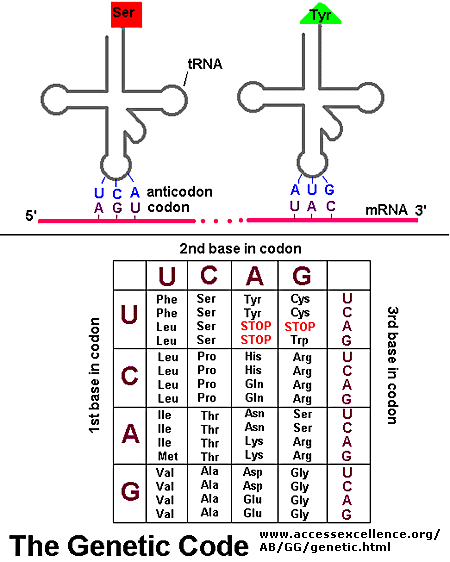
Each codon is a "genetic word," and refers to a specific amino acid (thus changes to these words can result in changes to final proteins). The tRNA is the agent of translation. On one end of the tRNA, you will find an anti-codon. Anti-codons are complimentary to codons. Example: Codon 1 reads AUG. The corresponding tRNA would have an anticodon reading UAC. (Question: Would these be antiparallel?). Codon 2 reads ACG, so the anticodon would read UGC. Oppisite the anticodon, you will find a binding site for a specific amino acid.

An amino acid can be attached to the free 3' end of the tRNA. There is a class of enzymes capable of attaching an amino acid to a tRNA: Aminoacyl tRNA Synthetase. Below is a very basic cartoon of how an amino acid is added to a tRNA.
Note that an ATP is needed to complete the binding. There is an Aminoacyl tRNA Synthetase for each tRNA-Amino Acid combination.
Below is a diagram showing the pairing of codon to anticodon. The diagram also contains a version of the Genetic Code table, showing the relationship between codon and amino acid.
Note that three codons are referred to as STOP codons: UAA, UAG, and UGA. These are used to terminate translation; they indicate the end of the gene's coding region. What would happen if you lost a Stop codon?

Daily Challenge

In an earlier newsletter, we discussed Hemoglobin, and how the change of one amino acid caused the configuration change in the protein.  Amino Acids are coded due to a codon.  If you recall, Valine (Val) is found in place of Glutamic Acid (Glu).  If we look at the sequences, we find that at the sixth codon, the wild type reads GAG, but the sickle type reads GUG.  This is a single nucleotide polymorphism.  Here is a video to explain SNPs (pronunciation: Snips)


Today, consider the consequence of a SNP.  What would happen if it occurred in a Start or Stop codon.  What would happen if an AAG upstream (before) the start codon had a SNP that changed the second nucleotide from an A to a U?  What would happen if CGC changed to CGG?  How about CAU to GAU?
After considering these, and looking at the above video, what are some of the consequences of a SNP?  How could a SNP either stop translation or prolong it?  Are all of the results harmful, or can they be neutral?

Link to Forum

Monday, September 8, 2014

Daily Newsletter: September 8, 2014 - Ground Rules for Gene Expression

Site LogoDaily Newsletter

September 8, 2014

Ground Rules for Gene Expression

(AKA Central Dogma)


Central Dogma, in broadest sense, encompasses the genetic mechanisms of Replication, Translation and Translation. In the strictest sense, Central Dogma describes gene expression: Information encoded in the nucleotides of DNA being use to construct proteins. The two core genetic processes involved in gene expression are Transcription (synthesis of RNA) and Translation (synthesis of proteins).
Central Dogma of Biology

Before digging into each process, let's talk a little about what is at stake here. DNA holds our genetic history. It holds codes on how to build an organism, but what does that really mean?

The basic unit of life is the cell, and cells are formed from phospholipids can naturally form bilayers. Furthermore, phospholipids can even natrually form spherical structures that create two fluid compartments, outside vs. inside.  The phospholipids that make up the cellular membrane form the most basic feature of the cell: a dividing point, separating the inside from the outside (more on this in the weeks to come).


Membranes though are passive. As a selectively permeable barrier, only certain materials can cross. Proteins add functionality to the membrane. By embedding proteins, you can chance the permeability of the membrane. This is how cells balance what is on the inside, and what is on the outside. Membrane proteins can also have enzymatic or signal functions. Proteins add functionality to the membrane.

A common expression is that DNA holds the code to make an organism. The meaning of this phrase lies in the concept that by making proteins, we make phospholipid membranes and cells functional. From DNA, cells can build proteins for metabolic pathways, to produce various chemical compounds, anchor with other cells, and in multicellular complex life, we even have the development of special cellular roles that work together to form a composit whole.

The concept of how we go from DNA to RNA and then Proteins is one of the most critical concepts in biology! Today we are going to focus on some of the basics, the Ground Rules, of genetics.

All genetic processes work due to base complementarity. If you know the base complementarity rules, then the foundations of genetics will make sense. At times, this may seem repetitious, but I really want you to get these terms and concepts.
Genes are sometimes referred to as the unit of heredity, and with good reason. A gene is a segment of DNA that holds the code to make a protein (NOTE: or functional RNA, such as trasfer RNA). In modern biology, we refer to gene products, which are just the expressed macromolecules coded by a gene.
Remember, a gene product can be either a proteins or functional RNA (e.g., tRNA). Functional RNA does not code for proteins, instead, these RNA strands have some function in cellular metabolism, most notably in the genetic process of Translation. Examples include tranfer RNA (tRNA), ribosomal RNA (rRNA), and small nuclear RNA (snRNA).

All genes have non-coding portions that are critical for the correct transcription (synthesis of RNA). These non-coding areas are critical for regulation and aligning the transcription enzymes (e.g., RNA polymerase). Below is a graphic that shows structure of a gene. The promoter of a gene is a sequence of DNA upstream of the actual code (coding region) that indicates the "Start" point for transcription. This is how your cell knows where to begin transcription. The loss of the promoter means that the gene will no longer be expressed.
In Eukaryotic cells, a common promoter is a DNA sequence that reads TATAAA, and is better known as the TATA-Box. In bacteria the promoter is known as the Pribnow Box (Pribnow-Schaller box).  In both cases, the promoter is found in the Major Groove of the DNA Major Groovemolecule. As can be seen in the image to the right, the major groove is wide enough to "see" the base pairs. The base pairs have an electrochemical profile, and thus can respond to other chemicals (via van Der Waals forces). Thus, the major groove is a place where proteins (and other compounds) can bind to specific sequences of DNA! The promoter sequences are found in the major groove. Major Groove with Initation FactorThe image to the right shows a bacterial promoter event. One of the factors needed to start transcription (by recognizing the promoter) has bound into the major groove. This recognition event is needed to identify the start point of a gene. The Transcription Initation Complex will then begin to form at this site, and begin the transcription of the gene. 

Many genes are regulated, meaning they can be turned on and off. Beyond a promoter, a regulated gene will typically have a non-coding region known as the Operator. The operator is located down stream of the promoter (meaning it will be between the promoter and the coding region). Regulatory proteins can bind to the operator, preventing transcription. Remember, cells are masters at energy conservation. They will not begin producing proteins that are unnecessary. Gene regulation is a common activity of Signal & Receptor systems. The image below is a good visual of the promoter & operator systems. Gene House keeping genes are those that are needed for the general function of the cell, and can include genes for glycolysis, citric acid cycle, and ribosomes. These genes are always ON, and are referred to as constituative genes

Messanger RNA (mRNA) is a molecule of RNA that cares the gene code for the construction of a protein. mRNA is sent to the Ribosome in order to produce a protein. The code for constructing a protein is in Nucleotide Language, meaning the code is a code of nucleotides. Specifically, the code in mRNA is in the ribonucleotide language (A, U, G, C). In order to make a protein, it is necessary to Translate the ribonucleotide language into the language of proteins, i.e., amino acid sequcences. 

In order to translate, you need an agent of translation. This agent of translation must be a molecule that contains both ribonucleotides and amino acids (think of it as the nucleotide-amino acid dictionary). A specific ribonucleotide sequence must directly correspond to an amino acid, just as in translating human languages requires word for word relationships. This concept of a direct nucleotide to amino acid relationship is the basis of the Genetic Code.

tRNAThe agent of translation is Transfer RNA (tRNA). In tRNA, there is a direct physical correspondence between a 3 nucleotide sequence (anti-codon) and an amino acid. To the right are common ways of illustrating tRNA, with the 3rd image being the most common way of drawing the molecule. In the image, each molecule has a region known as the anticodon; this region will interact with mRNA. At the 3' end of the molecule, a specific amino acid will be bound. 

On the mRNA, the code is broken down into codons (think of these as genetic words). Codons consist of 3 adjacent nucleotides. Codons are complimentary to anticodons found on tRNA. Each tRNA has a specific anticodon-amino acid relationship, so each codon then specifies an amino acid. The genetic code is NOT ambiguous. There is a direct correspondence between codon and amino acid; the tRNAs make sure of this.
The ribonucleic language is divided into 64 3-nucleotide words known as codons. Condons specify though tRNA an amino acid. The Genetic Code is thus the translation scheme between codons and amino acids. [NOTE: another way to describe the genetic code is in terms of a computer algorithm]. Below is a rather unique way of viewing the genetic code. It is an excellent way of visualizing the number of redundancies in the code.
Genetic Code Algorithm
The genetic code is redundant, which means that there are multiple codons (3 nucleotides) that specify the same amino acid. For example, around the 12 o'clock position of the above chart, you see the amino acid glycine. The codons GGU, GGC, GGA and GGG all specify Glycine. Phenylalanine is specified by UUU and UUC. There are only a few amino acids, such as methionine, that are specified by a single codon (in the case of methionine it is AUG).

The presence of redundancies means that some alterations in the gene sequence are silenced (silent mutation). For example, changing GGU to GGA does not change the specified amino acid (Glycine). This is a silent mutation. Changing UUC to UUA may cause a problem (point mutation), but both Leucine and Phenylalanine are hydrophobic, so the variation may be minor. Chaing CAC to CAG though has more impact as you are changing the positive histidine to a polar glutamine (you loose the full positive charge of histidine). Remember, chaning amino acids can easily change the way a protein folds. REMEMBER: The genetic code has redundancies, and this will limit some problems with mutation.

Below is a more classic way to represent the genetic code, in the form of a table. The way the table is arranged, you can easily see the various redundancies in the system. In both representations, notice that there are three codons that specify STOP. These stop codons, UAA, UAG and UGA are essential for the termination of protein synthesis. In the image below, you will notice AUG has been tagged as the initiation (start) codon. All protein synthesis begins with the code AUG. We will talk more about this later in the the week.
Genetic Code

Daily Challenge

Today's newsletter helps to set the stage for our discussion of the central dogma of biology (gene expression).  In reading you find that DNA hold the codes to make various types of RNA and Proteins.  Most of the time, what concerns us is the production of proteins, as they will add functionality to our cells.
At the heart of the Central Dogma is the genetic code.  This code shows how you move from the language of nucleic acids to the language of proteins (aka, amino acids).  This code is Universal and Non-Ambiguous, but what does that mean?  Your goal today is to read, in your text and in the optional reading, and reflect on the concept of gene expression and the genetic code.  Why is it so important?  How do we use it?  How does this influence concepts from understanding hormonal changes at puberty, evolution and genetic engineering?

Link to Forum

Thursday, February 20, 2014

Microbiology Daily Newsletter February 20, 2014 - Transcription Termination

Site LogoMicrobiology Daily Newsletter

February 20, 2014 - Transcription Termination


Transcription Termination

 The elongation phase of transcription (polymerization of RNA) occurs the same in all domains, working via base complementarity.  Termination, like initiation, is different.  In bacteria, transcription termination occurs either through an intrinsic termination system (Rho-Independent) or through the use of a Rho (ρ) factor (Rho-Dependent).

The Intrinsic System (Rho-Independent) 

After a the coding region of the gene, or the final coding region of an operon, there will be an inverted repeat of nucleotides on the DNA.  Following this repeat will be a series of six adenine nucleotides.  When this region is translated, the inverted repeat (usually rich in G-C) will anneal, creating a hairpin loop structure.  The six adenine nuclotides are transcribed into uracil.

A protein associated with the RNA polymerase, nusA, catches the hairpin loop structure, and holds it.  This stalls transcription in the region where Uracil has been transcribed.  A region of A-U in a DNA-RNA duplex (i.e., strand of RNA bound to a complementary DNA strand) is very weak (it is a major weak point).  This naturally dissociates from the DNA strand, and is released by the RNA polymerase.

Summary:  The intrinsic system relies on the stalling of a hairpin loop at the end of the transcript, and a region of A-U, to terminate transcription.


The Rho-Dependent System

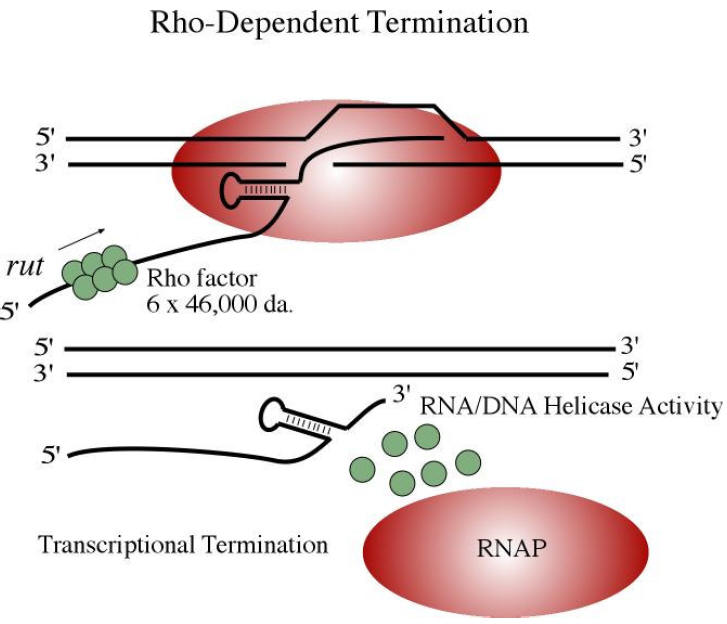
The ρ-Factor is an ATP-dependent hexameric helicase, and binds to a cytosine rich region of RNA >70 bases upstream from the termination site.  This cytosine dominant region is known as the Rho Utilization Site (abbreviated rut).  Once bound, the ρ-Factor moves up the RNA strand toward the 3' end (e.g., where the DNA-RNA duplex is found).  RNA Polymerase pauses at the termination site, and during this time, the ρ-Factor comes catches up to the transcription fork (DNA-RNA duplex), and unwinds it.  Transcription ends.

Comparison between the two termination systems
Comparision of intrinsic termination and Rho-mediated termination.  Greive S.J. and P.H. von Hippel. (2005) Thinking quantitatively about transcriptional regulation. Nat Rev Mol Cell Biol 6:221-32.


Eukaryotic Transcription

To refresh your memory regarding Eukaryotic transcription, you may want to read over these articles:

Daily Challenge 

Your goal today is to discuss the differences similarities and differences between bacterial and eukaryotic transcription, specifically initiation and termination.  Read DNA Transcription in case you need a refresher.
REMEMBER to discuss both similarities and differences.  While doing this, consider evolutionary differences.  

Wednesday, February 19, 2014

Microbiology Daily Newsletter February 18, 2014 - Transcription Initiation

Site LogoMicrobiology Daily Newsletter

February 18, 2014 - Transcription Initiation


Hopefully you remember the basic idea of a gene and the mechanism of transcription as it applies to eukaryotic cells.

For bacterial transcription, we will first look at the promoter.  You may recall the TATA box with eukaryotic promoters.  In bacteria, we find the Pribnow-Schaller box, commonly just referred to as the Pribnow box.  The Pribnow-Schaller box is a six nucleotide sequence TATAAT. QUESTION:  Why six nucleotides?

With eukaryotic promoters, you may recall that the TATA box is not the only recognition sequence needed.  This is also true of prokaryotic promoters.  The Pribnow-Schaller box is found at -10 from the start of the gene.  The complete promoter also contains a -35 recognition sequence, and is also comprised of six nucleotides.  The -35 promoter element usually has a sequence of TTGACA, but note that this can vary among different bacterial taxa (usually at the class or family level taxa).  NOTE:  The -10/-35 promoter is used for normal house keeping genes.  We will see some variation shortly.

The prokaryotic RNA Polymerase catalyzes the reaction of both coding and non-coding RNA, unlike eukaryotes that have job specific RNA polymerases (for example, you may remember that RNA-Pol I forms the 45S pre-rRNA, while RNA-Pol III forms tRNAs).  The prokaryote RNA Polymerase Complex is a holoenzyme composed of RNA Polymerase and a Sigma (σ)factor.  The eukaryotic RNA Polymerase complex has a specific RNA polymerase and a variety of initiation factors.

Below is an example of the bacterial transcription initiation complex.  Note that you are seeing RNA Polymerase with 2 different σ factors, and that the different sigma factors have slightly different promoter recognition sites.  When they bind, they move from a closed complex to an open complex; the open complex gaining its name from the opening of the DNA helix.
Add cFrom: Bush M , and Dixon R Microbiol. Mol. Biol. Rev. 2012;76:497-529.  Initiation of transcription by the RNAP-σ70 (A) and RNAP-σ54 (B) holoenzymes. The σ70 factor directs the binding of polymerase to the consensus −10 (TATAAT) and −35 (TTGACA) sequences to form an energetically unfavorable closed complex (CC) that is readily converted into an open complex (OC) to initiate transcription. In contrast, the σ54 factor directs the binding of RNAP to conserved −12 (TGC) and −24 (GG) promoter elements that are part of the wider consensus sequence YTGGCACGrNNNTTGCW (where uppercase type indicates highly conserved residues, lowercase type indicates weakly conserved residues, N is nonconserved, Y is pyrimidines, R is purines, and W is A or T) (10). This forms an energetically favorable CC that rarely isomerizes into the OC. In order to form the transcription “bubble,” a specialized activator (a bacterial enhancer binding protein [bEBP]) must bind and use the energy from ATP hydrolysis to remodel the holoenzyme. aption
Once the RNA Polymerase-σ factor Holoenzyme is bound in the open complex form, transcription can proceed to the elongation phase.  The next issue specific for prokaryotic transcription will be termination.


Daily Challenge

Sigma factors play a critical role in coordinating bacterial cell physiological states.  Below is a list of common sigma factors.


Sigma Factor
Gene
Function
s70
RpoD
Primary s factor, Housekeeping
s19
FecI
Regulates fec gene for iron transport
s24
RpoE
Extreme heat stress
s28
RpoF
Flagellar genes
s32
RpoH
Heat shock
s38
RpoS
Starvation/Stationary phase

Along with these can be found anti-sigma factors that block the function of expressed sigma factors (a form of regulation).  Discuss the role of sigma factors as means of global gene regulation.  Why is having a sigma factor system beneficial to bacteria?  How does this differ from eukaryotic promoters?

Tuesday, September 10, 2013

Daily Newsletter - September 10, 2013 - Transcription

Site LogoDaily Newsletter

September 10, 2013 Transcription


Transcription is the genetic process where a single strand of DNA acts as a template for the construction of a complementary RNA strand. Generally when talking about transcription, we will be talking about the formation of messenger RNA (mRNA), which carries the code for one gene to a ribosome where it is translated into a protein.
DNA holds the "permanent" copy of the genes needed to make a functional organism (nothing is really permenant). Think of DNA as a locked safe where you hold all your company's blueprints, patents and documented procedures. You don't want to loose these, or risk that they might be changed. You only bring them out to make copies of them, then they go back to the safe. This is what happens with your DNA. You keep it tightly locked up (in a double-helix that is coiled around histones, and then possibly supercoiled), and open it up only when you NEED to make a copy. Notice how NEED is highlighted? Do you think it might be an important concept?
TranscriptionIn eukaryotic DNA every gene starts with a promoter. This is a sight of ~8 nucleotides visible in the major groove of DNA. The transcription complex recognizes this sequence as a "START" indicator. The main core of the transcription complex will be RNA polymerase. This enzyme works to build a strand of RNA complementary to DNA. The name polymerase indicates that it is involved with dehydration synthesis polymerazation reactions (taking one nucleotide, and adding it to a growing chain of nucleotides). Like DNA polymerase, RNA polymerase builds in the 5' to 3', and builds phosphodiester linkages between nucleotides.
But RNA polymerase can not act alone. In eukaryotic systems, initiation factors are needed to recognize the promoter region, and then to correctly align the RNA polymerase. To the left is a great picture showing the initiation complex and the RNA polymerase II holozyme (RNA polymerase II with all associated protein structures). You are not responsible for knowing all of the factors needed to initiate eukaryotic transcription, but you do need to start understanding the concept that it takes multiple factors to identify a promoter and start RNA polymerase. What do you think you need in order to recognize a specific sequence of nuclotides?
As you can see, TATA Binding Protein (TBP) is the first structure to attach to DNA. It recognizes the TATA sequence in the major groove of the DNA double helix. It then forces the the DNA to bend, and acts as a signal to other enzymes directing interactions with DNA. A cascade of reactions occur to then produce the Preinitiation Complex, which ensures that the transcription complex is positioned correctly over the Transcription Start Site, and begins the unwinding (sometimes referred to as denaturation) of the double helix. The Transcription Complex then begins to read the template strand of DNA, and makes an RNA copy (Elongation). [NOTE: Bacteria use proteins known as sigma factors to help find promoter regions and initiate transcription. There are different sigma factors linked to different environmental and physiological states, such as the Heat Shock Sigma factor which alter's the bacteria's ability to deal with higher temperatures)]
Elongation works due to base complementarity. Ribonucleotide triphophates are brought into the transcription complex, and are added to the free 3' end of the growing RNA strand. During the elongation phase, the RNA polymerase continues to add nucleotides to the growing RNA strand.
At some point, the RNA polymerase comes to a termination sequence. We are not going to spend a lot of time on termination (you are not held responsible for the various models). There are a couple different models of eukaryotic transcription termination. The main feature is that there is a signal sequence of deoxyribonucleotides in DNA that signals the end of transcription. Once this signal sequence is found, RNA polymerase is removed and the new transcript (new RNA molecule) is released.
mRNA processing: Once transcription is complete, in eukaryotes, the RNA needs to be processed. The following is a quick reference for mRNA processing:
  • 5' capping: To protect the mRNA from ribonucleases (RNA degrading enzymes) that attack the 5' end, 7-methylguanosine is added to the 5' end. Usually, the 5' ribonucleotide is replace by this compound. Additionally, methyl groups can be added to the sugar-phosphate backbone to further protect the mRNA.
  • Polyadenylation: In maturing RNA to mRNA, a poly-A tail is added (usually after cleaving off a small section of the 3' end). This process adds ~250 adenyls to the 3'end of the molecule. This is needed to stabilize the molecule and facilitate export through the nuclear pores. As mRNA is translated, the poly-A tail gets shorter. When short enough, the mRNA is degraded. Thus, the polyadenylation (poly-A tail) is responsible for setting a time limit to the mRNA. 
  • Splicing: The RNA is composed of both coding (exon) and non-coding (intron) regions. To mature into mRNA, the introns have to be removed, and the remaining exon spliced together. This job is the responsibility of the splicosomes.
  • The above image is a quick reference to the effects of splicing.
 
  • The above image is a quick reference to the effects of the splicosome.
Once RNA has been processed (matured), it is ready to be used in translation (protein synthesis). NOTE: Bacterial RNA does not undergo processing. The bacterial RNA transcript is immediately translated.

Daily Challenge

Transcription In your own words, discuss the process of transcription, and the formation (maturation) of mRNA. Remember that we have focused on eukaryotic transcription. Briefly, how does prokaryotic (specifically bacterial) transcription differ from eukaryotic transcription?
Link to Forum

Monday, September 9, 2013

Daily Newsletter - September 9, 2013 - Central Dogma (Ground Rules)

Site LogoDaily Newsletter

September 9, 2013

Ground Rules for Gene Expression

(AKA Central Dogma)


Central Dogma, in broadest sense, encompasses the genetic mechanisms of Replication, Translation and Translation. In the strictest sense, Central Dogma describes gene expression: Information encoded in the nucleotides of DNA being use to construct proteins. The two core genetic processes involved in gene expression are Transcription (synthesis of RNA) and Translation (synthesis of proteins).
Central Dogma of Biology

Before digging into each process, let's talk a little about what is at stake here. DNA holds our genetic history. It holds codes on how to build an organism, but what does that really mean?

The basic unit of life is the cell, and cells are formed from phospholipids can naturally form bilayers. Furthermore, phospholipids can even natrually form spherical structures that create two fluid compartments, outside vs. inside.  The phospholipids that make up the cellular membrane form the most basic feature of the cell: a dividing point, separating the inside from the outside (more on this in the weeks to come).


Membranes though are passive. As a selectively permeable barrier, only certain materials can cross. Proteins add functionality to the membrane. By embedding proteins, you can chance the permeability of the membrane. This is how cells balance what is on the inside, and what is on the outside. Membrane proteins can also have enzymatic or signal functions. Proteins add functionality to the membrane.

A common expression is that DNA holds the code to make an organism. The meaning of this phrase lies in the concept that by making proteins, we make phospholipid membranes and cells functional. From DNA, cells can build proteins for metabolic pathways, to produce various chemical compounds, anchor with other cells, and in multicellular complex life, we even have the development of special cellular roles that work together to form a composit whole.

The concept of how we go from DNA to RNA and then Proteins is one of the most critical concepts in biology! Today we are going to focus on some of the basics, the Ground Rules, of genetics.

All genetic processes work due to base complementarity. If you know the base complementarity rules, then the foundations of genetics will make sense. At times, this may seem repetitious, but I really want you to get these terms and concepts.
Genes are sometimes referred to as the unit of heredity, and with good reason. A gene is a segment of DNA that holds the code to make a protein (NOTE: or functional RNA, such as trasfer RNA). In modern biology, we refer to gene products, which are just the expressed macromolecules coded by a gene.
Remember, a gene product can be either a proteins or functional RNA (e.g., tRNA). Functional RNA does not code for proteins, instead, these RNA strands have some function in cellular metabolism, most notably in the genetic process of Translation. Examples include tranfer RNA (tRNA), ribosomal RNA (rRNA), and small nuclear RNA (snRNA).

All genes have non-coding portions that are critical for the correct transcription (synthesis of RNA). These non-coding areas are critical for regulation and aligning the transcription enzymes (e.g., RNA polymerase). Below is a graphic that shows structure of a gene. The promoter of a gene is a sequence of DNA upstream of the actual code (coding region) that indicates the "Start" point for transcription. This is how your cell knows where to begin transcription. The loss of the promoter means that the gene will no longer be expressed.
In Eukaryotic cells, a common promoter is a DNA sequence that reads TATAAA, and is better known as the TATA-Box. In bacteria the promoter is known as the Pribnow Box (Pribnow-Schaller box).  In both cases, the promoter is found in the Major Groove of the DNA Major Groovemolecule. As can be seen in the image to the right, the major groove is wide enough to "see" the base pairs. The base pairs have an electrochemical profile, and thus can respond to other chemicals (via van Der Waals forces). Thus, the major groove is a place where proteins (and other compounds) can bind to specific sequences of DNA! The promoter sequences are found in the major groove. Major Groove with Initation FactorThe image to the right shows a bacterial promoter event. One of the factors needed to start transcription (by recognizing the promoter) has bound into the major groove. This recognition event is needed to identify the start point of a gene. The Transcription Initation Complex will then begin to form at this site, and begin the transcription of the gene. 

Many genes are regulated, meaning they can be turned on and off. Beyond a promoter, a regulated gene will typically have a non-coding region known as the Operator. The operator is located down stream of the promoter (meaning it will be between the promoter and the coding region). Regulatory proteins can bind to the operator, preventing transcription. Remember, cells are masters at energy conservation. They will not begin producing proteins that are unnecessary. Gene regulation is a common activity of Signal & Receptor systems. The image below is a good visual of the promoter & operator systems. Gene House keeping genes are those that are needed for the general function of the cell, and can include genes for glycolysis, citric acid cycle, and ribosomes. These genes are always ON, and are referred to as constituative genes

Messanger RNA (mRNA) is a molecule of RNA that cares the gene code for the construction of a protein. mRNA is sent to the Ribosome in order to produce a protein. The code for constructing a protein is in Nucleotide Language, meaning the code is a code of nucleotides. Specifically, the code in mRNA is in the ribonucleotide language (A, U, G, C). In order to make a protein, it is necessary to Translate the ribonucleotide language into the language of proteins, i.e., amino acid sequcences. 

In order to translate, you need an agent of translation. This agent of translation must be a molecule that contains both ribonucleotides and amino acids (think of it as the nucleotide-amino acid dictionary). A specific ribonucleotide sequence must directly correspond to an amino acid, just as in translating human languages requires word for word relationships. This concept of a direct nucleotide to amino acid relationship is the basis of the Genetic Code.

tRNAThe agent of translation is Transfer RNA (tRNA). In tRNA, there is a direct physical correspondence between a 3 nucleotide sequence (anti-codon) and an amino acid. To the right are common ways of illustrating tRNA, with the 3rd image being the most common way of drawing the molecule. In the image, each molecule has a region known as the anticodon; this region will interact with mRNA. At the 3' end of the molecule, a specific amino acid will be bound. 

On the mRNA, the code is broken down into codons (think of these as genetic words). Codons consist of 3 adjacent nucleotides. Codons are complimentary to anticodons found on tRNA. Each tRNA has a specific anticodon-amino acid relationship, so each codon then specifies an amino acid. The genetic code is NOT ambiguous. There is a direct correspondence between codon and amino acid; the tRNAs make sure of this.
The ribonucleic language is divided into 64 3-nucleotide words known as codons. Condons specify though tRNA an amino acid. The Genetic Code is thus the translation scheme between codons and amino acids. [NOTE: another way to describe the genetic code is in terms of a computer algorithm]. Below is a rather unique way of viewing the genetic code. It is an excellent way of visualizing the number of redundancies in the code.
Genetic Code Algorithm
The genetic code is redundant, which means that there are multiple codons (3 nucleotides) that specify the same amino acid. For example, around the 12 o'clock position of the above chart, you see the amino acid glycine. The codons GGU, GGC, GGA and GGG all specify Glycine. Phenylalanine is specified by UUU and UUC. There are only a few amino acids, such as methionine, that are specified by a single codon (in the case of methionine it is AUG).

The presence of redundancies means that some alterations in the gene sequence are silenced (silent mutation). For example, changing GGU to GGA does not change the specified amino acid (Glycine). This is a silent mutation. Changing UUC to UUA may cause a problem (point mutation), but both Leucine and Phenylalanine are hydrophobic, so the variation may be minor. Chaing CAC to CAG though has more impact as you are changing the positive histidine to a polar glutamine (you loose the full positive charge of histidine). Remember, chaning amino acids can easily change the way a protein folds. REMEMBER: The genetic code has redundancies, and this will limit some problems with mutation.

Below is a more classic way to represent the genetic code, in the form of a table. The way the table is arranged, you can easily see the various redundancies in the system. In both representations, notice that there are three codons that specify STOP. These stop codons, UAA, UAG and UGA are essential for the termination of protein synthesis. In the image below, you will notice AUG has been tagged as the initiation (start) codon. All protein synthesis begins with the code AUG. We will talk more about this later in the the week.
Genetic Code

Daily Challenge

Today's newsletter helps to set the stage for our discussion of the central dogma of biology (gene expression).  In reading you find that DNA hold the codes to make various types of RNA and Proteins.  Most of the time, what concerns us is the production of proteins, as they will add functionality to our cells.
At the heart of the Central Dogma is the genetic code.  This code shows how you move from the language of nucleic acids to the language of proteins (aka, amino acids).  This code is Universal and Non-Ambiguous, but what does that mean?  Your goal today is to read, in your text and in the optional reading, and reflect on the concept of gene expression and the genetic code.  Why is it so important?  How do we use it?  How does this influence concepts from understanding hormonal changes at puberty, evolution and genetic engineering?

Link to Forum

Tuesday, October 30, 2012

Daily Newsletter: October 30, 2012 - Transcription

Site LogoDaily Newsletter

October 30, 2012 Transcription


Transcription is the genetic process where a single strand of DNA acts as a template for the construction of a complementary RNA strand. Generally when talking about transcription, we will be talking about the formation of messenger RNA (mRNA), which carries the code for one gene to a ribosome where it is translated into a protein.
DNA holds the "permanent" copy of the genes needed to make a functional organism (nothing is really permenant). Think of DNA as a locked safe where you hold all your company's blueprints, patents and documented procedures. You don't want to loose these, or risk that they might be changed. You only bring them out to make copies of them, then they go back to the safe. This is what happens with your DNA. You keep it tightly locked up (in a double-helix that is coiled around histones, and then possibly supercoiled), and open it up only when you NEED to make a copy. Notice how NEED is highlighted? Do you think it might be an important concept?
TranscriptionIn eukaryotic DNA every gene starts with a promoter. This is a sight of ~8 nucleotides visible in the major groove of DNA. The transcription complex recognizes this sequence as a "START" indicator. The main core of the transcription complex will be RNA polymerase. This enzyme works to build a strand of RNA complementary to DNA. The name polymerase indicates that it is involved with dehydration synthesis polymerazation reactions (taking one nucleotide, and adding it to a growing chain of nucleotides). Like DNA polymerase, RNA polymerase builds in the 5' to 3', and builds phosphodiester linkages between nucleotides.
But RNA polymerase can not act alone. In eukaryotic systems, initiation factors are needed to recognize the promoter region, and then to correctly align the RNA polymerase. To the left is a great picture showing the initiation complex and the RNA polymerase II holozyme (RNA polymerase II with all associated protein structures). You are not responsible for knowing all of the factors needed to initiate eukaryotic transcription, but you do need to start understanding the concept that it takes multiple factors to identify a promoter and start RNA polymerase. What do you think you need in order to recognize a specific sequence of nuclotides?
As you can see, TATA Binding Protein (TBP) is the first structure to attach to DNA. It recognizes the TATA sequence in the major groove of the DNA double helix. It then forces the the DNA to bend, and acts as a signal to other enzymes directing interactions with DNA. A cascade of reactions occur to then produce the Preinitiation Complex, which ensures that the transcription complex is positioned correctly over the Transcription Start Site, and begins the unwinding (sometimes referred to as denaturation) of the double helix. The Transcription Complex then begins to read the template strand of DNA, and makes an RNA copy (Elongation). [NOTE: Bacteria use proteins known as sigma factors to help find promoter regions and initiate transcription. There are different sigma factors linked to different environmental and physiological states, such as the Heat Shock Sigma factor which alter's the bacteria's ability to deal with higher temperatures)]
Elongation works due to base complementarity. Ribonucleotide triphophates are brought into the transcription complex, and are added to the free 3' end of the growing RNA strand. During the elongation phase, the RNA polymerase continues to add nucleotides to the growing RNA strand.
At some point, the RNA polymerase comes to a termination sequence. We are not going to spend a lot of time on termination (you are not held responsible for the various models). There are a couple different models of eukaryotic transcription termination. The main feature is that there is a signal sequence of deoxyribonucleotides in DNA that signals the end of transcription. Once this signal sequence is found, RNA polymerase is removed and the new transcript (new RNA molecule) is released.
mRNA processing: Once transcription is complete, in eukaryotes, the RNA needs to be processed. The following is a quick reference for mRNA processing:
  • 5' capping: To protect the mRNA from ribonucleases (RNA degrading enzymes) that attack the 5' end, 7-methylguanosine is added to the 5' end. Usually, the 5' ribonucleotide is replace by this compound. Additionally, methyl groups can be added to the sugar-phosphate backbone to further protect the mRNA.
  • Polyadenylation: In maturing RNA to mRNA, a poly-A tail is added (usually after cleaving off a small section of the 3' end). This process adds ~250 adenyls to the 3'end of the molecule. This is needed to stabilize the molecule and facilitate export through the nuclear pores. As mRNA is translated, the poly-A tail gets shorter. When short enough, the mRNA is degraded. Thus, the polyadenylation (poly-A tail) is responsible for setting a time limit to the mRNA. 
  • Splicing: The RNA is composed of both coding (exon) and non-coding (intron) regions. To mature into mRNA, the introns have to be removed, and the remaining exon spliced together. This job is the responsibility of the splicosomes.
  • The above image is a quick reference to the effects of splicing.
 
  • The above image is a quick reference to the effects of the splicosome.
Once RNA has been processed (matured), it is ready to be used in translation (protein synthesis). NOTE: Bacterial RNA does not undergo processing. The bacterial RNA transcript is immediately translated.

Daily Challenge

Transcription In your own words, discuss the process of transcription, and the formation (maturation) of mRNA. Remember that we have focused on eukaryotic transcription. Briefly, how does prokaryotic (specifically bacterial) transcription differ from eukaryotic transcription?
Link to Forum