Showing posts with label Mendel. Show all posts

Thursday, November 7, 2013

Daily Newsletter: November 7, 2013 - Beyond Mendel

Site LogoDaily Newsletter

October 18, 2012 Beyond Mendel


As discussed in class yesterday, after the rediscover of Mendel's work, people began investigating inheritance in other systems. As research continued, scientists began seeing that the Mendelian ratios did not always work. There were variations.
  • Sex linked traits: Many species have what is known as a sex chromosome. Normally, every chromosome of a given set is the same size and shape, and most importantly, they carry the same genetic information. Not so with sex chromosomes. One variation of the chromosome is shorter, and does not carry the same information. When the standard and shorter chromosome (X and Y) are in the same cell, you have a Hemizygotic state. The suffix hemi come from ancient Greek, and means half. This refers to the idea that some of the genes in an XY pairing are haploid, not diploid. If the X has a gene that the Y does not possess, then it is always expressed (as would be the case in haploid organisms).
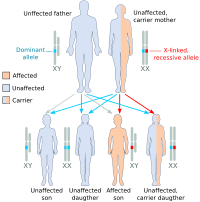
X-linked DomDominant X linked
    X-linked Dom
  • Epistasis: Epistasis involves a two gene system. While the genotype follows Mendelian Laws, the phenotype does not. The reason is that one gene completely masks the effect of the second gene. Below is an epistatic example. Can you describe how this is different from a standard dihybrid cross?
Epistasis
  • Pleiotrophy: This is when an allele has widespread impact in an organism, and so is not limited to one trait. For example, would a change in microtubles affect only one aspect of a cell? Would it affect only one cell type? Pleiotrophy may also cause problems at different stages of development, such as varying affects at different ages. Here is an example of pleiotrophy.
  • Heterosis: Hybrid Vigor. Inbreeding can depress the Heterosisadaptive strength of a species by allowing recessive traits a greater chance to express. When you begin crossing inbreed strains, you suddenly see an increase in adaptive vigor. This is useful with coordinated breeding of animals and plants, as the hybrid produced is stronger than the parental strains. It also informs our understanding of endangered species, and helps researchers work on ways to increase not only the adaptive vigor an an endangered species, but also the population size (without increasing inbreeding depression).
  • Gene expression from environmental cues: Some genes are only triggered during certain environmental conditions. Remember the concept of signal pathways and signal transduction. The body picks up an environmental signal, and then tells the cells to change in some way. There are two terms you need to understand when dealing with Environmentally Cued Gene Expression:
    • Expressivity: This describes how much gene expression you get in an individual when exposed to the proper cues.
    • Penetrance: This is a population concept. When exposed to a given condition, how many individuals of the population express the gene?


Some additional reading for those interested in genetics:


Blood Typing 

 The ABO blood type system is an example of codominance, meaning that in a heterozygous individual, both alleles are expressed, giving the individual two phenotypes (not a blending).  In other words, the alleles are considered dominant.  The ABO blood type is also multi-allelic, meaning there are more than two alleles for this one gene.  IMPORTANT:  The ABO blood type is derived from a single gene that has multiple alleles, of which two are considered dominant (A type and B type).

The gene (FUT1) for the ABO blood type system is a glycosyltransferase.  This enzyme adds carbohydrates onto proteins during post-translational modification.  The gene is found on chromosome 19. The antigen carrying proteins (the transmembranal protein that is glycosylated) currently has an unknown function.  The following shows the glycosylation patterns of the H antigen (the correct designation for the ABO antigen).
The fucose-galactose-N-acetyl-glucosamine glycosylation seen in O is common throughout the system.  It is the precursor to the other forms.  The FUT1 gene has allelic variation based on several SNPs.  The result is a difference in glycosylation patterns.  Specifically, we see the an additional N-acetyl-glalactosamine on A and an additional Galactose on B.
  • If you have the allele for A, you produce the A glycosylation pattern. 
  • If you have the allele for B, you produce the B gylcosylation pattern.
  • If you have the allele for A and B, you produce both A and B glycosylation patterns.
  • If you have neither the A or B allele, then you produce the precursor O configuration only.
  • If you are Heterozygous A or B, meaning you have the (Aio) or (Bio) genotype, then you will produce the O glycosalation pattern.  Remember though, A and B are dominant to O.
An important discovery for the ABO system was the discovery of Antigen H.  This discovery began in 1952 by Y.M. Bhende.  Dr. Bhende, working in what is now known as Mumbai, India, discovered a patient who reacted to all ABO blood types.  They built antibodies against all ABO blood.   This led to the realization that O blood was antigenic to this patient.  What is now known is that the specific glycosylation of O is an antigen, and is the precursor to the A and B phenotypes.  Antigen H is the antigen found on O blood.  Antigen H is the precursor to antigen A and antigen B, as such, antigen H is found in A, B, AB and O blood.

Individuals who do not produce antigen H, described genotypically as (h,h) (heterozygoun recessive for the H antigen), are intolerant to all ABO blood (they build a reaction against it).  This blood group (h,h) is known as the Bombay Blood Group.  It represents the an additional allelic variation to the ABO blood type system.


Daily Challenge

Even with multiple alleles in a population (consider the ABO, Bombay blood groups) and multiple genes (epistasis), Mendel's laws still hold at the level of the genotype.  Explain how the laws of inheritance still hold true, and how variations such as multiple alleles, co-dominance, incomplete dominance, and epistasis all serve to increase population diversity.

Wednesday, November 6, 2013

Daily Newsletter: November 6, 2013 - Mendel's Second Law of Inheritance

Daily Newsletter

November 6, 2013 -

Mendel's Second Law of Inheritance


Yesterday we talked about inheritance of one genetic trait (gene). But humans (and other organisms) are made up of more than one genetic trait. Every protein made by a cell is encoded in at least one gene (quaternary proteins would be encoded by multiple genes). While most genes are "house keeping" genes, i.e., needed for the organisms survival that don't have many variations among individuals(ribosomes, the genes for glycolysis, respiratory chains, etc...), some genes have greater variance. This is how we get the diversity of life, and more importantly, the uniqueness of individuals (this uniqueness is needed for evolution).

So, what happens if you are interested in more than one trait? This is where Mendel's second law comes into play. He was curious as to whether he could follow the inheritance probabilities of two traits, so he looked simultaneously at two traits in the pea.

NOTE: Going above two traits becomes mathematically more difficult, and we generally don't look at those problems at this level. When you take genetics you may see some of these higher order problems.

Mendel's experiments helped him propose what is now known as the Law of Independent Assortment. We now know that the traits Mendel looked at were found on different chromosomes (DNA molecules). The math would have been horrible if they had been on the same chromosome! As research into genetics progressed, and we realized that genes could be on the same chromosome, Mendel's second law (and the expected probabilities) became the model by which variations were assessed. Gene Mapping utilizes Mendel's probabilities for a dihybrid cross as the starting point.


With the Law of Segregation (first law), Mendel showed that for each individual trait, a pea plant (and by extension a human) has two possible allele that they can carry for a single trait (gene). When ovum and sperm (pollen) are produced, the parent donates only one allele to the ovum or sperm; the parent donates only one allele to the next generation. Therefore a new individual is composed of a set of genes (and alleles) from the mother, and another set from the father.


So, what happens when you look at two different traits (genes)? Ultimately, what Mendel discovered is that the two different traits do no interfere with each other. An allele from the first gene is donated independently, and is uninfluenced by, the allele from the second gene. So, you have a 50/50 chance of donating a given allele from the first gene, and a 50/50 chance of donating an allele from the second plant. [When looking at two distinct traits, we refer to the mating as a dihybrid, i.e., two trait, cross]

The math gets a little harder, but the idea is the same. The easiest way of showing what happens is to look at the Punnet Square for a visual interpretation of the probabilities. Below is a great picture of a Punnet square:
As you can see, on the top we put the Male Genetic Donation, and on the left side we put the Female Genetic Donation. There is a 50/50 chance the male will donate a given allele, same with the female. Look at how this is represented. Male donation is either B or b. Each has its own column. For the female, each possible donation has its own row. You then just cross-reference column and row to find out the possible offspring. The Punnet square also provides a rapid visual. 4 possible offspring, 3 of which are purple.

The Punnet square can be expanded to look at a dihybrid cross (two traits). Below is a good image of a dihybrid Punnet square. Note that the PHENOTYPIC ratio is 9:3:3:1. This is a critical ratio that will be seen repeatedly in biology.Dihybrid Cross

Daily Challenge

Explain the concept of Independent Assortment. I made a point that this does not always occur when genes are on the same chromosome. So, what happens to Independent Assortment when genes (traits) are on the same chromosome? Why is it important?

Tuesday, November 5, 2013

Daily Newsletter: November 5, 2013 - Mendel's First Law of Inheritence

Daily Newsletter

November 5, 2013 -

Mendel's First Law of Inheritence


To understand Mendel, we must first understand some terms and put them into context.
  • Gene - A segment of DNA that holds a sequence of nucleotides that provide the instructions on how to create either RNA or a Protein. These are known as gene products.
  • Chromosome - This is a molecule of DNA and associated proteins. The chromosome is only visible during specific phases of nuclear division. The word chromosome is used loosely (weak sense) as a synonym of DNA.
  • Haploid - A cell that has only one copy of each DNA molecule (chromosome).
    • NOTE: each organism has a known number of DNA molecules (chromosomes).
    • Humans have 23 different DNA molecules (23 different chromosomes).
  • Diploid - A cell that has two copies of each DNA molecule.
    • Humans have 46 chromosomes total: 2 copies of each of the 23 different DNA molecules.
  • Mutation - A change in the nucleotide sequence of DNA.
  • Genetic Variation - Different versions of the same gene generated by mutation. These could be subtle or pronounced alterations.
  • Phenotype - The specific physical form an individual's genetics produces. Generally we start by looking at one well defined physical trait, such as flower or seed color.
  • Allele - Genetic Variation in a single gene that results in different phenotypic expression.
    • There can be many different genetic variations in a population.
    • An individual can only possess a number of allele equal to the # of chromosomal copies.
      • So, a human is diploid, possessing 2 copies of each gene.
      • Humans can therefore have at most 2 alleles for each gene.
      • There can be more than 2 alleles though for the entire human population; each individual can only have a maximum of 2.
    • A haploid individual has only 1 allele for each gene.
  • Homozygous - A diploid organism that has the same allele for a given gene.
  • Heterozygous - A diploid organism that has different alleles for a given gene.
  • Genotype - The specific alleles an individual possesses for a given trait.
The following picture will help you visualize the concept of Alleles, Homozygous, and Heterozygous.Alleles
Mendel's work with the garden pea, Pisum sativum, resulted in two laws of inheritance. The focus of his work was to determine the inheritance pattern of specific traits. For example, if you have a pure breeding strain that produces white flowers, and a pure breeding strain that produces purple flower, what is the percentage of offspring which will possess purple flowers? His work was based on probability mathematics, and as we have discussed previously, mathematical certainty is needed in the establishment of laws.
Mendel's First Law is known as the Law of Segregation. Remember, Mendel did not know about genes or even DNA. He was working solely with gross physical characteristics that could be observed with the naked eye.
Going back to flower color, Mendel first wanted to see what would happen if you took pure-breeding white flowered peas and crossed (mated) them with pure-breeding purple flowered peas (F0 generation with homozygous purple and homozygous white individuals). Many of Mendel's contemporaries held the view that the offspring were produced by a blending of characteristic. What Mendel saw directly contradicted this view. He saw only purple flowers, this contradicted the idea of blending.F1 generation
Mendel decided to self-cross (self-pollinate) this generation of purple flowers (F1 heterozygous individuals). The next generation held both purple and white flowered individuals, but in a very specific ratio - 3:1. He repeated his experiment, and even used different characteristics. The same thing happened: pure-breeding parents produced offspring with a specific trait, and when self-crossed, these produced offspring in which the original parental traits appeared in a 3:1 ratio.F2 Generation
Mendel inferred the following from his mathematical calculations:
  • Each individual possesses two "factors" which determined the specific trait, e.g., Flower Color. (Mendel's Factors = Genes).
  • When an ovum or pollen is produced, it holds only one Factor (Gene).
  • When an ovum and pollen join, the new individual will carry one factor (gene) from the ovum (mother) and one factor (gene) from the pollen (father).
  • There is a 50% chance (probability) that the mother will donante one factor over another, and a 50% chance (probability) that the father will donate one factor over another.
  • You thus have four possible outcomes.
Punnett SquareAn easy way to view these possible outcomes is to use a Punnett square, a simple visual probability tool. The square shown to the right demonstrates the inheritence (genotype and phenotype) probability of pea flower color. On the left hand side of the square you will see the female (pistil) allelic contribution, and on top the male (pollen) allelic contribuition. The mother can donate either B or b; the father can donate either B or b.
If the offspring came from the joining of B from the mother and B from the father, then it will be Homozygous B (dominant) and Purple. An offspring with Bb will be heterozygous and Purple, while an offspring with bb will be homozygous (recessive) and white. There is a 1/4 probability of BB (25%), a 1/2 probability of Bb (50%), and a 1/4 probability of bb (25%). The most common is the heterozygous condition (remember this).
We now understand more regarding the mechanism which Mendel inferred, and have molecular data to support his initial findings. Mendel's factors are genes, and alleles describe the differences between factors. Cells undergo meiosis to produce gametes (sperm/ovum, pollen/ovum, etc...), and it is this process that causes the seperation of genes. We will talk more about meiosis next week.
But why did the offspring of the pure-breeding plants produce only purple flowers?
The traits he picked had variations based on a mutation of a single gene. Today we would call this type of mutation a knock-out mutation, because a function was knocked out. The purple color is produced by a fully functional gene. It produces a functional pigment. The white color is produced because the gene that codes for the pigment is flawed; it can't produce the pigment. What you have is one functional gene product (dominant) that masks a non-functional gene product (recessive). Mendelian genetics become much more murky when you have multiple genes coding for a trait or when you don't have a complete knockout.

Daily Challenge

How does the first law of inheritance affect our understanding of how genes are passed from generation to generation, and how does it affect our understanding of evolution.  Consider the consequences of a single mutation, such as the one seen in Sickle Cell Anemia.  How does that move from generation to generation, and how does natural selection play a role once we understand inheritance?

Friday, October 26, 2012

Daily Newsltter: October 26, 2012 - Mendel, Meiosis and Evolution

Site LogoDaily Newsltter

October 26, 2012

Mendel, Meiosis and Evolution


With meiosis we see the mechanism of inheritance first hinted at by Mendel. Gregor Mendel discussed how each person has two "copies" of the information that gives rise to a physical trait (genes), and that there were variations in that information which gave rise to different expressions of these traits (alleles).

Mendel's work gave biologists an understanding of inheritence, and an understanding of chromosomes and nuclear division helps to understand Mendel's inheritence model and the variations of that model. With cross-over in Prophase I, and the random seperation of homologs in Anaphase II, we can see the recombination of parental genes that result in genetically unique gametes (sperm and egg). This results in genetically unique individuals each generation.

Diversity is one of the greatest advantages of sexual reproduction. While >99% of our genes are held in common within a species, there is sufficent genetic variation to allow provide a species with a broad adaptaion range. Remember, the goal of evolution and survival resides not in the individual, but in the population. Those with genetic, metabolic, or physiological advantage will have a greater chance to leave offspring; thus the species survives and thrives.

In class, I mentioned that when you get to the core of biology, it is ultimately all about sex. Not the physical act, but the concept. The recombination of genes allows for diversity. Some organisms spend most of their life in haploid, or non-sexual reproductive states. They only expend the energy for sexual reproduction when they need to insure the survival of their offspring.

Daily Challenge


Today, you are to reflect upon what you have learned so far regarding metabolism, Mendelian inheritence, and meiosis. Build a picture of evolution based upon the need for a diverse population. Use an example to help illustrate the need for diversity. As a starting point, look to endangered species (why is it a problem when you have few individuals left?) or look at what happens when you have genetically similar trees struck by disease (Pine Bark Beetle infestations).
Link to Forum

Video Challenge


Today, I'm going to give you a video challenge. Below is a link to a video about animal genitalia (penises to be percise). The video is informative, but at times very vulgar (so be warned). The video's narrator makes some interesting, and humorous, comments about evolution.

What you are to do is reflect upon the views of evolution discussed. What insights can you glean from the narrator and the topic, and what errors are made (even jokingly) about evolution.

The World's Most Terrifying Penises: The Echidna

Link to Forum

Thursday, October 18, 2012

Daily Newsletter: October 18, 2012 - Beyond Mendel

Site LogoDaily Newsletter

October 18, 2012 Beyond Mendel


As discussed in class yesterday, after the rediscover of Mendel's work, people began investigating inheritance in other systems. As research continued, scientists began seeing that the Mendelian ratios did not always work. There were variations.
  • Sex linked traits: Many species have what is known as a sex chromosome. Normally, every chromosome of a given set is the same size and shape, and most importantly, they carry the same genetic information. Not so with sex chromosomes. One variation of the chromosome is shorter, and does not carry the same information. When the standard and shorter chromosome (X and Y) are in the same cell, you have a Hemizygotic state. The suffix hemi come from ancient Greek, and means half. This refers to the idea that some of the genes in an XY pairing are haploid, not diploid. If the X has a gene that the Y does not possess, then it is always expressed (as would be the case in haploid organisms).
X-linked DomDominant X linked
    X-linked Dom
  • Epistasis: Epistasis involves a two gene system. While the genotype follows Mendelian Laws, the phenotype does not. The reason is that one gene completely masks the effect of the second gene. Below is an epistatic example. Can you describe how this is different from a standard dihybrid cross?
Epistasis
  • Pleiotrophy: This is when an allele has widespread impact in an organism, and so is not limited to one trait. For example, would a change in microtubles affect only one aspect of a cell? Would it affect only one cell type? Pleiotrophy may also cause problems at different stages of development, such as varying affects at different ages. Here is an example of pleiotrophy.
  • Heterosis: Hybrid Vigor. Inbreeding can depress the Heterosisadaptive strength of a species by allowing recessive traits a greater chance to express. When you begin crossing inbreed strains, you suddenly see an increase in adaptive vigor. This is useful with coordinated breeding of animals and plants, as the hybrid produced is stronger than the parental strains. It also informs our understanding of endangered species, and helps researchers work on ways to increase not only the adaptive vigor an an endangered species, but also the population size (without increasing inbreeding depression).
  • Gene expression from environmental cues: Some genes are only triggered during certain environmental conditions. Remember the concept of signal pathways and signal transduction. The body picks up an environmental signal, and then tells the cells to change in some way. There are two terms you need to understand when dealing with Environmentally Cued Gene Expression:
    • Expressivity: This describes how much gene expression you get in an individual when exposed to the proper cues.
    • Penetrance: This is a population concept. When exposed to a given condition, how many individuals of the population express the gene?


Some additional reading for those interested in genetics:

Daily Challenge

How do variations in Mendelian genetics provide adaptive strengths to a species? For example, how would epistasis aid a species?
Link to Forum

Wednesday, October 17, 2012

Daily Newsletter: October 17, 2012 - Mendel's Second Law of Inheritance

Daily Newsletter

October 17, 2012

Mendel's Second Law of Inheritance


Yesterday we talked about inheritance of one genetic trait (gene). But humans (and other organisms) are made up of more than one genetic trait. Every protein made by a cell is encoded in at least one gene (quaternary proteins would be encoded by multiple genes). While most genes are "house keeping" genes, i.e., needed for the organisms survival that don't have many variations among individuals(ribosomes, the genes for glycolysis, respiratory chains, etc...), some genes have greater variance. This is how we get the diversity of life, and more importantly, the uniqueness of individuals (this uniqueness is needed for evolution).

So, what happens if you are interested in more than one trait? This is where Mendel's second law comes into play. He was curious as to whether he could follow the inheritance probabilities of two traits, so he looked simultaneously at two traits in the pea.

NOTE: Going above two traits becomes mathematically more difficult, and we generally don't look at those problems at this level. When you take genetics you may see some of these higher order problems.

Mendel's experiments helped him propose what is now known as the Law of Independent Assortment. We now know that the traits Mendel looked at were found on different chromosomes (DNA molecules). The math would have been horrible if they had been on the same chromosome! As research into genetics progressed, and we realized that genes could be on the same chromosome, Mendel's second law (and the expected probabilities) became the model by which variations were assessed. Gene Mapping utilizes Mendel's probabilities for a dihybrid cross as the starting point.


With the Law of Segregation (first law), Mendel showed that for each individual trait, a pea plant (and by extension a human) has two possible allele that they can carry for a single trait (gene). When ovum and sperm (pollen) are produced, the parent donates only one allele to the ovum or sperm; the parent donates only one allele to the next generation. Therefore a new individual is composed of a set of genes (and alleles) from the mother, and another set from the father.


So, what happens when you look at two different traits (genes)? Ultimately, what Mendel discovered is that the two different traits do no interfere with each other. An allele from the first gene is donated independently, and is uninfluenced by, the allele from the second gene. So, you have a 50/50 chance of donating a given allele from the first gene, and a 50/50 chance of donating an allele from the second plant. [When looking at two distinct traits, we refer to the mating as a dihybrid, i.e., two trait, cross]

The math gets a little harder, but the idea is the same. The easiest way of showing what happens is to look at the Punnet Square for a visual interpretation of the probabilities. Below is a great picture of a Punnet square:
As you can see, on the top we put the Male Genetic Donation, and on the left side we put the Female Genetic Donation. There is a 50/50 chance the male will donate a given allele, same with the female. Look at how this is represented. Male donation is either B or b. Each has its own column. For the female, each possible donation has its own row. You then just cross-reference column and row to find out the possible offspring. The Punnet square also provides a rapid visual. 4 possible offspring, 3 of which are purple.

The Punnet square can be expanded to look at a dihybrid cross (two traits). Below is a good image of a dihybrid Punnet square. Note that the PHENOTYPIC ratio is 9:3:3:1. This is a critical ratio that will be seen repeatedly in biology.Dihybrid Cross

Daily Challenge

Explain the concept of Independent Assortment. I made a point that this does not always occur when genes are on the same chromosome. So, what happens to Independent Assortment when genes (traits) are on the same chromosome? Why is it important?
Link to Forum

Tuesday, October 16, 2012

Daily Newsletter: October 16, 2012 - Mendel's First Law of Inheritence

Daily Newsletter

October 16, 2012

Mendel's First Law of Inheritence


To understand Mendel, we must first understand some terms and put them into context.
  • Gene - A segment of DNA that holds a sequence of nucleotides that provide the instructions on how to create either RNA or a Protein. These are known as gene products.
  • Chromosome - This is a molecule of DNA and associated proteins. The chromosome is only visible during specific phases of nuclear division. The word chromosome is used loosely (weak sense) as a synonym of DNA.
  • Haploid - A cell that has only one copy of each DNA molecule (chromosome).
    • NOTE: each organism has a known number of DNA molecules (chromosomes).
    • Humans have 23 different DNA molecules (23 different chromosomes).
  • Diploid - A cell that has two copies of each DNA molecule.
    • Humans have 46 chromosomes total: 2 copies of each of the 23 different DNA molecules.
  • Mutation - A change in the nucleotide sequence of DNA.
  • Genetic Variation - Different versions of the same gene generated by mutation. These could be subtle or pronounced alterations.
  • Phenotype - The specific physical form an individual's genetics produces. Generally we start by looking at one well defined physical trait, such as flower or seed color.
  • Allele - Genetic Variation in a single gene that results in different phenotypic expression.
    • There can be many different genetic variations in a population.
    • An individual can only possess a number of allele equal to the # of chromosomal copies.
      • So, a human is diploid, possessing 2 copies of each gene.
      • Humans can therefore have at most 2 alleles for each gene.
      • There can be more than 2 alleles though for the entire human population; each individual can only have a maximum of 2.
    • A haploid individual has only 1 allele for each gene.
  • Homozygous - A diploid organism that has the same allele for a given gene.
  • Heterozygous - A diploid organism that has different alleles for a given gene.
  • Genotype - The specific alleles an individual possesses for a given trait.
The following picture will help you visualize the concept of Alleles, Homozygous, and Heterozygous.Alleles
Mendel's work with the garden pea, Pisum sativum, resulted in two laws of inheritance. The focus of his work was to determine the inheritance pattern of specific traits. For example, if you have a pure breeding strain that produces white flowers, and a pure breeding strain that produces purple flower, what is the percentage of offspring which will possess purple flowers? His work was based on probability mathematics, and as we have discussed previously, mathematical certainty is needed in the establishment of laws.
Mendel's First Law is known as the Law of Segregation. Remember, Mendel did not know about genes or even DNA. He was working solely with gross physical characteristics that could be observed with the naked eye.
Going back to flower color, Mendel first wanted to see what would happen if you took pure-breeding white flowered peas and crossed (mated) them with pure-breeding purple flowered peas (F0 generation with homozygous purple and homozygous white individuals). Many of Mendel's contemporaries held the view that the offspring were produced by a blending of characteristic. What Mendel saw directly contradicted this view. He saw only purple flowers, this contradicted the idea of blending.F1 generation
Mendel decided to self-cross (self-pollinate) this generation of purple flowers (F1 heterozygous individuals). The next generation held both purple and white flowered individuals, but in a very specific ratio - 3:1. He repeated his experiment, and even used different characteristics. The same thing happened: pure-breeding parents produced offspring with a specific trait, and when self-crossed, these produced offspring in which the original parental traits appeared in a 3:1 ratio.F2 Generation
Mendel inferred the following from his mathematical calculations:
  • Each individual possesses two "factors" which determined the specific trait, e.g., Flower Color. (Mendel's Factors = Genes).
  • When an ovum or pollen is produced, it holds only one Factor (Gene).
  • When an ovum and pollen join, the new individual will carry one factor (gene) from the ovum (mother) and one factor (gene) from the pollen (father).
  • There is a 50% chance (probability) that the mother will donante one factor over another, and a 50% chance (probability) that the father will donate one factor over another.
  • You thus have four possible outcomes.
Punnett SquareAn easy way to view these possible outcomes is to use a Punnett square, a simple visual probability tool. The square shown to the right demonstrates the inheritence (genotype and phenotype) probability of pea flower color. On the left hand side of the square you will see the female (pistil) allelic contribution, and on top the male (pollen) allelic contribuition. The mother can donate either B or b; the father can donate either B or b.

If the offspring came from the joining of B from the mother and B from the father, then it will be Homozygous B (dominant) and Purple. An offspring with Bb will be heterozygous and Purple, while an offspring with bb will be homozygous (recessive) and white. There is a 1/4 probability of BB (25%), a 1/2 probability of Bb (50%), and a 1/4 probability of bb (25%). The most common is the heterozygous condition (remember this).
We now understand more regarding the mechanism which Mendel inferred, and have molecular data to support his initial findings. Mendel's factors are genes, and alleles describe the differences between factors. Cells undergo meiosis to produce gametes (sperm/ovum, pollen/ovum, etc...), and it is this process that causes the seperation of genes. We will talk more about meiosis next week.
But why did the offspring of the pure-breeding plants produce only purple flowers?
The traits he picked had variations based on a mutation of a single gene. Today we would call this type of mutation a knock-out mutation, because a function was knocked out. The purple color is produced by a fully functional gene. It produces a functional pigment. The white color is produced because the gene that codes for the pigment is flawed; it can't produce the pigment. What you have is one functional gene product (dominant) that masks a non-functional gene product (recessive). Mendelian genetics become much more murky when you have multiple genes coding for a trait or when you don't have a complete knockout.

Daily Challenge

Using one of Mendel's genetic models, other than flower color, describe his experiment and the law of segregation. This must be in your own words.
Link to Forum

Wednesday, September 12, 2012

Daily Newsletter: September 7, 2012 - Evolution Friday

Site LogoDaily Newsletter

September 7, 2012 Evolution Friday


As with most scientific thought, the theory of evolution has been fefined since it's first conception. This occurs as we learn more about organisms. For instance, Darwin did not have a valid hypothesis regarding how inheritence of characteristics occurred. He knew that we inherited characteristics from our parents (phenotypes), but not how this occurred. In his own words "[t]he laws governing inheritance are quite unknown...."1 This is not unusual. We may see a pattern in nature, but we are not yet be able to explain it. The observed pattern is a model that we can start with, but ultimately, we want to find a way of understanding the pattern.

In 1866, Gregor Mendel published his work on plant hybridization, which included his mathematical descriptions of inheritence. Historians have shown that Darwin was not aware of this work, and it did not have a significant impact at the time. His work was 'rediscovered' during the 1890's, and a publication by Hugo de Vries of his own work and subsequent credit to Mendel's initial work led people to being looking at the science we know know as genetics.

There was actually a vigous debate between Darwinians and Mendelians as to which system best represented evolution. This debate would continue for years. The work of Sir Ronald Aylmer Fisher, a British biologist and statistician, would be instrumental in combining the work of Darwin and Mendel, and their intellectual descendents, into a new system. Sir Fisher was also one of the pioneers of population genetics, a field of study instrumental in modern evolutionary thought. His book, The Genetical Theory of Natural Selection, published in 1930, is considered one of the foundations of modern evolutionary thought. (NOTE: There were other's working at this time on this issue, including Ernst Mayer, Theodosius Dobzhansky, and George Gaylord Simpson. Fisher is discussed in detail here as his work became a turning point in the discussion of evolution).
So, what is this modern evolutionary view?
Here are a few brief articles to look at:

Daily Challenge

Read the articles above, and discuss the formation and refinement of scientific theories, specifically as it relates to evolution. One a hypothesis becomes a theory, is it set in stone? If we learn something new, does it over turn a theory, or could it explain something we previously didn't know? Is debate among experts useful in refining theories? Are we still refining the theory of evolution?
Additonally, what are the "main" points (concepts) of the modern theory of evolution?
Link to Forum


Reference

The reference below is linked to an online copy of the book.  While not required, it is a book all biology students are encouraged to read at some point.
1. Darwin, C. R. 1859. On the origin of species by means of natural selection, or the preservation of favoured races in the struggle for life. London: John Murray. [1st edition]