Friday, February 24, 2012

Daily Newsletter February 24, 2012

BiologyMOOC Logo4

Daily Newsletter February 24, 2012

Evolution Friday

In the bacteria, there are organisms defined as chemolithoautotrophs. Chemolithotrophs are organisms that gain reducing power from reduced inorganic compounds, like iron. Since bacterial respiratory chains are located on the cellular membrane (no mitochondria), they can interact with reduced compounds in the environment. Being an autotroph means that you can fix your own carbon (we will see this next week). Carbon fixation means that you take CO2 and reduce it to an organic carbon compound.

Bacterial respiratory chains are different than mitochondrial respiratory chains. In the mitochondria, you will find an ubiquinone between complex I and III that serves as an electron carrier (moving between complex I and III). In bacteria, you find a pool of quinones (ubiquinone is only one type of quinone). It is this quinone pool that allows chemolithotrophs to harvest reducing potential from reduced inorganic compounds.

The autotrophic aspect of these organisms is different from eukaryotic autotrophs (plants and algae). Some of these bacteria use what is called a reverse (reductive) TCA, or reverse citric acid cycle.
Bacteria in the Chlamydomonas, Proteobacteria groups are generally known to do this reaction. Some of these organisms can carry out these reactions without the presence of oxygen. (Why would the organism not need oxygen?  Why would that be important?)

Daily Challenge:
A strong evolutionary theory states that these organisms were present before organisms that show the process of photosynthesis as we see in plants. Explain why you might find these organisms before the forms of carbon fixation we see now (i.e., plants).

Thursday, February 23, 2012

Daily Newsletter February 23, 2012

BiologyMOOC Logo4

Daily Newsletter February 22, 2012

Today's Topic: The Respiratory Chain

In class today, we talked about the citric acid cycle and the respiratory chain. Below you will find some major points that I want you to remember:
  • The major way that energy is harvested is through redox reactions.
  • When needed for ATP production, electron carriers transfer electrons to the respiratory chain (electron transport chain) on the inner mitochondrial membrane.
  • Complex I, III, and IV are transmembranal electron transporters that serve as proton pumps.
  • The second law of thermodynamics is important in the respiratory chain.
    • As electrons pass between carriers, they loose energy.
    • They move from excited back to ground state.
  • When an electron is close to ground state, we need to give it to a terminal electron acceptor.
    • Eukaryotes use oxygen as a terminal electron acceptor.
    • Oxygen + 2 electrons + 2 Hydrogens produces water.
    • With out a terminal electron acceptor, the respiratory chain backs up.
    • Prokaryotes can use different electron acceptors.
  • When electrons move between transmembranal electron transporters, hydrogen is pumped to the intermembranal spaces (mitochondria).
  • You create a proton motive force (electrochemical gradient).
  • As ions move down their electrochemical gradient, across a membrane, work is done.
  • The proton motive force powers ATP synthesis.

Daily Challenge: The Respiratory Chain
Your task to day is to reflect and write about oxidative phosphorylation: the use of a respiratory chain and proton motive force to regenerate ATP. Start with NADH + H+ from the citric acid cycle (mitochondrial matrix).

Wednesday, February 22, 2012

Daily Newsletter February 22, 2012

BiologyMOOC Logo4

Daily Newsletter February 22, 2012

Daily Challenge: Citric Acid Cycle
There is no daily topic, instead, you are to continue reflecting upon the catabolism of glucose by looking at the conversion of pyruvate into acetyl CoA and then the Citric Acid Cycle. As before, the goal is to reflect upon the reactions and come up with a way of describing them in your own words.

Things to look out for:
1) Redox reactions.
2) The use of FAD instead of NAD as an electron carrier.
3) Decarboxylation (releasing a CO2 from the reaction).

There are some special cases in TCA, and we will talk about them on Thursday.

Tuesday, February 21, 2012

Daily Newsletter February 21, 2012

BiologyMOOC Logo4

Daily Newsletter February 21, 2012

Today's Topic: Gylcolysis

Here is one of the best images of glycolysis online. Feel free to use this as a reference when working through glycolysis.
 Today your goal is to review and reflect upon the second five steps of glycolysis.  These are referred to as the energy harvesting steps.  As with yesterday, I am only going to focus on one reaction:  Step 6. 

Step 6 is catalyzed by Glyceraldehyde Phosphate Dehydrogenase.  The word dehydrogenase explains the action.  We are removing hydrogens.  When we remove hydrogens, we also remove electrons.  Dehydrogenases are responsible for oxidizing a substrate.  So this is a redox reaction.  You can also tell this because our electron carrier NAD is being reduced as a by product of this reaction.  So we remove electrons (energy) from Glyceraldehyde 3-P and give electrons (energy) to NAD, forming NADH.

This is the single largest change in energy throughout glycolysis.  This is a major harvesting of energy (we harvest the most energy using redox reactions). 

Notice that we are also adding a phosphate.  But why?  We do not use ATP to add this phosphate.  We use an inorganic phosphate.  One reason is to maintain the stability of the molecule.  When substrates are oxidized, the molecule becomes unstable.  Sometimes the instability is needed for the next reaction, but sometimes the instability is just a little too much.  There is an intermediate here that is unstable, so we add Phosphate to stabilize the product.

But notice, the new phosphate is highlighted in yellow.  Why?  This is a notation used by the artist to represent a high energy phosphate.  On either end of the 1,3 bisphophoglycerate there is a phosphate group, a -2 phosphate group.  You have negative charges being held in close association.  Is this electrically stable?  No, the negative charges want to push away from each other.  Thus we get a "high energy" bond (one that is stable, but easily broken).

Daily Challenge: Energy Harvesting Steps of Glycolysis
I did not give you all of the information about reaction 6. Just enough to start you off. Go through reaction 6-10. Feel free to quote (and reference) other material to build descriptions of these reactions. After building descriptions, reflect upon what these descriptions are saying. Put the reaction into your own words.

Monday, February 20, 2012

Daily Newsletter February 20, 2012

BiologyMOOC Logo4

Daily Newsletter                                                            February 20, 2012

Administrative NOTE:  This week, we will be looking at how cells can breakdown glucose to acquire energy and carbon by using metabolic pathways. As we say last week, cells will put chemical reactions in sequence in an attempt to direct changes in molecular structure to either build or break biomolecules.
 
You may have noticed that there are no learning objectives given this week.  As part of this week's exercise, I want you to build your own learning objectives.  In reading the newsletter, and chapter 9 (pathways that harvest chemical energy), you will come across information on metabolic pathways and respiratory chains.  Try to come up with learning objectives by using specific phrases and terms that describe knowledge you will be expected to carry and use.  Before the next milestone, I'll give a set of learning objectives as I see them.  As a supplemental blog with 4 points, you can post your learning objectives before the end of this week.  Later, when mine are released, you can comment on your learning objectives by reflecting on how they match mine for another 4 points.

Daily Topic: Glycolysis steps 1-5

Today we start looking at the metabolic pathway of glycolysis. In the textbook, this information is catagorized as how cells harvest energy, but cells harvest carbon as well with these reactions. A question that every cell asks its self moment by moment is: What do I need now, carbon or energy? Intermediates from our catabolic pathways provide precursors for other biochemicals, but they also provide energy in the form of reducing potential.

With digital technology, you can go on line and pull down images of the glycolytic pathway. Nearly every biology textbook has these images. Your goal this weak is NOT to memorize these metabolic reactions. Your goal is to understand what is happening. I would like you to also learn something of the enzymes being used. As an example, I am going to discuss the first reaction:

Glycolysis describe the splitting of glucose into two three carbon Pyrvate molecules.  This pathway consists of 10 reactions that carry out this splitting by inducing specific changes into the molecule.  The first five steps are classified as preparatory, or energy consumptive. In these steps, we are preparing the molecule of glucose for the first split.

Glucose is chemical stable.  Glucose does not spontaneously explode or degrade.  Chemical stability also implies that it does not react easily.  So, we need to make it more reactive.  We also need to get it into the correct configuration for splitting.  That is the goal of the first four steps.

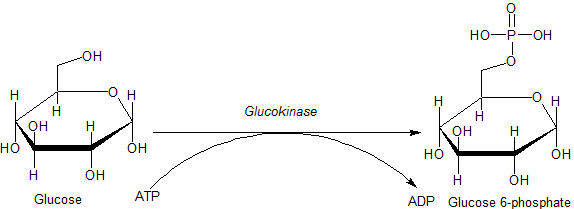
In step 1, we use the enzyme hexokinase.  The root word here is kinase.  A kinase is an enzyme that adds a phosphate group to a molecule.  In this case, hexokinase is an enzyme that adds a phosphate group to a six carbon sugar, namely glucose.  You will notice in the above picture that the enzyme is referred to as glucokinase.  Glucokinase is a specific hexokinase (Hexokinase IV), and is found in specific mammalian cells found in the intestines, liver, pancreas, and brain.

Hexokinase is generally attached to the glucose carrier found in the cell membrane.  When glucose is brought into the cell, hexokinase adds a phosphate group to the sixth carbon.  Glucose 6-P refers to a glucose molecule with a phosphate on the sixth carbon.  In order to carry out this phosphorylation, we use ATP.  ATP transfers a phosphate to the sixth carbon of glucose.  (enzymatically, how would this happen?  Would you need both ATP and Glucose in the active site?)

Why do we need to phosphorylate glucose? This is an important question, and something you should ask for every metabolic reaction.  Why do we need to do it?  What is the end product?  You should also ask yourself questions about the enzyme.

  • Why do you phosphorylate glucose?
    • Glucose is stable, so the addition of phosphate with its -2 charge causes an electrical instability in the molecule.
    • Glucose 6P is more reactive than Glucose.
    • Glucose 6P can not leave the cell through the Glucose Carrier (they are different molecules now).
    • Glucose 6P does not interfere with the concentration gradient of Glucose (they are different molecules, each with a concentration gradient).
    • Glucose then remains high on the outside of the cell, but almost zero inside of the cell (incredibly strong concentration gradient).
  • What about the enzyme?
    • Is it regulated?
      • Unidentified allosteric regulation.
    • What is the structure?
      • 465 amino acids
    • What does the active site look like?
      • Active site fits Glucose and ATP.
    • What about the activity?

Daily Challenge: Glycolysis steps 2-5
Go through steps 2-5 of glycolysis. Quote some source (book or textbook) that talks about the reaction and what is happening.  Make sure you provide the reference.  If you find a picture, add it.  After the quote, I want you to reflect on what is meant in the quote.  Most of you have not had organic chemistry yet, so I'm not asking you to delve into the chemistry behind the reaction (it is great though if you do).  What I want you to do is build a discussion of what happens in the reaction (in your own words).  Reference the quote all you like as you build your discussion.  What is important is that you build an understanding of what is happening.  Also reference the enzyme being used.  The enzyme name tells you the enzyme function.  So what is the function of the enzyme?  What reaction does it catalyze?  Is there anything interesting about the enzyme?

Thursday, February 16, 2012

Daily Newsletter February 16, 2012

BiologyMOOC Logo4

Daily Newsletter February 16, 2012

Today's Topic: Redox and Living System

Energy harvesting will be our topic next week, so I wanted to spend a moment and talk about energy in biological systems. Energy is a word that is often thrown around in various disciplines, and we define it as the capacity to do work. This definition helps to simplify a complex issue, but when it comes down to it, it really doesn't help you to understand the bigger picture of how a complex set of reactions combine to form a living system.

With ATP, you will recall, the emphasis was shifted from seeing ATP as a batter that powered reactions.  Instead, your focus was drawn to the Phosphate group, and the electrostatic effect it would have when added to a molecule or protein.  Today in lecture we saw how a phosphate could act as an allosteric regulator, turning an enzyme on or off.

With energy harvesting, I again want you to shift your focus from a nebulous form of energy.  This time, the focus will be on reducing potential.  Central metabolism describes the oxidation of glucose, so what are we harvesting?  Reducing potential.  So what is reducing potential?

A simple definition is reducing potential describes the capacity of a compound to donate electrons.  Chemistry has a strict definition involving measurements with electrodes, but for our purpose, the concept of donating electrons is what is important.

Remember the characteristics of life.  You must maintain homeostasis, and this means repair.  You have to build nucleic acids, lipids, carbohydrates and proteins.  These biosynthetic pathways often require you to reduce substrates.  To stay alive, you need a constant supply of electrons for reduction; you need reducing potential.  If you don't get these high energy electrons for reduction, you die.  We will also find that this reducing potential is needed for us to make ATP.

So, redox reactions become vital to our survival.  Redox reactions are coupled Oxidation and Reduction reactions.  One compound is oxidized as the next is reduced.
Remember, the molecules undergoing redox have to be close/touching.  But in relative size, a cell is huge compared to a simple molecule.  We may harvest electrons (oxidation) in one part of the cell, but use the harvested reducing potential in another part of the cell (reduction).  Remember, you don't have free electrons; you can't throw electrons across the cytoplasm. So, how do we couple reactions that may be separated spatially?  We use carriers!

Electron carriers, like nicotinamide adenine dinucleotide (NAD), accept electrons at the site of oxidation, and then donate electrons at the site of reduction. NAD is readily oxidized and reduced during metabolic reactions, and there is only a negligible loss of energy from the electrons carried (can we ever have NO loss of energy? why or why not?).
NAD is also classified as a coenzyme, meaning it must work with an enzyme to accept or donate electrons.  NAD can not randomly go to a molecule and oxidize or reduce it; its action is regulated by enzymes.  NAD then must bind to an enzyme that catalyzes an Oxidation, and NADH must bind to an enzyme that catalyzes a Reduction.

Daily Challenge: Action of nicotinamide adenine dinucleotide (NAD)
In the citric acid cycle is the following reaction:
In this reaction, malate is oxidized.  How do you know?  You know because NAD is reduced to NADH.  Below is a ribbon model of the protein malate dehydrogenase.  Within the protein, you will see two molecules of NAD represented as balls.  NAD binds to the enzymes active site first, and then malate binds.  Within the active site are both + and - amino acids.

Your task today, using the enzyme malate dehydrogenase, explain how enzymes work and explain how reducing potential is harvested from organic compounds.

Wednesday, February 15, 2012

Daily Newsletter February 15, 2012

BiologyMOOC Logo4

Daily Newsletter February 15, 2012

Today's Topic: Enzymes, structure and function.
  •  First thing to remember, Eynzymes are Proteins!
    • So they are constructed on ribosomes.
    • Their structure is determined by electrostatic interactions.
    • Their shape can change when things bind to it.
    • They can be denatured.
  • Second, they act as catalysts.
    • They lower activation energy by brining molecules together in the correct alignment, and can induce molecular tension to cause the reaction.
    • Though their shape may change during the chemical reaction, the enzyme is left essential unchanged at the end of the reaction.
Enzymes work by binding the substrate of the reaction, and then inducing molecular tension.  Remember, when something binds to a protein, the electrostatic interactions around the protein change, resulting in a conformational (shape) change in the protein. It is this shape change that will induce molecular tension.

Every enzyme has an active site.  This is the place where the substrate(s) will bind to the enzyme.  The active site must have a shape that loosely fits the substrate, and the electrochemical pattern of the active site must compliment the electrochemical pattern of the substrate.  When they bind, you get an Enzyme Substrate complex.  Below is a basic cartoon about the process:
Here is a quick video that shows the brief conformational change that helps to induce the reaction.


Conformational changes alone are not the only part in inducing a reaction.  You will also find that proteins can have prosthetic groups that aid them in their action.  For example, you can a Heme group with Iron that can hold Oxygen in red blood cells.  Some digestive enzymes use Chromium to help in their action.  Many metabolic pathways will contain Electron Carriers needed for redox reactions.  We will see examples of these over the next few weeks.

Daily Challenge: There are three enzymes that we will come across next week. Today, you are to look at the action of these three enzymes and articulate how they work. Use the information above as guidance, but be specific for each of these three enzymes. One point to look at is whether or not these enzymes require additional prosthetic groups or coenyzmes/cofactors. The enzymes are glucokinase (hexokinase 4), glyceraldehyde-3-phosphate dehydrogenase, and aldolase. [Wikipedia warning: be careful with wikipedia on this one. Some enzymes have good descriptions, while others are either too technical or poorly written.]

Admin Note: As of today, only 7% of the students have started the calibrations. Do not delay. You will only hurt yourself if you wait until the last minute.